Category: GEO Strategy

  • What to Expect from Generative Engine Optimization Services

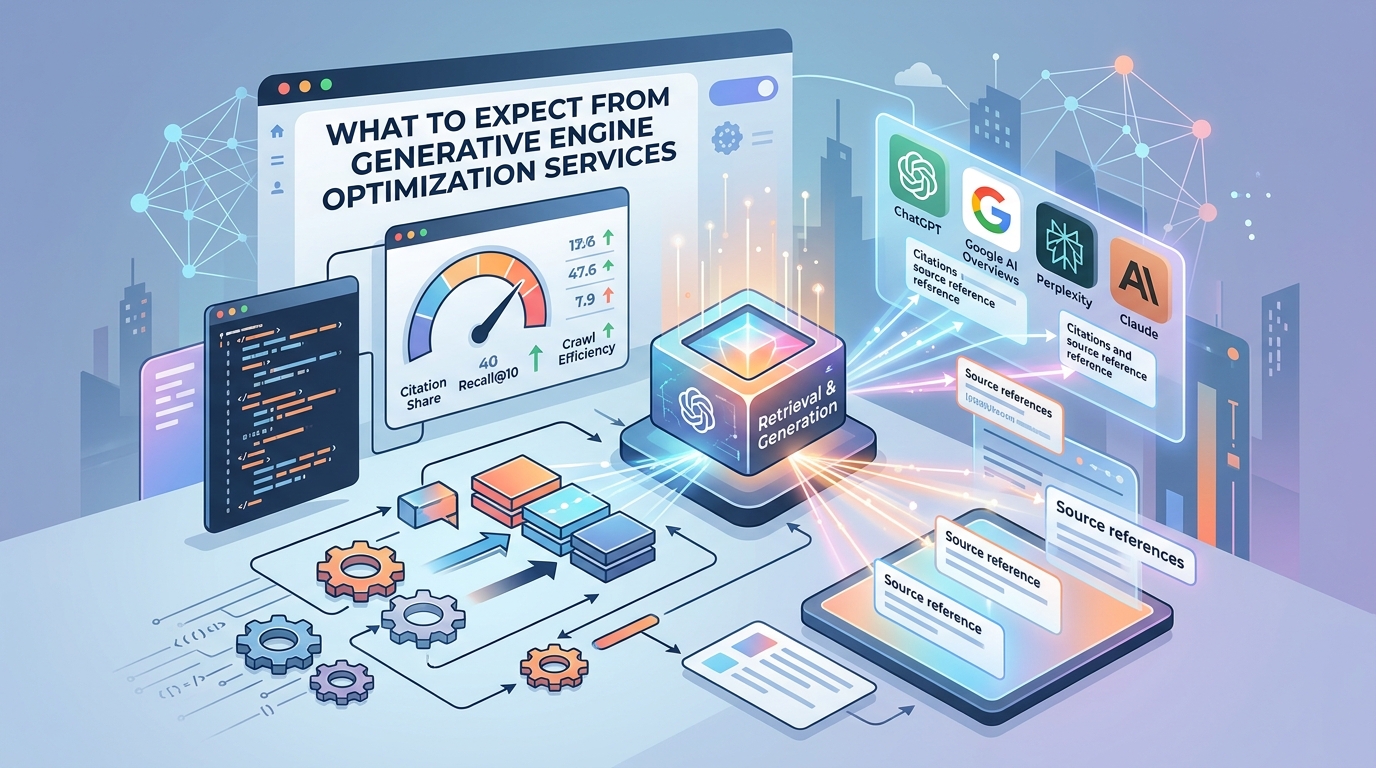
    What to Expect from Generative Engine Optimization Services

    Most companies evaluating GEO services already understand the basic idea. The harder question is more practical:

    What actually happens after you hire a GEO provider?

    A credible engagement should produce measurable technical changes, clearer content architecture, repeatable citation monitoring, and a reporting system that connects AI visibility to business outcomes.

    This guide explains what a professional GEO engagement can include, how the work progresses, what technical deliverables to expect, and how to compare providers before making a decision.

    At a Glance: Key Generative Engine Optimization Deliverables
    These should be treated as engagement benchmarks, not guaranteed outcomes. Actual performance depends on the site’s technical condition, authority, content quality, query set, AI platform, and implementation speed.

    1. How AI Search Engines Crawl, Retrieve, and Cite Content

    A GEO engagement is most useful when every deliverable maps to a specific part of the information-retrieval process.

    A simplified model looks like this:

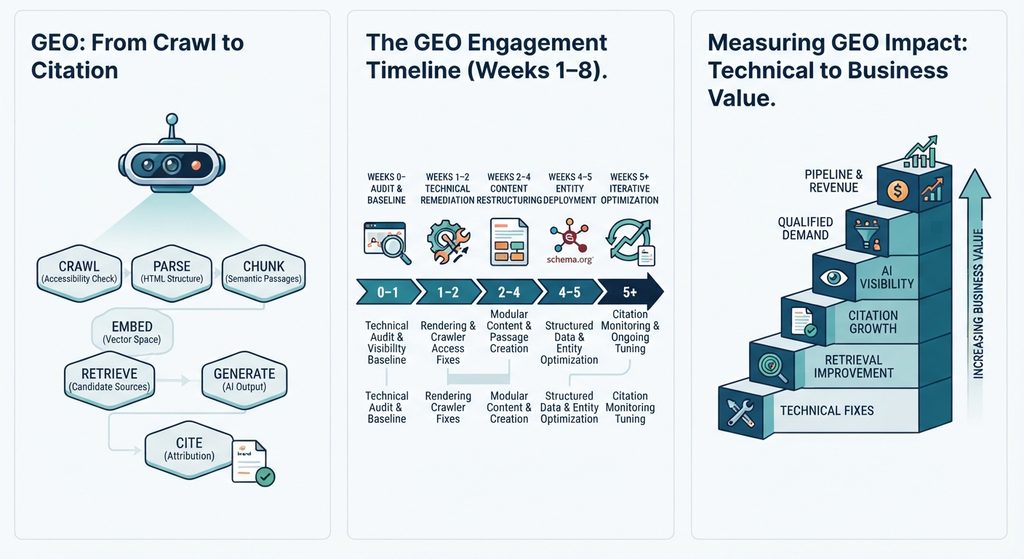
    Crawl → Parse → Chunk → Embed → Index → Retrieve → Generate → Cite

    The objective is not simply to “rank in AI.”

    The objective is to make the right information accessible, understandable, retrievable, and attributable when an AI system processes a relevant query.

    Crawl: Making Content Accessible for AI Bots

    The first step is technical accessibility.

    A GEO audit should examine:

    For JavaScript-heavy websites, the important question is whether the content that matters is available in the HTML that crawlers can access.

    A provider should be able to demonstrate the difference between what a browser renders and what a crawler can actually retrieve.

    Chunk: Structuring Information into Semantic Passages

    Large pages often contain multiple ideas competing for the same contextual signal.

    GEO work can therefore restructure important sections into self-contained semantic passages. Your existing implementation framework uses roughly 200–400 words as a working range for these passages.

    The purpose is not to force every section into an arbitrary word count.

    The purpose is to make each passage answer a coherent question without depending heavily on unrelated surrounding text.

    Embed: Strengthening Vector and Semantic Relevance

    Modern retrieval systems can represent content and queries in vector spaces.

    That makes semantic relationships important.

    Instead of optimizing a page around one exact keyword, GEO work should strengthen the relationships between:

    This creates broader contextual coverage rather than isolated keyword targeting.

    Retrieve and Generate: Becoming a Candidate Source

    Retrieval determines which information is available to the generation system.

    That means a page can be technically crawlable yet still perform poorly if its content is difficult to retrieve or lacks sufficient contextual relevance.

    A strong GEO engagement therefore measures retrieval performance rather than relying exclusively on traditional keyword rankings.

    2. Core Metrics Optimization in Generative Engine Optimization

    Traditional SEO metrics still have value, but they do not tell the entire story when the objective is AI visibility.

    A mature GEO measurement framework should include several layers.

    Information Retrieval Performance

    Measure how frequently relevant passages appear among the top retrieved candidates for a defined query set.

    Recall@10 can be used as one practical metric:

    The exact evaluation methodology should be documented so that results are reproducible.

    Citation Share & AI Visibility Tracking

    Track how frequently the brand or its content is cited across a defined set of relevant AI queries.

    Rather than reporting:

    A better report shows:

    The trend matters more than a single number.

    Entity & Semantic Relationship Coverage

    Entity Coverage

    A strong GEO strategy also evaluates whether important entities are clearly represented and connected.

    For example:

    Brand → Product → Category → Use Case → Problem → Industry

    The stronger these relationships are, the easier it becomes to build coherent topical coverage.

    Semantic Coverage

    Instead of measuring only one target phrase, map the broader question neighborhood around the commercial topic.

    For example:

    Generative engine optimization services

    can connect to:

    The objective is to create meaningful coverage around the subject, not simply repeat the primary keyword.

    3. Generative Engine Optimization Engagement Timeline (Weeks 1–8)

    A professional engagement should have a visible implementation roadmap.

    Week 0–1: Technical & Baseline Audit

    The first phase establishes the starting point.

    Typical deliverables:

    The key deliverable should not be a strategy deck alone.

    It should be a baseline that can be measured again later.

    Week 1–2: Rendering & Crawler Access Remediation

    Technical issues identified during the audit are addressed.

    Typical work includes:

    The goal is simple:

    Make important content technically accessible before investing heavily in content restructuring.

    Week 2–4: Modular Content & Passage Restructuring

    Priority pages are reorganized into clearer semantic units.

    Typical work includes:

    This is where GEO begins to move beyond technical SEO.

    The goal is to make information easier for retrieval systems to interpret and select.

    Week 4–5: Structured Data & Entity Deployment

    Structured data is implemented and validated where appropriate.

    Potential schema types include:

    Schema should accurately describe the page.

    It should not be treated as a shortcut for generating AI citations.

    Week 5+: Citation Monitoring & Iterative Search Optimization

    GEO does not end when the first technical fixes are deployed.

    AI search systems change continuously, and competitor content changes as well.

    Ongoing work can include:

    4. Performance Benchmarks for Generative Engine Optimization

    The following framework can be used as a practical way to communicate progress:

    These are working ranges from the engagement framework, not guarantees or universal industry benchmarks. The underlying draft explicitly presents them as realistic ranges that vary according to technical complexity.

    For that reason, a provider should always establish a baseline before promising a target.

    5. Technical Deliverables and Configuration Code

    A serious GEO engagement should produce artifacts that another technical team can inspect, reproduce, and implement.

    Example: GEO Audit Configuration

    The important point is not the YAML itself.

    It is the operational principle behind it.

    The engagement should define what is being tested, what constitutes a failure, what is being measured, and how the results will be compared over time. Your original draft similarly positions the runnable configuration and baseline report as a week-one deliverable rather than a static PDF.

    Example: Recurring Citation Sweep

    A useful report should show:

    Baseline → Current State → Change → Cause → Recommended Action

    That is substantially more useful than a monthly screenshot of AI search results.

    6. Measuring ROI and Business Impact of Generative Engine Optimization

    Executives ultimately need to connect technical improvements to commercial outcomes.

    This creates a more useful measurement chain:

    Technical Fix → Retrieval Improvement → Citation Growth → AI Visibility → Qualified Demand → Pipeline → Revenue

    Not every organization will be able to attribute revenue directly to an AI citation.

    That is why the measurement framework should distinguish between technical KPIs, visibility KPIs, behavioral KPIs, and revenue KPIs rather than forcing every engagement into an ARR number.

    7. Comparing Top Generative Engine Optimization Service Providers

    Provider comparisons are useful when they focus on what each company actually emphasizes, rather than presenting unsupported claims of superiority.

    The draft’s provider comparison uses these same providers and positions them around their stated service focus rather than treating the list as an endorsement.

    When comparing providers, ask five questions:

    The differentiator is not the number of deliverables.

    It is whether the provider can improve retrieval quality, demonstrate what changed, and measure whether visibility is increasing.

    8. Questions to Ask Before Hiring a GEO Agency

    Before signing a GEO engagement, ask for evidence rather than terminology.

    Ask for a Baseline

    A provider should be able to show where your domain currently appears across a defined query set.

    Ask What Gets Implemented

    There is a major difference between:

    “Here are 50 recommendations.”

    and:

    “Here are the 12 changes we implemented, why they matter, and how we will measure them.”

    Ask How Citations Are Measured

    The provider should define:

    Ask About Technical Access

    Implementation-level GEO work may require repository, hosting, CMS, analytics, or other technical access depending on scope.

    Without implementation access, the engagement may be an audit or consulting engagement rather than an implementation service.

    Ask for Trend Data

    Never evaluate GEO performance from one screenshot.

    Ask for:

    Baseline → Month 1 → Month 2 → Month 3

    The direction of change is more informative than a single citation percentage.

    9. The Bottom Line: What a Good Generative Engine Optimization Engagement Looks Like

    A strong generative engine optimization service should not feel like traditional SEO with “AI” added to the sales deck.

    It should have a measurable operating system:

    Audit → Fix → Structure → Retrieve → Measure → Iterate

    You should know:

    The technical work creates the foundation.

    The measurement system proves whether the foundation is producing better AI visibility.

    And the business layer determines whether that visibility is actually valuable.

    Ready to Evaluate Your AI Visibility?

    Start with the Answer Engine Diagnostic ($1,500) to establish a technical baseline, identify crawl and retrieval issues, and benchmark your current AI citation visibility.

    For organizations requiring implementation and ongoing optimization, the Enterprise GEO Blueprint extends the engagement into technical remediation, semantic architecture, structured data, retrieval measurement, and continuous citation optimization.

    The goal is not simply to appear in AI answers.

    The goal is to become a source that AI systems can reliably discover, retrieve, understand, and cite.
  • Why SSR Matters for Generative Engine Optimization

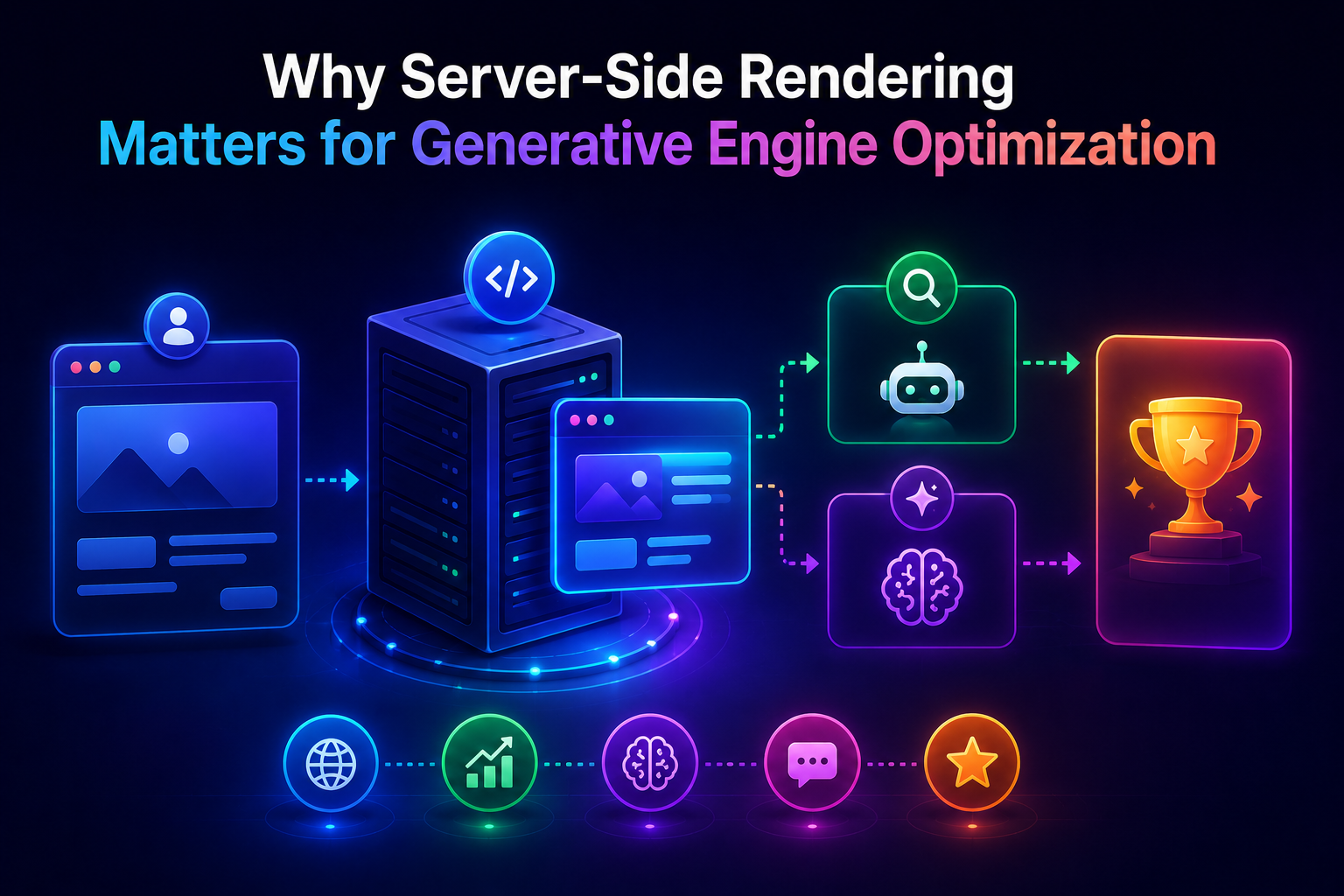
    Why SSR Matters for Generative Engine Optimization

    Generative Engine Optimization is usually framed as a content problem. Better answers, clearer structure, question-based headings.

    That advice is right — but it only works if crawlers can read your page in the first place. If your content lives inside JavaScript, no amount of writing quality will help. The crawler sees an empty page and moves on.

    Server-side rendering is the technical foundation that makes GEO possible. This article explains exactly why.


    AI-Friendly HTML: What Crawlers Actually Parse

    AI crawlers are not browsers. They do not render visual layouts, apply CSS, or execute JavaScript. They parse HTML — and specifically, they extract meaning from the structural elements within it.

    When GPTBot, PerplexityBot, or ClaudeBot visits a page, it reads through the HTML document sequentially, extracting information from specific elements:

    HTML ElementWhat the Crawler Extracts
    <title>The page’s primary topic
    <meta name="description">A summary of the page content
    <h1>The main subject of the page
    <h2>, <h3>Section topics and structure
    <p>Body content, answers, explanations
    <ul>, <ol>Lists of items, steps, features
    <table>Structured comparative data
    <script type="ld+json">Explicit schema metadata
    <a href>Links to related content

    Server-rendered pages deliver all of these elements in the initial HTTP response. The crawler receives a complete map of the page’s content and structure the moment it fetches the URL.

    Client-side rendered pages deliver none of them — because those elements are built by JavaScript in the browser, after the HTTP response has already been sent.

    Semantic Structure as AI Comprehension

    Beyond the presence of content, the quality of the HTML structure determines how well AI systems understand it.

    A page with a single H1 that accurately names the topic, H2s that break the content into clearly labeled sections, and H3s that subdivide those sections into specific subtopics gives AI systems an explicit content map. They can identify which part of the page answers which question, extract the most relevant section for a specific query, and cite it accurately.

    A page with inconsistent heading structure — multiple H1s, headings used for styling rather than structure, important content buried in generic wrapper divs — forces AI systems to guess at the content’s organization. The result is less accurate extraction, lower citation probability, and a higher chance of being paraphrased incorrectly.

    SSR ensures the HTML structure is complete and available. The semantic quality of that structure is then a content and development decision — one that sits on top of the SSR foundation.


    Faster Content Discovery: Why Speed Affects Citation Surface Area

    AI crawlers, like all crawlers, operate within time constraints. A crawler visiting your site will not wait indefinitely for a page to respond. If your server takes too long to return the HTML, the crawler times out and moves on — and that page goes uncrawled.

    This is why the speed of your server response directly affects how much of your content AI systems have ever seen.

    How SSR Supports Crawl Speed

    A well-implemented SSR setup with caching delivers pages extremely quickly:

    • Edge caching: SSR responses cached at CDN edge nodes can be served in under 100ms globally, comparable to static file delivery.
    • Consistent response times: A cached SSR response is deterministic — the crawler always receives the same fast response, never waiting for database queries or API calls.
    • Predictable resource usage: Crawlers can fetch more pages per session when each page responds quickly and consistently.

    The result is a larger effective crawl surface — more pages visited, more content extracted, more opportunities for AI systems to encounter and potentially cite your work.

    The Compounding Effect on Citation Surface Area

    Think of your website’s “citation surface area” as the total volume of content that AI systems have successfully crawled and can potentially cite. Every page that gets crawled completely adds to that surface area. Every page that times out, returns an error, or delivers empty HTML subtracts from it.

    A fast, fully server-rendered site with 200 blog posts and 50 product pages has a citation surface area of 250 pages. The same site with slow server responses or JavaScript-dependent content might have an effective surface area of 30 pages — the ones that happened to respond fast enough for the crawler to complete the fetch.

    SSR with caching maximizes citation surface area by ensuring every page responds quickly and delivers complete content every time.


    Better Context Extraction: How AI Systems Read Your Pages

    The way AI systems extract context from a page follows a predictable sequence. Understanding this sequence explains why server-rendered HTML is not just required for crawlability, but actively advantageous for GEO.

    The Context Extraction Sequence

    When an AI crawler reads your page, it processes the HTML roughly in this order:

    1. <title> tag — establishes the primary topic
    2. <meta name="description"> — provides a concise summary
    3. Structured data in <head> — gives explicit, machine-readable metadata
    4. <h1> — confirms the main subject
    5. First paragraph after H1 — the most important content on the page; often used as the citation excerpt
    6. <h2> sections in sequence — maps the full scope of the content
    7. Body paragraphs under each H2 — the detail that supports each section
    8. <h3> subsections — finer-grained structure within sections

    SSR ensures this entire sequence is present and complete in the server response. The crawler reads through the full document, builds an accurate model of what the page covers and what it says, and can match specific sections to specific queries with high confidence.

    The Context Fragmentation Problem in CSR

    When AI crawlers encounter a CSR page, they do not get this sequence. They get the <title>, perhaps a generic meta description, and then nothing. The H1, the intro paragraph, the H2 sections — all of it is absent because it lives in JavaScript.

    This creates context fragmentation: the crawler has the topic (from the title) but none of the content. It cannot determine what questions the page answers, how thoroughly it covers the subject, or whether any part of it is worth citing.

    The practical consequence is that CSR pages are classified as thin or irrelevant even when their actual content is comprehensive and authoritative. The classifier never sees the content. It makes its judgment on the empty shell.


    Structured Content Delivery: Schema Markup Done Right

    Schema markup — structured data written in JSON-LD format — is one of the most powerful tools in GEO. It gives AI systems explicit, machine-readable metadata about your content: what type of content it is, who wrote it, when it was published, what questions it answers, and what steps it contains.

    Why Schema Markup Belongs in the Server Response

    Schema markup is most effective when it is delivered in the <head> of the server-rendered HTML document. This means:

    html

    <head>
      <script type="application/ld+json">
      {
        "@context": "https://schema.org",
        "@type": "Article",
        "headline": "Why SSR Matters for GEO",
        "author": {
          "@type": "Person",
          "name": "Your Name"
        },
        "datePublished": "2026-01-15",
        "dateModified": "2026-03-20"
      }
      </script>
    </head>

    When schema is in the server-rendered <head>, every crawler that fetches the page receives it immediately. There is no ambiguity about whether the crawler will see it.

    When schema is injected by client-side JavaScript — a common pattern in React apps that use react-helmet or similar libraries — AI crawlers that do not execute JavaScript never see the schema. The structured metadata that would have helped them understand and cite the content is invisible.

    High-Value Schema Types for GEO

    The schema types most likely to improve AI citation rates are those that explicitly structure the content AI systems are looking for:

    FAQPage — marks up question-and-answer content. AI systems are built to answer questions; FAQPage schema tells them directly which content contains the question and which contains the answer.

    json

    {
      "@type": "FAQPage",
      "mainEntity": [{
        "@type": "Question",
        "name": "What is server-side rendering?",
        "acceptedAnswer": {
          "@type": "Answer",
          "text": "SSR is a technique where the server generates
            complete HTML before sending it to the browser,
            making content immediately available to crawlers."
        }
      }]
    }

    Article — provides publication date, modification date, and author information. Freshness signals are critical for retrieval-based AI systems like Perplexity.

    HowTo — marks up step-by-step instructional content with explicit step names and descriptions. Ideal for technical guides.

    Organization — establishes brand identity, website, and social profiles. Helps AI systems correctly identify and attribute your content.

    All of these schema types must be in the server-rendered HTML to reliably reach AI crawlers. SSR makes this straightforward. CSR makes it unreliable.


    GEO Benefits of SSR: The Complete Picture

    Bringing everything together, here is what SSR specifically contributes to each dimension of GEO performance:

    Crawlability

    SSR ensures every public page delivers complete, readable HTML to every crawler that visits. There are no pages that appear empty, no content that requires JavaScript execution to access, no sections that are invisible because they were loaded lazily.

    GEO impact: Maximum citation surface area — every page you’ve published is available for AI systems to read and potentially cite.

    Content Comprehension

    Complete HTML with proper semantic structure (H1 → H2 → H3, lists, tables, paragraphs) gives AI systems an accurate map of every page’s content and organization.

    GEO impact: Better topic classification, more accurate citation excerpts, higher probability of being matched to relevant queries.

    Schema Effectiveness

    Schema markup in the server-rendered <head> is guaranteed to reach every crawler. FAQPage, Article, HowTo, and Organization schema work as intended.

    GEO impact: AI systems receive explicit metadata about your content type, authorship, publication date, and content structure — reducing ambiguity and increasing citation confidence.

    Freshness Signals

    SSR pages can serve real-time data and updated content on every request. Combined with accurate dateModified in Article schema, AI retrieval systems receive strong freshness signals.

    GEO impact: Higher citation probability for queries where freshness matters — news, product information, technology topics, current events.

    Performance

    Fast TTFB from cached SSR responses maximizes crawl efficiency. More pages get crawled completely per session.

    GEO impact: Larger effective citation surface area — crawlers can cover more of your site in less time.


    Implementing SSR for GEO: The Practical Checklist

    If you are building or migrating a content site with GEO in mind, these are the SSR implementation requirements that matter most:

    • All public content pages use SSR or SSG — no CSR for pages that need to be visible
    • Complete <head> content (title, description, canonical, Open Graph) is in the server response
    • JSON-LD schema is in the server-rendered <head>, not injected by client JavaScript
    • Server response time is under 800ms before caching; under 200ms with CDN caching
    • Semantic heading structure (one H1, logical H2 → H3 hierarchy) is server-rendered
    • All body content — every paragraph, list, and table — is present in the initial HTML
    • robots.txt allows major AI crawlers (GPTBot, PerplexityBot, ClaudeBot, OAI-SearchBot)
    • XML sitemap is accurate and includes <lastmod> dates for all content pages

    The Foundation Everything Else Builds On

    Content strategy, schema markup, internal linking, topical authority — all of the practices that make GEO work are built on a single technical foundation: the ability of crawlers to read your content.

    SSR provides that foundation. It is not one optimization among many. It is the prerequisite that determines whether any other optimization has a chance of working.

    Get the rendering right first. Then build everything else on top of it.


    Next: How Googlebot, GPTBot, and Other Crawlers Process Your Website →

    ← Previous: SSR vs CSR vs SSG: Which Rendering Method Wins for SEO and AI?

    This article is part of a 20-article series on SEO, GEO, and AI Visibility. View the complete series →

  • Why AI Cites Your Competitors Instead of You

    Why AI Cites Your Competitors Instead of You

    The Foundational Misdiagnosis

    Answer engine optimization is not “SEO but for ChatGPT.” The two disciplines serve different retrieval mechanisms.

    The confusion starts with a surface-level similarity: both disciplines are about visibility. But the mechanism is completely different, and the difference matters operationally. Whether you call it generative engine optimization or answer engine optimization, the target is the same — earning citations inside AI-generated responses rather than positions in a ranked list of blue links.

    Traditional SEO Answer Engine Optimization (AEO)
    Earns a position in a ranked list of links. The user decides whether to click. You are competing for attention in a results page the user actively scans. Click-through rates at position #1: around 28%. At position #3: closer to 11%. Earns a citation inside a synthesized answer. The AI has already decided what the answer is — your brand either appears in it or does not. There is no position #3. Visibility is effectively binary — you’re cited or you’re absent.

    A strong Google ranking remains the primary driver of AI citation visibility — the majority of cited sources in AI responses draw from top organic results. However, ranking alone does not guarantee that an AI system will extract and cite a specific page’s content; the structure and clarity of the page content also influence whether it gets referenced.

    The space is young enough that thoughtful execution matters more than speed. The core dynamic is straightforward: your well-ranked owned content is the primary driver of AI citation visibility (the RAG pipeline draws predominantly from indexed search results), while third-party coverage on external platforms can expand the range of contexts in which your brand appears. Neither replaces the other — they are complementary.


    The Architecture of AI Visibility

    Three non-negotiable layers. Missing one reduces the impact of the others.

    Pillar I — Content Layer: Semantic Density

    LLMs are trained to retrieve self-contained, definitionally rich answers. A page that raises a question and then defers to another source for context is, from the retrieval model’s perspective, incomplete — and incompleteness is penalized by lower confidence scoring.

    The Princeton/Georgia Tech/Allen Institute peer-reviewed study (KDD 2024, 10,000 queries across 25 domains) tested on-page content mutations — adding statistics, citations, and fluency improvements to existing pages — in a controlled setting. It found measurable improvements:

    – Including statistics: roughly +32% visibility lift

    – Adding citations: roughly +30%

    – Optimizing fluency: roughly +28%

    These numbers reflect the controlled study conditions; real-world results vary based on competition, domain authority, and implementation quality. The study’s scope is limited to on-page content changes and does not address back-end engineering like MCP servers or RAG pipelines.

    The standard:

    – Every page must answer the question it raises without requiring AI to cross-reference external sources for context. Run this filter: could an LLM extract a clean, attributable answer from this page alone?

    – Articles with structured data — hierarchical headings, comparison tables, numbered steps — are 28–40% more likely to be cited by large language models.

    – Content freshness matters: AI systems tend to factor recency into retrieval decisions. A visible “last updated” date and current statistics help signal relevance.

    Pillar II — Brand Layer: Entity Authority

    LLMs reason in entities — brands, products, authors, concepts — not keyword frequencies. Your brand functions as a node in a knowledge graph, and its weight in that graph influences whether it surfaces in retrieval. A 2026 industry snapshot found that 26% of brands had zero mentions in AI Overviews, suggesting gaps in how those brands present themselves as recognizable entities.

    The standard:

    – Schema markup is table stakes. Content with proper schema implementation shows 30–40% higher visibility in AI-generated answers (Dataslayer, 2026).

    – Consistent NAP data and presence in authoritative industry databases are not optional extras — they are the entry ticket to AI retrieval pools.

    – E-E-A-T signals now directly influence which domains generative models choose as sources. Author entities with verifiable credentials outperform anonymous content.

    – When evaluating an approach, verify that entity authority work is part of the plan. A content rewrite without entity grounding produces limited results.

    Pillar III — Trust Layer: Citation Architecture

    Retrieval models assign confidence scores partly based on the web graph. A page that stands in isolation reads as low-confidence. You need to be a central node, not a leaf node — referenced by others, referencing primary sources, and building internal citation chains that demonstrate the authority of your proprietary data.

    According to Semrush’s AI Visibility Index, 40–60% of cited sources in AI responses rotate month over month. Maintaining citations is an active, continuous process — not a one-time optimization.

    The standard:

    – Build explicit citation chains: reference primary data, link to foundational documents, cite your own proprietary research with transparent methodology.

    – Distributing content across multiple publications broadens the contexts in which your brand may be cited.

    – Monitor continuously. Brands with citation monitoring detect drift faster than those without it.


    Where Most Strategies Fail

    Answer engine optimization is an infrastructure challenge, not just a content one.

    True AI visibility requires moving beyond on-page optimization into how your data is structured for machine retrieval. Content rewrites alone produce limited results if the underlying data architecture does not support AI retrieval.

    The MCP Shift — What Your Engineering Team Needs to Understand

    >

    Model Context Protocol (MCP), introduced as an open standard, allows AI agents to connect directly to external data sources. Its primary use case today is internal enterprise AI ecosystems — custom chatbots, support agents, and private AI tools that query your own knowledge base. Public consumer AI engines (ChatGPT, Perplexity, Google Gemini) do not dynamically crawl private MCP endpoints when answering general user queries. They continue to rely on standard web crawlers (GPTBot, Bingbot) and indexed web content. MCP is not a shortcut to bypass search engine ranking — it is a complementary tool for closed-ecosystem integrations.

    RAG pipelines, Knowledge Graph integration, and MCP server architecture bridge marketing and engineering concerns. Organizations with cross-functional teams — a content strategist, a technical SEO architect, and an engineer familiar with retrieval systems — are often better positioned to execute across all three layers.


    Applied ROI — Three Enterprise Cases

    What measurable returns from these approaches look like in practice.

    Business Type Core Problem Intervention Measured Outcome
    B2B SaaS — High CAC, crowded market Buyers using Perplexity for vendor research; brand absent from AI-generated comparisons Full entity architecture rebuild + technical docs structured for MCP and RAG retrieval +340% brand citations in Perplexity (90 days); +28% organic traffic from high-intent AI queries; 60+ new featured snippets (8 weeks)
    Enterprise E-commerce — Product discovery High-margin products absent from generative AI shopping recommendations due to flat product descriptions Semantic density overhaul on category pages + aggressive product schema deployment Direct reduction in dependency on bottom-funnel PPC; AI-referred visitors convert at 4× higher rate than unassisted organic
    Enterprise Support — Knowledge management High Tier-1 ticket volume because AI assistants cannot extract answers from legacy help center Restructured support docs for maximum semantic density with LLM-parseable step-by-step formatting Significant ticket deflection — users ask their AI tool, receive clean accurate answers sourced from the company

    The pattern across all three: the financial return materializes at the intersection of content quality, entity definition, and retrieval architecture. Any single pillar in isolation produces marginal results. The multiplier effect requires all three working simultaneously.


    Priority Sequence: Where to Start

    A suggested ordering based on common industry patterns, not a rigid playbook.

    The sequence below reflects a logical dependency chain — each step builds on the one before it. You may find your organization already has some pieces in place, in which case the ordering will differ.

    Priority 1: Audit & Entity Establishment

    Define your brand as an entity the web can agree on.

    Map your current Knowledge Graph footprint. Audit structured data gaps using Google’s Rich Results Test. Establish or update your author entities with verifiable credentials. Ensure consistent representation across major industry databases. Fix NAP inconsistencies. Document what AI tools currently say about your brand — this is your baseline, and you cannot optimize what you have not measured.

    Priority 2: Semantic Density Overhaul

    Rebuild your highest-value content for LLM retrieval standards.

    Identify your ten highest-traffic legacy pages. Rewrite them to achieve semantic density: definitional clarity, self-contained context, explicit citations, original statistics, and structured formatting (comparison tables, numbered steps, clear hierarchical headings). Add a “What changed in 2026” section to perennial articles — freshness is a ranking signal for AI systems, not just humans. The target: could an LLM extract a complete, attributable answer from this page alone, without cross-referencing anything else? If not, the page has a density problem.

    Priority 3: Pipeline Architecture

    Structure proprietary data for internal enterprise AI tools.

    Engage your engineering team. Identify your highest-value proprietary data assets: product catalogs, technical documentation, pricing matrices, support knowledge bases. Structure these for internal RAG pipeline access and MCP server implementation. This is primarily relevant for closed-ecosystem AI tools — custom chatbots, internal support agents, and private AI assistants that query your own data. For public search visibility, the two prior priorities (entity authority and semantic content density) remain the primary levers.


    On Compounding Effects

    Citation authority can accumulate similarly to how domain authority did in traditional SEO.

    In 2012, brands that invested early in domain authority built positions that later entrants found difficult to replicate. A similar dynamic may apply to AI citation authority, though the landscape is too new for definitive long-term conclusions.

    AI search landscapes evolve through discrete algorithm updates rather than gradual monthly shifts. Sustained investment in content quality and entity structure is more reliable than attempting to race an arbitrary timeline.

    There is also a conversion asymmetry that changes the ROI calculation entirely. AI-referred visitors arrive pre-qualified: they have already received a recommendation from a trusted interface, they arrive with context and intent built in, and they spend nearly twice as long on site as Google referrals (15 minutes vs. 8 minutes, per Seer Interactive). This is structurally different from clicking position three on a search result page. The visitor who arrives from a ChatGPT recommendation is closer to a warm referral than a cold organic click — and your content strategy, landing pages, and conversion architecture should reflect that distinction.


    If there is a single takeaway, it is this: your traditional SEO foundation still matters — 99% of AI Overview citations come from the organic top 10, and 87% of ChatGPT citations map to top Bing results. Ranking well on standard search engines is still the entry ticket. What AEO adds is the layer that determines whether that ranking translates into an AI citation — through entity clarity, semantic density, and a strategic mix of owned and third-party content.

    Build the entity. Earn the citation. Keep your foundations solid. Brands that invest in this sequence create a citation advantage that compounds over time.


    Sources & Verification: Key sources referenced in this article include: OpenAI (ChatGPT user data, February 2026); Gartner VP Analyst Alan Antin (search volume projections, 2024); Princeton/Georgia Tech/Allen Institute for AI/IIT Delhi — “GEO: Generative Engine Optimization,” KDD 2024 peer-reviewed study; Seer Interactive conversion rate analysis (June 2025); Conductor AEO/GEO Benchmarks Report (January 2026, 13,770 domains, 10 industries); Semrush AI Visibility Index (2026); HubSpot 2026 State of Marketing Report. Statistical claims reflect findings as reported under specific study conditions; enterprise results vary by vertical, existing authority, and implementation fidelity.