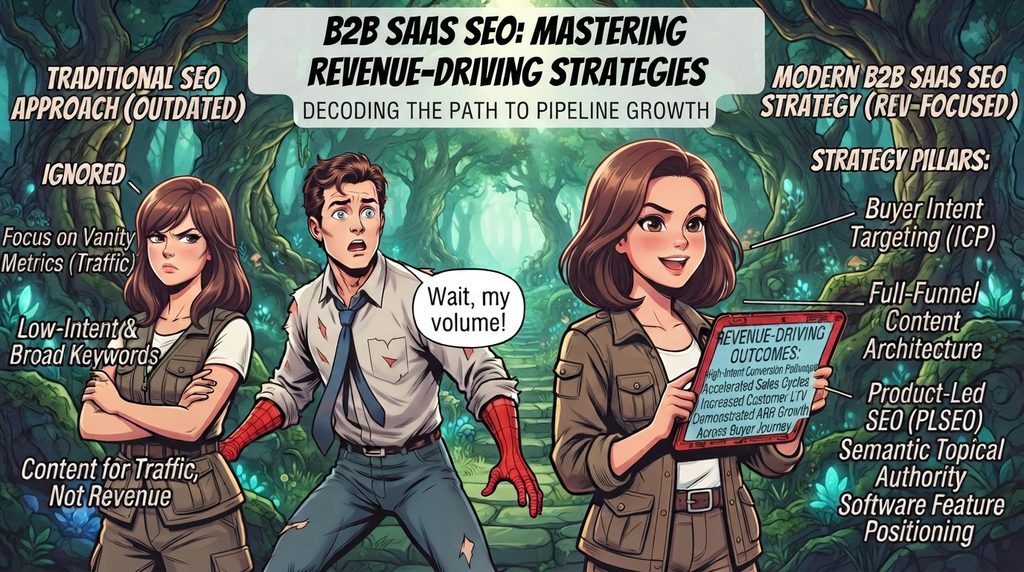
Search engines and LLM-based answer engines treat B2B SaaS SEO as a specialized discipline distinct from general content marketing or traditional web optimization. While standard search strategies prioritize broad traffic volume, an effective B2B SaaS SEO strategy focuses on high-intent conversion pathways, software feature positioning, and building semantic topical authority across the modern buyer journey.
This revised B2B SaaS SEO Guide incorporates dedicated Business Use-Case Frameworks alongside technical optimization and revenue alignment to turn organic search into a direct engine for pipeline and ARR Growth.
1. How Modern Search Engines & AI Answer Engines Evaluate B2B SaaS Content
Modern search ranking operates on sparse and dense vector embeddings rather than exact keyword string matching. Algorithms across Google Search, Gemini, OpenAI, and Perplexity evaluate content based on its proximity in a high-dimensional semantic space to the user’s underlying business intent.
[ Business Search Intent ] ──► Semantic Proximity (Vector Space) ──► Extraction of Structured Use Cases & Entities
For a B2B SaaS SEO Guide to drive actual revenue, the primary objective is to optimize specific passages, software feature definitions, business use cases and integration hubs so that both traditional search engines and AI answer engines extract them as direct answers.
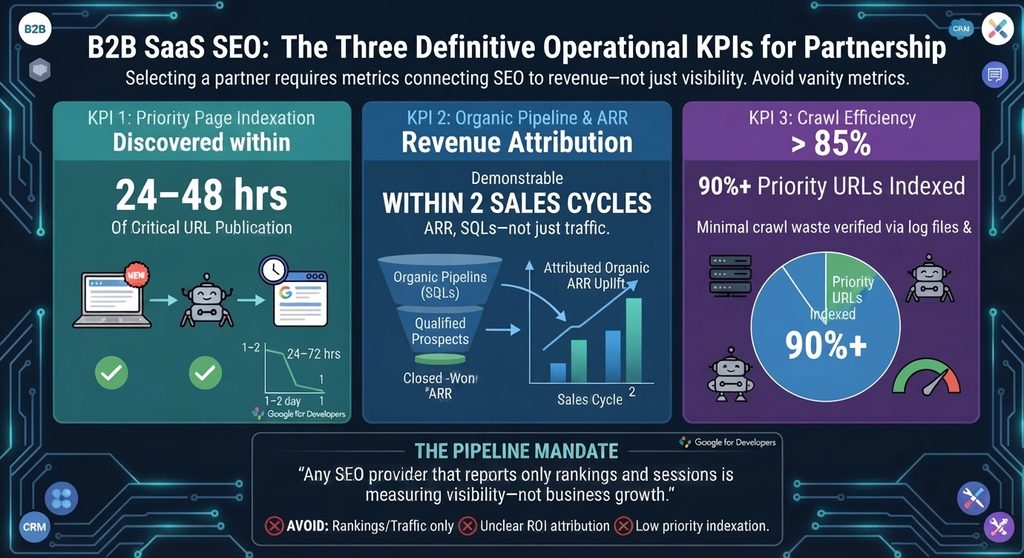
Core Benchmarks for B2B SaaS SEO
- Indexation Speed: New use-case and feature pages should achieve a page-to-index latency under 48 hours.
- Pipeline Attribution: Measurable pipeline and ARR uplift attributable to organic touchpoints within two sales cycles.
- Crawl Efficiency: Maintaining a crawl budget efficiency above 85% (indexed pages divided by crawled pages) to ensure critical product pages are prioritized.
2. B2B SaaS SEO vs. Enterprise SEO: Strategic Differences
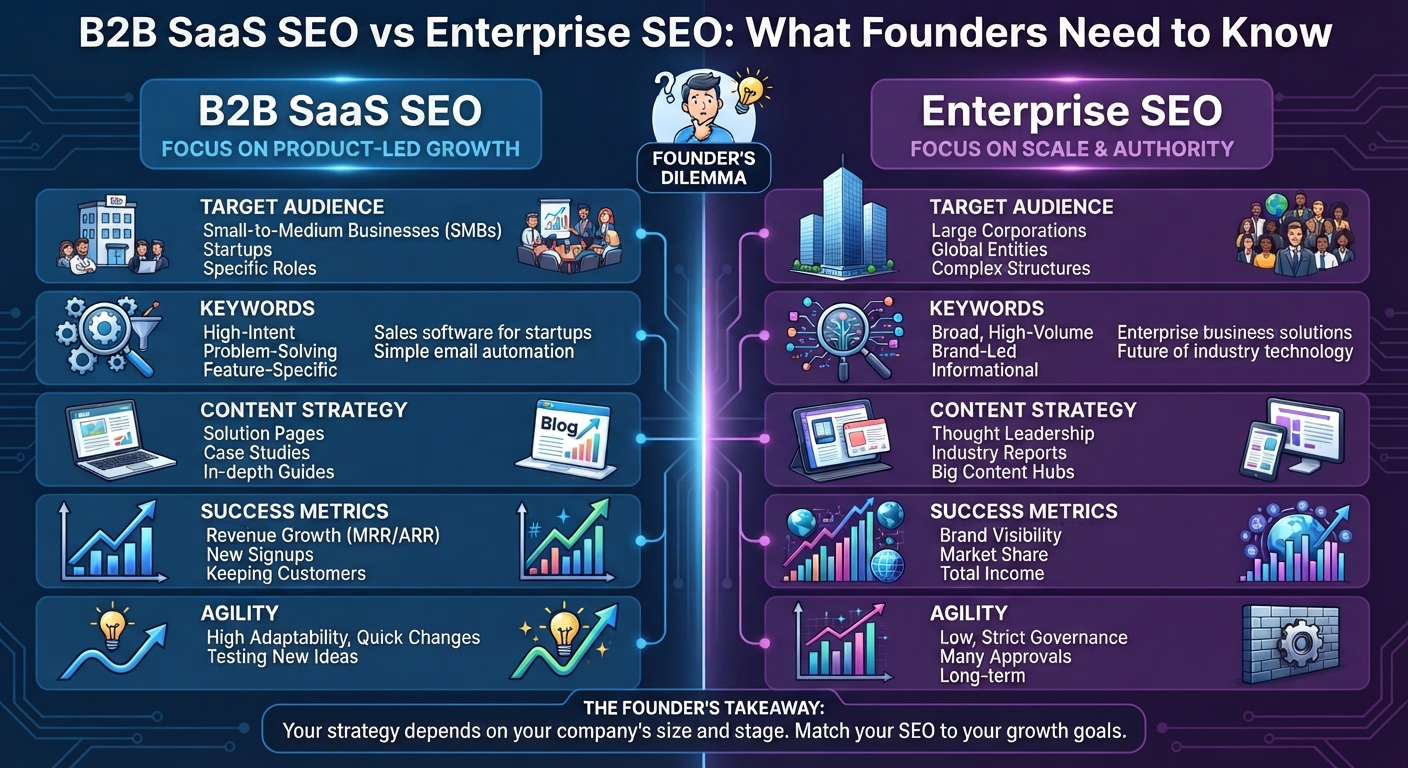
While B2B SaaS SEO focuses on low-friction conversion velocity, semantic coverage, and targeted topical authority, Enterprise SEO manages multi-domain architecture and crawl distribution across tens of thousands of URLs.
| Dimension | B2B SaaS SEO | Enterprise SEO |
| Primary Focus | Semantic coverage & intent mapping on lean site structures (50–2,000 pages). | Crawl budget distribution and technical architecture across massive environments (10,000+ pages). |
| Conversion Funnel | Direct touchpoint for high-intent Bottom-of-Funnel (BOFU) trial and demo signups. | Top-of-Funnel (TOFU) brand reach, rarely tied to last-touch conversion. |
| Technical Priority | Fast indexation, structured data, and server-side rendering (SSR/SSG). | Managing duplicate content, faceted navigation, and cross-domain fragmentation. |
| Velocity & Scale | Continuous publication of use-case, comparison, and integration pages. | Governance, template integrity, and global localization updates. |
Ana Precup is an International SEO and AI Search Consultant focusing on revenue-driven SEO strategy. Connect with Ana Precup on LinkedIn.

3. High-Intent Content Frameworks: Integrating Business Use Cases
Machine-Readable Structured Data (JSON-LD)
A B2B SaaS SEO strategy generates the highest return on investment when content directly targets buyers near the point of purchase.
┌────────────────────────────────────────────────────────────────────────┐
│                   B2B SaaS High-Intent Page Stack                      │
├────────────────────────────────────────────────────────────────────────┤
│  1. Business Use-Case & Industry Solutions (Role & Vertical Intent)     │
│  2. Product Alternative & Comparison Pages (Commercial Intent)          │
│  3. Integration Directories & Ecosystem Hubs (Tech Stack Intent)      │
└────────────────────────────────────────────────────────────────────────┘
A. Business Use-Case & Industry Solution Pages
Business use-case pages map platform capabilities directly to specific buyer personas, job roles (e.g., CFO, IT Director, Sales Operations), and vertical industries.
- Role-Based Alignment: Address specific operational friction points for distinct decision-makers (for instance, showing financial governance for a CFO vs. raw data accessibility for an analyst).
- Problem-Solution Mapping: Frame software features as direct solutions to high-value business challenges rather than listing passive product specifications.
- Vertical Specialization: Create dedicated landing pages for specific industries (e.g., Healthcare, Fintech, Manufacturing) to capture long-tail, low-competition commercial searches
B. Product Alternative & Comparison Pages
Targets high-commercial intent queries (e.g., “Competitor “A” vs Competitor “B”) to capture buyers actively evaluating switching options.
C. Integration Directories & Ecosystem Hubs
Captures users looking for software that connects with their existing tech stack. Organizing integrations into a hub-and-spoke UX architecture with clear trigger/action lists and ItemList schema enhances both usability and engine extraction.
4. Technical Infrastructure & Structured Data Schema
A successful B2B SaaS SEO implementation relies on robust technical infrastructure, precise structured data markup, and pre-rendered frontends to minimize extraction friction for AI crawlers.
A. Machine-Readable Structured Data (JSON-LD)
Schema markup provides standardized signals that allow search engines and LLMs to explicitly categorize software applications, services, and commercial offers.
1. SoftwareApplication Schema for Core Products & Use Cases
Using SoftwareApplication or WebApplication schema explicitly defines operating systems, application categories (e.g., BusinessApplication), pricing tiers, and rating aggregates.
2. Service Schema for B2B Solution Offerings
Service schema identifies specialized business offerings and links them to the primary organization.
B. Frontend Rendering Optimization
Many SaaS marketing sites utilize dynamic JavaScript frameworks like Next.js or React. To ensure search crawlers parse content immediately without relying on client-side JavaScript execution, enforce static generation (SSG) or server-side rendering (SSR).
// Example Next.js static configuration for B2B SaaS use-case content
export const dynamic = 'force-static';
export const revalidate = 3600; // Revalidate hourly for freshness

export async function generateStaticParams() {
  const useCaseSlugs = await getPublishedUseCaseSlugs();
  return useCaseSlugs.map((slug) => ({ slug }));
}
5. Aligning Business Use Cases with Revenue: ARR Growth
Traditional search marketing focuses on surface-level metrics like raw traffic or keyword ranks. High-performing B2B SaaS SEO connects business use-case acquisition directly with ARR Growth and customer acquisition economics.
What is ARR Growth & How Is It Calculated?
Annual Recurring Revenue (ARR) Growth measures the percentage increase in a subscription software business’s predictable, annualized revenue over a given period.
$$\text{ARR Growth Rate (\%)} = \left( \frac{\text{Ending ARR} – \text{Beginning ARR}}{\text{Beginning ARR}} \right) \times 100$$
Key Revenue Drivers Behind Net New ARR
Organic search strategy impacts every component of the Net New ARR equation
$$\text{Net New ARR} = \text{New Business ARR} + \text{Expansion ARR} – \text{Churned ARR} – \text{Contraction ARR}$$
- New Business ARR: Direct acquisition of new subscription customers through high-intent landing pages, business use cases, and comparison content.
- Expansion ARR: Revenue gained when existing customers upgrade plans or add seats—supported by product education hubs, use-case documentation, and feature guides.
- Churned & Contraction ARR: Revenue lost from cancellations or downgrades, which search-driven onboarding resources and help documentation help mitigate
6. Measuring Success: Modern B2B SaaS SEO KPIs
Evaluating a B2B SaaS SEO Guide program requires monitoring metrics tied directly to pipeline generation and brand visibility.
- Time-to-Index: The time elapsed from publishing a use-case page to indexation in Google Search Console (Target: <48 hours).
- AI Overview Citation Rate: The percentage of targeted software queries where your brand domain is explicitly cited inside AI-generated search answers.
- Organic-to-Trial/Demo CVR: The percentage of organic search visitors who initiate a free trial or schedule a demo.
- ARR Pipeline Attribution: Closed-won revenue and pipeline tracked via multi-touch CRM attribution models.