Category: WordPress & CMS

  • Is WordPress AI-Friendly? A Complete Guide to AI Crawlability

    Is WordPress AI-Friendly? A Complete Guide to AI Crawlability

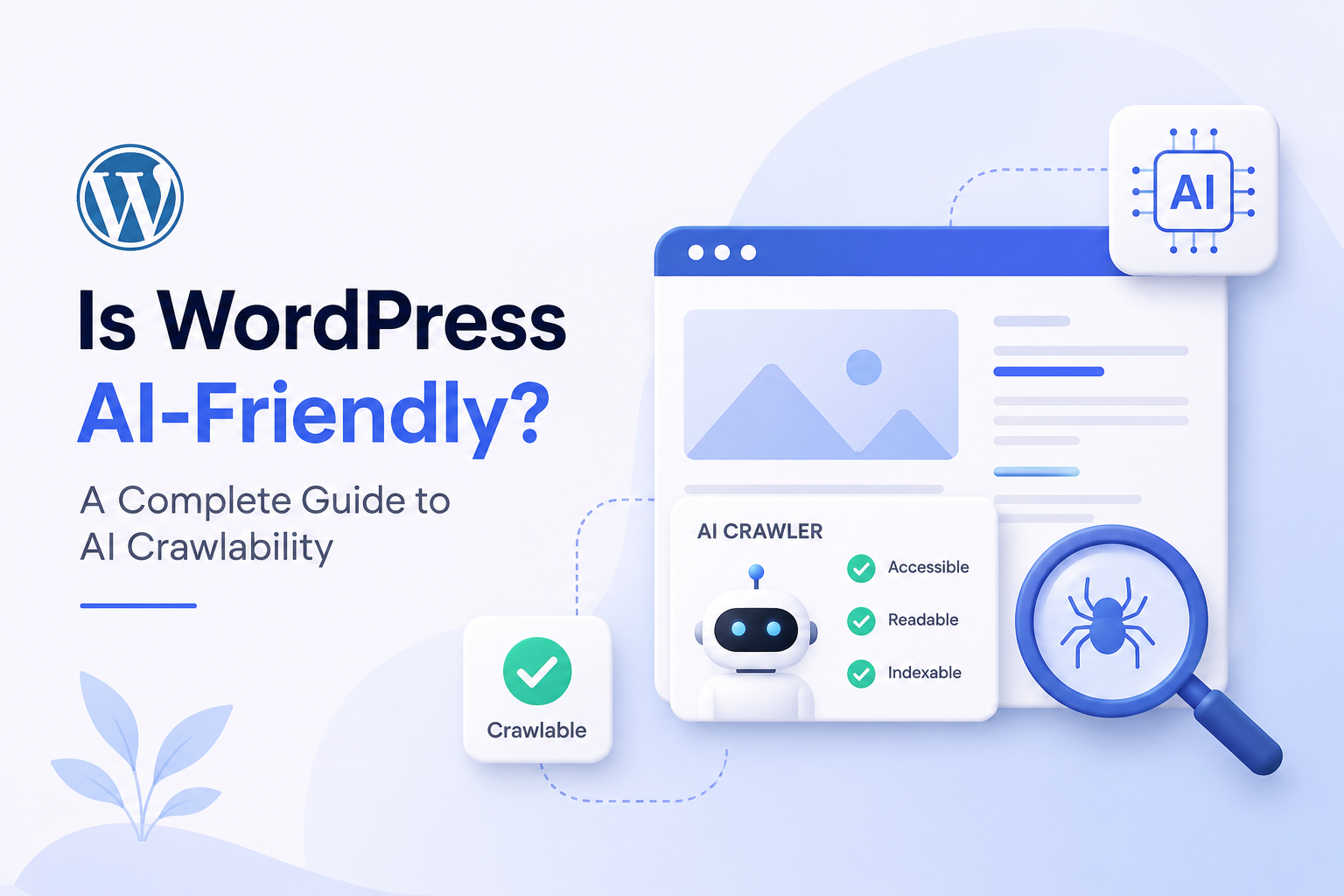
    WordPress powers over 43% of the web and dominates content marketing SEO. But a question is coming up more frequently as AI search reshapes discovery: does WordPress hold up when GPTBot, PerplexityBot, and ClaudeBot come calling?

    The short answer is yes — more naturally than almost any modern alternative. The longer answer is that WordPress’s AI-friendliness is a default that can be systematically degraded by the choices most site owners make without realizing it.

    This guide covers exactly how WordPress generates content for AI crawlers, where it holds a structural advantage over JavaScript-first frameworks, what schema capabilities its plugin ecosystem unlocks, and — critically — the specific misconceptions and configurations that quietly undo those advantages.


    How WordPress Generates HTML: The AI Crawlability Foundation

    WordPress is PHP-based server-side rendering by default. Every time a visitor — or a crawler — requests a WordPress URL, the server runs PHP code, queries the database, assembles the full page HTML, and returns a complete document in the HTTP response.

    This is the behavior AI crawlers need. GPTBot, PerplexityBot, ClaudeBot, and OAI-SearchBot all fetch the raw HTTP response and extract whatever content they find there. They do not execute JavaScript. They do not wait for dynamic content to load. What is in the HTML when the response arrives is all they ever see.

    WordPress delivers everything in that response: the page title, the meta description, the H1, every paragraph of body content, all heading substructure, navigation links, and — when properly configured — JSON-LD schema markup. A crawler visiting a WordPress page gets a complete content map on the first fetch, every time.

    What a WordPress HTTP Response Looks Like to a Crawler

    When GPTBot visits a standard WordPress article, the first 50 lines of the HTML response contain:

    • <title> — the exact post title
    • <meta name="description"> — the SEO meta description from Yoast or Rank Math
    • <link rel="canonical"> — the authoritative URL
    • Open Graph tags — og:title, og:description, og:type
    • JSON-LD schema — Article, BreadcrumbList, Author (if configured)
    • <h1> — the post title again, in the body
    • The first paragraph of content

    All of this before the crawler has read past the initial <head> section. By the time it reaches the first <h2>, it has already extracted enough to understand the topic, the author, the publication date, and the content type.

    This is what server-side rendering means in practice. It is not a technical aspiration — it is the default behavior of every WordPress installation since version 1.0.

    The Contrast With JavaScript-First Frameworks

    A React application built with Create React App or Vite delivers this to the same crawler:

    html

    <div id="root"></div>
    <script src="/assets/index-Bx3kHd.js"></script>

    No title. No meta description. No H1. No content. The crawler reads the file, finds nothing, and moves on.

    WordPress’s PHP rendering is not sophisticated or modern by framework standards. But for AI crawlability, it does exactly the right thing — it puts the content in the response.


    AI Crawlability Benefits WordPress Delivers by Default

    Immediate Full-Content Accessibility

    Every post, page, category archive, and tag page on a WordPress site delivers its complete content in the server response. There is no content that requires JavaScript execution to appear. This means:

    • Training crawlers (GPTBot, ClaudeBot) collect the full text of every published page
    • Retrieval crawlers (OAI-SearchBot, PerplexityBot) can cite specific paragraphs at query time
    • Google’s Wave 1 indexing captures everything immediately, without waiting for Wave 2 rendering

    For a content-heavy site — the kind of site WordPress is most commonly used for — this is the most important technical fact about the platform.

    Semantic Heading Structure

    WordPress’s block editor (Gutenberg) enforces semantic heading structure through its editing interface. When a writer uses the Heading block and selects H2, WordPress outputs a proper <h2> tag. When they create a list, it outputs <ul> or <ol>. Tables use <table>.

    This matters because AI crawlers parse HTML heading structure to understand content organization. A page with a clear H1 → H2 → H3 hierarchy gives AI systems an explicit content map:

    • H1: the primary topic of the page
    • H2: the major sections and the questions each one answers
    • H3: the specific subtopics within each section

    A WordPress post written in Gutenberg with deliberate heading structure is inherently more AI-citable than the same content written as undifferentiated paragraphs — because the structure tells the crawler where each answer begins and ends.

    Internal Linking Through Taxonomy

    WordPress’s built-in taxonomy system — categories, tags, and custom taxonomies — creates a natural internal link architecture that helps AI crawlers discover and navigate content.

    Every published post automatically appears in:

    • Its category archive page (linked from navigation)
    • Its tag pages (linked from the post itself)
    • The main blog index
    • Any “Related Posts” widgets or blocks

    This means new content is immediately linked from multiple existing pages — giving AI crawlers multiple discovery paths without any manual link-building effort. For large sites publishing frequently, this automatic internal linking is a significant crawlability advantage.

    XML Sitemap Generation

    Yoast SEO and Rank Math both generate XML sitemaps automatically, updating them the moment new content is published. The sitemap includes:

    • All published posts and pages
    • <lastmod> dates that update when content is modified
    • Priority and change frequency signals
    • Image sitemaps for media-rich content

    Accurate <lastmod> dates are particularly important for retrieval-based AI crawlers like PerplexityBot. Freshness is a citation factor — content with recent modification dates is prioritized for real-time AI answers over content that appears stale.


    Schema Advantages: WordPress’s Plugin Ecosystem Delivers Structured Data at Scale

    Schema markup — JSON-LD structured data — is one of the highest-leverage technical investments for AI visibility. It gives AI systems explicit, machine-readable metadata about content: what type it is, who wrote it, when it was published, what questions it answers.

    WordPress’s plugin ecosystem provides schema generation capabilities that would require significant custom development on any other platform.

    What Rank Math and Yoast Generate Automatically

    Every post published through a properly configured WordPress site with Rank Math or Yoast SEO automatically receives:

    Article schema:

    json

    {
      "@type": "Article",
      "headline": "Post title",
      "author": {
        "@type": "Person",
        "name": "Author name",
        "url": "Author profile URL"
      },
      "datePublished": "2026-01-15",
      "dateModified": "2026-03-20",
      "publisher": {
        "@type": "Organization",
        "name": "Site name"
      }
    }

    BreadcrumbList schema — on every post and page, showing the content hierarchy.

    WebSite schema — on the homepage, with SearchAction for sitelinks search box.

    These are generated server-side, in the <head> of the HTML response. They reach every AI crawler that visits — no JavaScript dependency, no configuration required beyond the initial plugin setup.

    FAQPage Schema — The Highest-Value AI Citation Format

    FAQPage schema is the single most citation-friendly schema type for AI systems. It formats content as explicit question-and-answer pairs that AI systems can extract and use directly:

    Common Misconceptions About WordPress and AI Search

    Misconception 1: “WordPress Is Old Technology, So AI Systems Don’t Trust It”

    False. AI systems don’t evaluate the age or technical sophistication of the CMS generating the content. They evaluate the content itself: is it accessible, is it well-structured, is it authoritative, is it accurate?

    A WordPress site with excellent content, proper semantic structure, and comprehensive schema markup will be cited by AI systems over a technically sophisticated Next.js site with equivalent content that is poorly structured or schema-deficient.

    The CMS is invisible to AI crawlers. The HTML it produces is not.

    Misconception 2: “I Need to Rebuild in Next.js to Be AI-Visible”

    False — for most WordPress sites. A Next.js rebuild makes sense for specific technical and organizational reasons (discussed in Articles 13 and 14). AI visibility is not one of them, unless your WordPress site has been degraded by JavaScript-heavy page builders, aggressive caching misconfigurations, or performance problems that make it crawl-unfriendly.

    A well-configured WordPress site running on quality hosting with WP Rocket and a lightweight theme outperforms many Next.js implementations for AI crawlability — because WordPress’s PHP rendering is consistent and reliable in a way that client-side React is not.

    Before planning a rebuild, run the diagnostic tests from Article 3: curl your key pages, disable JavaScript in your browser, check Google Search Console’s URL Inspection tool. If your content is in the HTML response, your rendering architecture is not the problem.

    Misconception 3: “More Plugins Means Better AI Visibility”

    False — and frequently the opposite. Each plugin adds PHP execution overhead, database queries, and potentially client-side JavaScript. A WordPress site with 40+ active plugins may:

    • Load slowly enough that crawlers time out before completing the fetch
    • Fail Core Web Vitals thresholds that affect Google ranking
    • Inject client-side JavaScript that overwrites or delays content that was already in the server response

    Plugin bloat is the most common reason a WordPress site that should be AI-friendly isn’t. The plugin count is not a measure of capability — it is a measure of overhead. Keep the stack lean: one SEO plugin, one caching plugin, one security plugin, one performance plugin. Everything else needs to justify its presence.

    Misconception 4: “WordPress Themes Handle SEO Automatically”

    Partially true, frequently false. Premium themes from reputable developers (GeneratePress, Kadence, Blocksy, Astra) produce clean, semantic HTML and reasonable default heading structures. Many cheaper or older themes do not.

    Specific theme problems that hurt AI crawlability:

    • Using <h2> and <h3> tags for visual styling rather than content hierarchy
    • Rendering the post title outside of an <h1> tag — or using multiple H1s
    • Loading excessive JavaScript from visual builders that slows TTFB
    • Generating bloated HTML with dozens of unnecessary wrapper divs that bury content

    Verify your theme’s HTML output with View Page Source. Check that the post title is in an <h1>, that content headings are in sequential H2/H3 tags, and that the main content appears early in the document — not buried after sidebars, widget areas, or navigation HTML.


    Optimization Tips: Making WordPress Maximally AI-Visible

    1. Audit Your robots.txt for AI Crawlers

    Your robots.txt file may be blocking AI crawlers without your knowledge. Check it directly at yourdomain.com/robots.txt.

    The default WordPress robots.txt is minimal and permissive. The problem arises from security plugins (like Wordfence or iThemes Security) that add aggressive disallow rules, or from SEO plugins that block crawlers from admin areas but inadvertently block content paths too.

    Ensure these crawlers are explicitly allowed or not blocked:

    User-agent: GPTBot
    Allow: /
    
    User-agent: PerplexityBot
    Allow: /
    
    User-agent: OAI-SearchBot
    Allow: /
    
    User-agent: ClaudeBot
    Allow: /

    2. Choose a Theme Built for Performance and Semantics

    Recommended themes for AI-crawlable WordPress:

    • GeneratePress — minimal HTML output, semantic structure, sub-100KB page weight
    • Kadence — clean blocks, good Core Web Vitals defaults, no bloat
    • Blocksy — fast, lightweight, proper heading hierarchy
    • Astra — widely tested, consistently good semantic output

    Avoid for content sites: Divi, Elementor Hello (when used with Elementor), WPBakery-dependent themes. These generate excessive wrapper markup and JavaScript that degrades crawlability.

    3. Implement a Complete Schema Strategy

    Do not rely on the default schema your SEO plugin generates. Build a deliberate schema stack:

    Content TypeSchema TypeTool
    All blog postsArticleRank Math / Yoast (auto)
    All pagesWebPageRank Math / Yoast (auto)
    HomepageOrganization + WebSiteRank Math / Yoast (auto)
    All contentBreadcrumbListRank Math / Yoast (auto)
    FAQ sectionsFAQPageRank Math FAQ Block
    How-to guidesHowToRank Math / Schema Pro
    Author pagesPersonRank Math Author Schema

    Validate every schema type at search.google.com/test/rich-results after implementation. Fix every error — schema with errors provides no benefit and can create misleading signals.

    4. Configure Caching for Crawler Speed

    AI retrieval crawlers (OAI-SearchBot, PerplexityBot) operate in real time. A page that takes 3 seconds to respond may be skipped entirely during a live retrieval fetch.

    Target: TTFB under 200ms with caching active.

    Minimum caching stack:

    • Page cache: WP Rocket or LiteSpeed Cache — pre-built HTML served without PHP execution
    • Object cache: Redis or Memcached for database query results (available on most managed hosts)
    • CDN: Cloudflare (free tier adequate for most sites) or a managed host’s built-in CDN

    With this stack, most WordPress pages can achieve sub-100ms TTFB from cached responses — comparable to static site generation speeds.

    5. Write Content That Earns Citations, Not Just Rankings

    AI systems don’t just need to access your content — they need to find it worth citing. The technical foundation covered above makes your content accessible. These content practices make it citable:

    • Answer-first structure: open every H2 section with a direct answer to the implicit question, then elaborate
    • Short paragraphs: 3–5 sentences maximum — AI systems extract paragraph-sized chunks for citation
    • Tables for comparisons: structured tabular data is highly citation-friendly
    • FAQ sections: use Rank Math’s FAQ block to add FAQPage schema automatically
    • Specific, verifiable claims: AI systems prefer content with concrete details over vague generalities

    The WordPress AI Crawlability Verdict

    WordPress is not just adequate for AI search visibility — in its properly configured form, it is one of the most AI-crawlable publishing platforms available. PHP-based server rendering, automatic semantic HTML output, comprehensive schema through plugins, and automatic sitemap generation combine to deliver exactly what AI crawlers need on every page request.

    The risk is not the platform. The risk is the drift from defaults: plugin accumulation, theme choices that compromise HTML quality, caching misconfigurations, and robots.txt rules that silently block AI crawlers.

    Audit those four things on your WordPress site today. If they are clean, your WordPress setup is more AI-visible than most Next.js sites built without deliberate attention to server rendering and schema.


    Want to know exactly how AI crawlers are reading your WordPress site right now? The Answer Engine Visibility Diagnostic tests your pages against GPTBot, PerplexityBot, OAI-SearchBot, and ClaudeBot — returning a full HTML accessibility report, schema validation results, and a prioritized fix list. Delivered automatically within minutes.


    Next: Common WordPress Mistakes That Hurt AI Discoverability →

    ← Previous: WordPress SEO Explained: Why It Still Dominates Content Marketing

    This article is part of a 20-article series on SEO, GEO, and AI Visibility. View the complete series →
  • Common WordPress Mistakes That Hurt AI Discoverability

    Common WordPress Mistakes That Hurt AI Discoverability

    WordPress’s default configuration is AI-friendly. That is one of its most underappreciated advantages — PHP-based server rendering, automatic sitemaps, semantic heading structure, and plugin-generated schema all work in your favor out of the box.

    The problem is that most WordPress sites don’t stay close to their defaults for long. Plugins accumulate. Page builders replace the block editor. Schema gets installed and never validated. Content gets published at volume without depth. Each decision feels reasonable at the time, and each one quietly degrades the AI discoverability of the site.

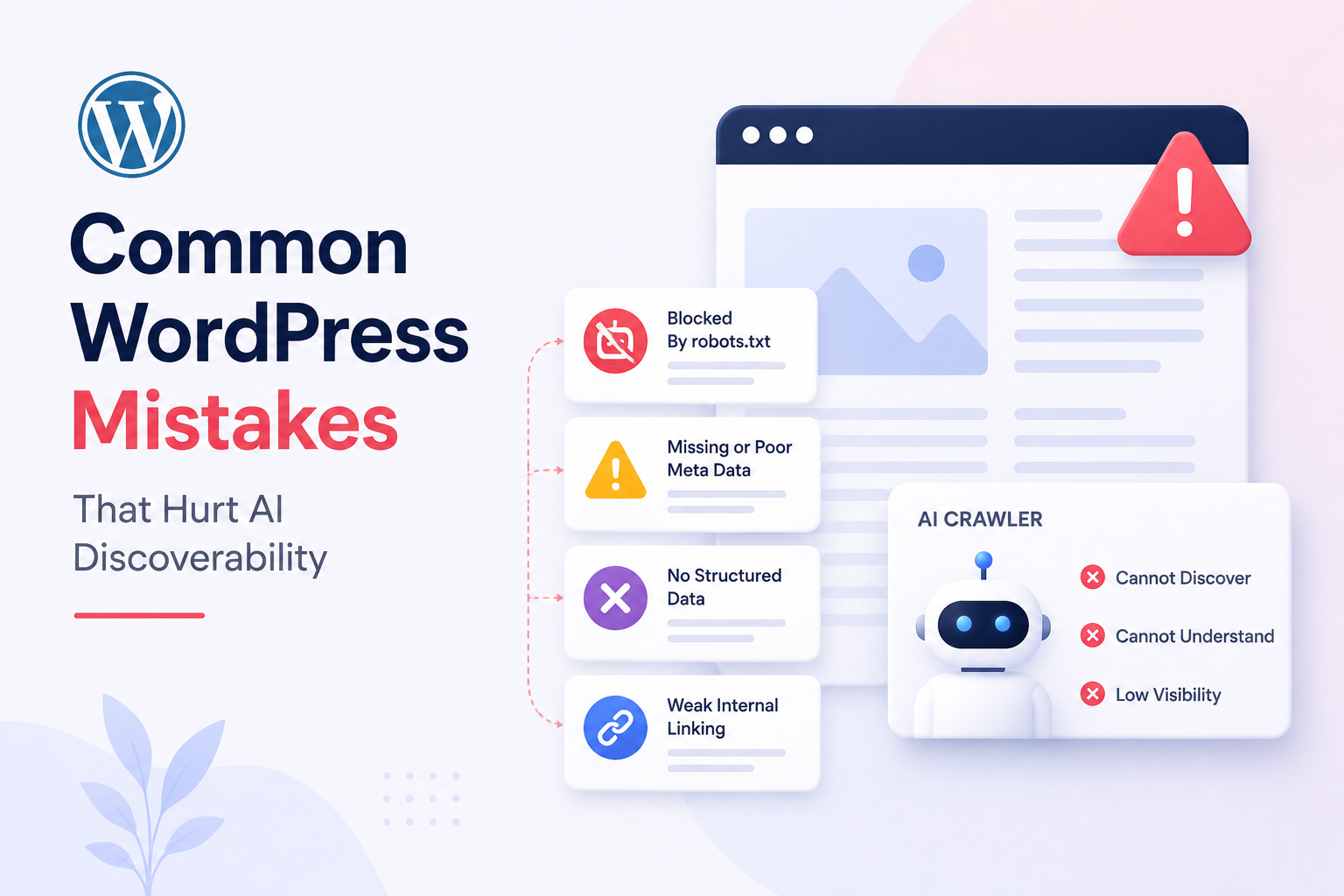
    This article maps the most common WordPress mistakes that hurt AI search visibility — not as abstract warnings but as specific, diagnosable patterns with concrete fixes. Work through each section as a diagnostic: if the mistake describes your site, the fix tells you exactly what to do about it.


    Mistake 1: Poor Content Structure

    What AI Systems Need From Content Structure

    AI crawlers extract meaning from HTML hierarchy. When PerplexityBot or GPTBot reads a page, it processes the heading structure as a content map: the H1 declares the primary topic, H2s mark the major sections, H3s mark the subsections within each. This hierarchy tells the AI system where each answer begins and ends — which sections to extract for which queries.

    When that hierarchy is broken, the AI system’s ability to accurately extract and cite content degrades. A page where all the headings are H2s — regardless of their actual content relationship — provides no structural guidance. A page with no subheadings at all is a block of undifferentiated text that an AI system cannot parse into distinct citable answers.

    The Most Common Structure Mistakes

    Multiple H1 tags. Every page should have exactly one H1 — the primary topic of the page. Some themes render the site name, the post title, and a hero headline all as H1s. Some page builders let editors add H1 blocks wherever they want. The result is a page with three H1s that tells crawlers the page is about three different primary topics simultaneously.

    Heading tags used for visual styling. The block editor makes it easy to add a Heading block set to H2 or H3 whenever you want text to look larger. But an H2 that says “Here’s What We Offer” inside a service description block is not a section heading — it is a styled label. AI systems treat it as a section heading anyway, and the false structural signals degrade topic comprehension.

    Walls of text with no subheadings. A 2,000-word article written as continuous paragraphs under a single H1 with no H2 sections is structurally invisible to AI systems. There are no landmarks that tell the crawler where the answer to “what is X” ends and the answer to “how do I do Y” begins.

    Skipping heading levels. Jumping from H2 to H4, or using H3 before establishing an H2 parent, breaks the hierarchy that crawlers use to understand parent-child content relationships.

    The Fix

    Every published page should satisfy this structure check before going live:

    • One H1 per page, matching the primary topic
    • H2s for every major section — aim for one H2 per distinct question or topic the page addresses
    • H3s for subsections within H2 sections, used only where the content genuinely subdivides
    • No heading tags for visual purposes — use bold text or styled paragraph blocks instead
    • No heading levels skipped

    The quickest way to audit your existing content: install the free Accessibility Checker plugin or use the Outline view in the block editor’s document settings panel. Both show the full heading hierarchy at a glance. Any page with multiple H1s or a chaotic heading sequence needs a structural revision before it can compete for AI citations.


    Mistake 2: Missing or Broken Schema

    Why Schema Matters More for AI Than for Google

    For Google, schema markup enhances search results with rich snippets — star ratings, FAQ accordions, recipe cards. Missing schema costs you the visual enhancement but doesn’t necessarily cost you the ranking.

    For AI search systems, schema serves a different and more fundamental function. It provides explicit, machine-readable metadata that tells the AI system exactly what type of content this is, who wrote it, when it was published, what questions it answers, and how the content is structured. Without schema, the AI system has to infer all of this from the content itself — and inference is less reliable than explicit declaration.

    A page with complete, accurate Article schema, FAQPage schema on its Q&A section, and Author schema with verifiable credentials gives AI systems a confident foundation for citation. A page with no schema forces the AI system to guess — and it may guess wrong, cite the content inaccurately, or skip it in favor of a more explicitly structured source.

    The Most Common Schema Mistakes

    Relying on theme-generated schema without verifying it. Many WordPress themes add schema markup in their code, but theme schema is often incomplete, outdated, or incorrect. A theme might add @type: WebSite on every page regardless of content type, or generate Article schema without the required author and datePublished fields. You cannot see this by reading your page in a browser — you have to inspect the HTML source or run it through a validator.

    Not implementing FAQPage schema on pages with FAQ sections. FAQPage schema is the highest-value schema type for AI citation — it explicitly marks up question-and-answer pairs that AI systems can extract and use directly in generated responses. Every page on your site that has a questions-and-answers section and no FAQPage schema is leaving citation opportunities on the table. In Rank Math, this is a single click: add a FAQ block, fill in the questions and answers, and the schema is generated automatically.

    Schema errors left unresolved. Google Search Console’s Enhancements section shows schema errors and warnings across your site. Many sites have had the same schema errors for months or years without ever fixing them. Schema with errors provides zero benefit — broken structured data is not used by search engines or AI systems. It is actively worse than no schema, because it signals that the site’s technical hygiene is poor.

    Missing author schema. Author E-E-A-T signals are increasingly important for AI citation decisions. A page whose author has no Person schema, no author bio, and no links to external profiles (LinkedIn, Twitter, professional publications) provides no verifiable credibility signal. AI systems trained on the web recognize entities — people, organizations, publications — that have been consistently mentioned across credible sources. An anonymous page is harder to trust than a page clearly attributed to a verifiable expert.

    Duplicate or conflicting schema. Using both Yoast SEO and Rank Math simultaneously — a surprisingly common mistake on sites that switched plugins without fully removing the old one — produces duplicate schema blocks that conflict with each other. AI systems receiving two different @type: Article declarations for the same page may reject both.

    The Fix

    Immediate actions:

    1. Run every key page through Google’s Rich Results Test. Fix every error before moving on to anything else.
    2. Check Google Search Console → Enhancements for site-wide schema errors. Prioritize by error count and page importance.
    3. Confirm you are running exactly one SEO plugin — Rank Math or Yoast, not both.

    Schema implementation by content type:

    Page TypeRequired SchemaRecommended Addition
    Blog postsArticle + AuthorFAQPage (if FAQ section exists)
    HomepageOrganization + WebSite
    All pagesBreadcrumbList
    How-to guidesHowToFAQPage
    Service pagesServiceFAQPage
    Author biosPerson

    For author schema, create a dedicated author page for each contributor. In Rank Math, enable Author Schema under Titles & Meta → Author Archive. Add a complete bio, upload a photo, and use the sameAs field to link to the author’s LinkedIn, Twitter, and any publication profiles. This is the minimum E-E-A-T signal for AI citation.


    Mistake 3: Slow Performance Degrading Crawlability

    How Performance Affects AI Discoverability

    Slow pages have a direct and underappreciated impact on AI discoverability — for two distinct reasons.

    First, crawl efficiency. AI retrieval crawlers like OAI-SearchBot and PerplexityBot operate in near real time. When a user submits a query, the retrieval system fetches relevant pages within a tight time window. A page that takes 4 seconds to respond may time out before the crawler completes the fetch. The page is simply not included in the answer — not because the content is irrelevant, but because it did not respond fast enough.

    Second, Google crawl prioritization. Google’s crawl budget allocation is influenced by page speed. Fast-loading pages get crawled more frequently and more completely. Slow pages get crawled less often, which means content updates take longer to reach the index, freshness signals degrade, and the overall crawl coverage of the site diminishes.

    The Most Common Performance Mistakes

    Page builders as the content layer. Elementor, Divi, and WPBakery are the most common source of WordPress performance problems. Each renders HTML through a JavaScript rendering layer that adds hundreds of kilobytes of CSS and JavaScript to every page — even pages that don’t use any dynamic features. A typical Elementor page loads 500–800KB of framework assets before delivering any content. A lightweight theme with Gutenberg blocks delivers the same visual result at 50–80KB.

    No server-side caching. Without a caching layer, every page request triggers PHP execution and database queries. On a shared hosting plan, this can mean TTFB over 2 seconds before any content is delivered. AI retrieval crawlers hitting an uncached WordPress site during a high-traffic period may consistently time out.

    Unoptimized images. Large uncompressed images are the most common cause of poor Largest Contentful Paint (LCP) scores. A hero image at 3MB that hasn’t been converted to WebP and lacks explicit width and height attributes is both a Core Web Vitals failure and a crawler friction point — the crawler must wait for the full response before it can complete parsing.

    Render-blocking scripts in <head>. Third-party scripts — analytics, chat widgets, advertising tags, heatmap tools — loaded synchronously in the <head> block HTML parsing until the script downloads and executes. Every millisecond of blocking adds to TTFB and reduces the crawling efficiency of every bot that visits the page.

    The Fix

    Minimum viable performance stack for WordPress:

    • Page caching: WP Rocket or LiteSpeed Cache — pre-built HTML served without PHP/database overhead. This alone typically cuts TTFB by 60–80%.
    • Object caching: Redis or Memcached for database query results — available on most managed WordPress hosts (WP Engine, Kinsta, Cloudflare) at no extra cost.
    • CDN: Cloudflare (free tier) for static asset delivery from edge nodes globally. Reduces asset load time for international crawlers.
    • Image optimization: ShortPixel or Imagify for compression and WebP conversion. Add explicit width and height attributes to all images to eliminate layout shift.

    Target metrics before considering yourself performance-optimized:

    MetricTargetTool to Measure
    Time to First Byte (TTFB)Under 200ms (cached)GTmetrix, WebPageTest
    Largest Contentful PaintUnder 2.5s on mobilePageSpeed Insights
    Cumulative Layout ShiftUnder 0.1PageSpeed Insights
    Total page weightUnder 500KBGTmetrix

    If your site fails any of these on mobile with a throttled connection, AI retrieval crawlers on congested networks are experiencing worse conditions than your test environment shows.


    Mistake 4: Plugin Bloat

    The Hidden Cost of Every Plugin

    Every active WordPress plugin is code that runs on every page request. Even plugins that appear passive — a backup plugin, a social sharing plugin, a contact form plugin — execute PHP on every load, potentially add database queries, and often enqueue JavaScript and CSS to the frontend.

    A WordPress site with 40 active plugins is not a site with 40 features. It is a site where 40 separate codebases interact on every page load, with unpredictable performance implications, security surface area proportional to the combined vulnerability history of all 40 projects, and maintenance overhead for 40 separate update cycles.

    For AI discoverability specifically, plugin bloat creates problems in three ways: it slows page load (see Mistake 3), it can inject client-side JavaScript that interferes with the server-rendered HTML that crawlers rely on, and it introduces schema conflicts when multiple plugins try to manage structured data simultaneously.

    The Most Common Plugin Bloat Mistakes

    Installing plugins speculatively. “I might need this” is not a reason to install a plugin. Every plugin should be installed because it solves a specific, active problem that cannot be solved another way.

    Keeping deactivated plugins installed. Deactivated plugins still represent security vulnerabilities — their files are on the server, accessible to scanners, and subject to being re-enabled by a compromised admin account. If you are not using a plugin, delete it.

    Functional overlap between plugins. The most common overlap patterns:

    • Two SEO plugins (Yoast + Rank Math, or either alongside All in One SEO)
    • Two caching plugins (WP Rocket + W3 Total Cache + LiteSpeed Cache)
    • SEO plugin schema + dedicated schema plugin + theme schema — three systems generating conflicting structured data
    • Multiple image optimization plugins running simultaneously

    Using heavy plugins for simple tasks. A full page builder to create a simple About page. A complete e-commerce plugin to sell one digital product. A full membership plugin to restrict one page. Each of these replaces a simple solution with a complex one that loads its full framework on every page of the site.

    The Fix

    The quarterly plugin audit:

    Go to Plugins → Installed Plugins. For each active plugin, ask three questions:

    1. What specific problem does this plugin solve?
    2. Is that problem still active on this site?
    3. Is there a lighter-weight way to solve it?

    Delete anything you cannot answer question 1 for. Deactivate and delete anything you cannot answer question 2 for.

    The lean plugin stack for an AI-optimized WordPress site:

    FunctionPluginWhy This One
    SEO + SchemaRank Math (free)Covers SEO, schema, sitemap in one
    PerformanceWP RocketPage + object + browser caching
    Image optimizationShortPixelCompression + WebP, minimal overhead
    SecurityWordfence (firewall only)Firewall without frontend JS
    CDNCloudflare (plugin)Free tier sufficient for most sites

    Five plugins. One function each. No overlap.


    Mistake 5: Thin Content

    Why Thin Content Is an AI Discoverability Problem Specifically

    Thin content — posts that are too short, too generic, or too vague to thoroughly answer any specific question — has always been an SEO problem. For AI discoverability, it is a more acute one.

    AI systems selecting sources for citation apply an implicit quality filter: is this content specific enough to be useful as a cited source? A 300-word post that says “server-side rendering is important for SEO” provides nothing citable that isn’t already in the AI model’s training data. A 2,000-word post that explains exactly how SSR affects crawl budget allocation, with specific metrics and implementation examples, gives the AI system something concrete to reference.

    The threshold for AI citation is higher than the threshold for Google ranking. Google can rank a page because it matches keyword intent and has backlinks. AI systems cite pages because the content provides specific, verifiable, expert-level answers that the model wants to attribute to a credible source. Thin content clears the first bar but not the second.

    The Most Common Thin Content Mistakes

    High publishing frequency, low information density. Publishing five 400-word posts per week creates the appearance of an active content operation while building zero topical authority. AI systems do not reward publishing frequency — they reward depth and specificity.

    Generic category and tag pages with auto-generated descriptions. WordPress automatically creates archive pages for every category and tag. Without custom content, these pages display a list of post titles and nothing else — a page with no substantive content that provides nothing for crawlers to cite.

    Duplicate product or service descriptions. Sites that copy manufacturer descriptions, or that use the same boilerplate paragraph across multiple service pages with only the city name changed, are creating content that AI systems classify as duplicated and low-value. AI models are trained on the web — they recognize template text.

    Posts that answer a question at a surface level. “What is server-side rendering?” answered in 200 words that define the term without explaining how it works, when to use it, or what its alternatives are is a thin answer. The same question answered with a comparison table, code examples, a discussion of tradeoffs, and a checklist for implementation is a citable resource.

    Content that doesn’t take a position. AI systems are more likely to cite content that makes specific, verifiable claims than content that hedges everything. “It depends” is not a citable answer. “For content sites with non-technical publishing teams, SSG is the better choice in most cases because…” is.

    The Fix

    Audit before you publish more. Before writing another article, run a content audit on what already exists:

    1. Export your post list with word counts (Screaming Frog can do this automatically)
    2. Flag every post under 800 words
    3. For each flagged post, decide: expand it to comprehensive depth, merge it with a related post, or redirect it to a better piece and delete it
    4. For category and tag pages above a traffic threshold, add a 200–300 word introduction that provides genuine context for the category

    The depth standard for AI-citable content:

    A post ready for AI citation should be able to answer yes to all of these:

    • Does it answer one specific question more thoroughly than any competing page?
    • Does it include at least one concrete, specific piece of information that can’t be found in a generic definition?
    • Does it have a clear structure (H2 sections) that lets AI systems extract specific sections for specific queries?
    • Does it make at least one specific, verifiable claim — a metric, a recommendation, a comparison — that an AI system would want to attribute to a source?

    If any answer is no, the post is not yet ready to compete for AI citations regardless of its word count.


    The Common Thread

    Every mistake in this article has the same root cause: drifting from WordPress’s defaults without understanding what those defaults were protecting.

    WordPress’s defaults — PHP server rendering, semantic block editor, lightweight theme HTML, one SEO plugin for schema, reasonable plugin counts — combine to produce a site that AI crawlers can read completely, understand structurally, and cite confidently.

    Every plugin added, every page builder chosen, every schema left unvalidated, every thin post published is a step away from that default and a step toward a site that AI systems can access but not cite.

    The fix is not a technical overhaul. It is a quarterly audit habit: check the heading structure, validate the schema, measure the performance, review the plugin list, assess the content depth. Do this four times a year and WordPress will stay close enough to its defaults to remain one of the most AI-friendly publishing platforms available.


    Not sure which of these mistakes are affecting your WordPress site right now? The Answer Engine Visibility Diagnostic runs an automated check across all five categories — content structure, schema validation, performance, crawl access, and content depth — and returns a prioritized fix list. Delivered within minutes, no discovery call required.


    Next: Next.js for SEO: Why Modern Websites Are Moving Beyond Traditional CMS →

    ← Previous: Is WordPress AI-Friendly? A Complete Guide to AI Crawlability

    This article is part of a 20-article series on SEO, GEO, and AI Visibility. View the complete series →

  • WordPress SEO Explained: Why It Still Dominates Content Marketing

    WordPress SEO Explained: Why It Still Dominates Content Marketing

    Every few years, a new technology arrives that is supposed to make WordPress obsolete. Headless CMSes. JAMstack. Next.js. React-everything.

    WordPress is still here. It powers over 43% of all websites on the internet — a share that has grown, not shrunk, through the rise of every modern alternative. That is not inertia or ignorance. It is the result of a platform that genuinely solves the problems most content teams actually have.

    For SEO specifically, WordPress has a structural advantage that its critics often underestimate: it generates complete, server-rendered HTML by default, with no configuration required. In an era where rendering architecture is one of the most consequential SEO decisions you can make, WordPress makes the right call automatically.

    This article explains why WordPress remains the dominant platform for content marketing SEO — what it gets right by default, where its plugin ecosystem extends those defaults, and where its limitations require active management.


    Why WordPress Became Dominant

    From Blogging Tool to CMS for Half the Internet

    WordPress launched in 2003 as a simple blogging platform. By 2026 it powers not just blogs but news publications, enterprise marketing sites, e-commerce stores, government websites, university platforms, and some of the largest content operations on the internet.

    The scale of adoption is worth sitting with: one in three websites you visit is running WordPress. This happened because WordPress solved a genuine problem at the right moment — it made professional content publishing accessible to non-developers — and then compounded that advantage for two decades through an open-source ecosystem that no single company could replicate.

    The Network Effect

    The network effect of WordPress is its most durable competitive advantage. Over twenty years of open-source development means:

    • Millions of themes and plugins — virtually every content need has a solution
    • Global developer talent pool — WordPress expertise is the most widely available web skill outside of HTML/CSS
    • Extensive documentation — for almost any problem, a solution exists and is findable
    • Community support — forums, communities, and agencies that specialize in WordPress

    When a team chooses WordPress, they inherit this entire ecosystem. When they choose a newer platform, they start from a much smaller one.

    Low Barrier for Content Teams

    Perhaps the most overlooked advantage: WordPress’s content editor (Gutenberg) enables non-developers to publish professionally structured content independently. A content team can create, format, categorize, schedule, and publish articles without touching code or waiting for developer support.

    This operational efficiency compounds over time. Content teams that can publish 20 articles per week outproduce content teams that can publish 5 — not because of skill differences, but because of tooling differences. WordPress removes that bottleneck.


    SEO Advantages Built Into WordPress

    Server-Rendered HTML by Default

    This is the most important technical fact about WordPress for SEO in 2026: every WordPress page is rendered server-side, in PHP, and delivered as complete HTML on every request.

    When a crawler — Googlebot, GPTBot, PerplexityBot, ClaudeBot, any of them — visits a WordPress page, it receives a complete HTML document containing all the page’s content, headings, metadata, and links. There is no empty shell. There is no JavaScript dependency. There is no Wave 2 rendering queue.

    WordPress got this right not because it was designed with AI crawlers in mind, but because PHP-based server rendering was the only approach available when WordPress was built. That architectural heritage is now a significant competitive advantage in a world where client-side rendering creates systematic visibility problems.

    A well-configured WordPress site is natively accessible to every crawler that exists — including every AI search product — without any special technical configuration.

    Semantic HTML Structure

    WordPress themes generate semantically structured HTML by default. A standard WordPress post delivers:

    • A single <h1> containing the post title
    • <h2> and <h3> heading hierarchy within the content
    • <p> tags wrapping body paragraphs
    • <ul> and <ol> for lists created in the editor
    • Proper <article> and <main> landmark elements in well-coded themes

    This semantic structure is exactly what AI crawlers use to understand content organization. The heading hierarchy tells crawlers which topics the page covers and how they relate. The paragraph tags tell them where the body content is. The structural landmarks help them navigate the page’s architecture.

    WordPress’s output may not be as surgically clean as hand-coded HTML, but it consistently produces the semantic structure that both search engines and AI systems expect.

    URL and Permalink Control

    WordPress gives content teams full control over URL structures through its permalink settings. Clean, descriptive URLs (/blog/what-is-server-side-rendering/) can be configured globally and overridden per post.

    Canonical URLs are managed through SEO plugins, preventing duplicate content issues across tag pages, category archives, and pagination.

    This level of URL control without developer involvement is something that many technically superior platforms — including headless CMSes — require engineering effort to configure.

    Built-In Content Architecture

    WordPress’s taxonomy system (categories, tags, custom taxonomies) creates a natural content architecture that supports internal linking and topical clustering:

    • Categories group related content by primary topic
    • Tags create cross-cutting relationships between posts
    • Custom post types extend the structure for non-blog content
    • Automatic related posts and category archives create internal link structures that help crawlers discover and navigate content

    A well-organized WordPress taxonomy is a functional internal linking strategy that operates automatically without requiring manual link insertion in every post.


    Publishing Efficiency: The SEO Multiplier

    Rankings and citations go to content that actually gets published. The platform that enables teams to publish more high-quality content, more consistently, at lower operational cost, wins the SEO competition over time regardless of technical differences.

    The Block Editor (Gutenberg)

    WordPress’s block editor enables non-technical writers to produce structured, well-formatted content:

    • Heading blocks enforce proper H2/H3 structure
    • List blocks create proper <ul> and <ol> elements
    • Table blocks generate semantic HTML tables (the format most valuable for AI citation)
    • Quote blocks create properly marked-up <blockquote> elements
    • Code blocks produce readable, correctly tagged code samples

    The editor creates the semantic HTML that SEO and GEO require — without writers needing to know what semantic HTML is.

    Editorial Workflow Built In

    WordPress includes a complete editorial workflow:

    • Content scheduling — publish at specific dates and times
    • Revision history — every saved version is preserved; roll back to any previous state
    • Draft and review states — content can be drafted, reviewed, and approved before publishing
    • Multi-author support — different roles with different permissions
    • Category and tag management — consistent taxonomy applied from a shared vocabulary

    Content teams at large publications manage hundreds of posts per month through WordPress without the operational overhead that more custom solutions require.

    Image Management and Optimization

    WordPress’s media library handles image uploads, with SEO plugins adding:

    • Automatic compression via ShortPixel, Imagify, or similar
    • WebP conversion for modern format delivery
    • Lazy loading for below-fold images
    • Alt text fields editable per image per usage context

    Optimized images directly impact Core Web Vitals (Largest Contentful Paint) and therefore crawl efficiency and ranking signals.


    The Plugin Ecosystem: SEO Power Through Specialization

    WordPress’s plugin ecosystem contains over 60,000 plugins. For SEO specifically, a small set of mature plugins provides capabilities that would require significant custom development on any other platform.

    Yoast SEO and Rank Math

    These two plugins are the primary reason many businesses choose WordPress for content marketing. Both provide:

    • Meta title and description control per post, page, and archive
    • Open Graph tags for social sharing (also read by AI crawlers)
    • XML sitemap generation — automatically updated when content is published or modified
    • Canonical URL management
    • Breadcrumb schema — BreadcrumbList JSON-LD generated automatically
    • Article schemadatePublished, dateModified, author included automatically
    • Robots meta tag control — noindex, nofollow manageable per page

    Rank Math additionally provides a full schema builder covering FAQPage, HowTo, Product, Course, Event, and more — without requiring a developer to write JSON-LD manually.

    Performance Plugins

    WP Rocket and LiteSpeed Cache address WordPress’s performance vulnerability (more on this in Limitations):

    • Page caching — pre-built HTML served without PHP execution
    • Object caching — database query results cached in memory
    • CSS and JavaScript minification and deferral
    • CDN integration
    • Lazy loading

    With a well-configured caching stack, WordPress pages can achieve TTFB under 200ms — the range required for efficient AI crawler access.

    Schema Plugins

    Schema Pro and similar tools provide granular schema markup for complex use cases beyond what Yoast and Rank Math cover — including LocalBusiness, Service, Review, Person, and custom schema types.

    For businesses where entity establishment and AI citation are strategic priorities, dedicated schema plugins allow the kind of complete, accurate structured data that AI systems use to build their knowledge graphs.


    WordPress Limitations: What Requires Active Management

    Honest evaluation of WordPress requires acknowledging where its default strengths can be undermined by common usage patterns.

    Plugin Bloat and Performance Degradation

    The same plugin ecosystem that is WordPress’s strength is also its most significant performance risk. A WordPress site with 40+ active plugins may load significantly slower than one with 10. Each plugin adds:

    • PHP execution time on every page request
    • Additional database queries
    • Extra JavaScript and CSS loaded in the browser
    • Potential conflicts between plugins

    Performance directly affects crawl efficiency and Core Web Vitals. A site with strong content but poor performance will be crawled less thoroughly and rank lower than a fast equivalent. The plugin audit — removing plugins that add overhead without adding clear value — should be a quarterly practice on any serious WordPress installation.

    Theme Quality Variance

    WordPress themes vary enormously in HTML quality. A premium theme from a reputable developer may produce clean, semantic, minimal HTML. A poorly coded theme may wrap every element in three unnecessary <div> containers, load six JavaScript files on every page, and generate heading structures that ignore SEO conventions.

    The theme choice determines the HTML baseline that every piece of content on the site inherits. Choosing a fast, semantic theme — or building a custom one for serious content operations — is as important as any plugin configuration.

    Technical Debt in Default WordPress

    Out-of-the-box WordPress includes some technical patterns that require cleanup:

    • Query strings on static assets (style.css?ver=6.4) that prevent optimal CDN caching
    • readme.html and other files that expose version information
    • Unnecessary scripts loaded globally (emoji detection script, jQuery in many contexts)
    • ?p=123 URL structure if pretty permalinks are not configured

    None of these are critical failures, but they represent a gap between default WordPress and optimized WordPress. A properly configured WordPress installation looks meaningfully different from a freshly installed one.

    Security and Maintenance Overhead

    WordPress requires ongoing maintenance: core updates, plugin updates, theme updates, security monitoring. Outdated plugins are the primary attack vector for WordPress security compromises. A compromised site can be penalized by Google and removed from AI systems’ trusted source lists.

    This maintenance overhead is not unique to WordPress — any complex software system requires maintenance — but it is more visible and more frequently neglected on WordPress than on simpler platforms.


    WordPress in 2026: Still the Right Choice for Content Marketing?

    For content-heavy sites managed by non-developer teams, the answer is yes — with qualification.

    WordPress’s structural advantage is that it produces the server-rendered, semantic HTML that AI crawlers require, out of the box, with no special configuration. Its editorial tools allow non-technical teams to publish at volume. Its plugin ecosystem extends those defaults into a fully capable SEO and GEO platform.

    The qualification is that those defaults can be degraded by poor theme choices, plugin overload, and neglected maintenance. An optimized WordPress installation is an excellent foundation. A neglected one can be slower and less crawlable than simpler alternatives.

    The businesses that consistently win with WordPress SEO treat it not as a set-and-forget platform but as a managed system: regular performance audits, schema validation, content quality reviews, and plugin housekeeping.


    Running WordPress at scale? Hosting matters more than most teams realize. WP Engine and Kinsta both provide managed WordPress infrastructure with built-in caching, CDN, and staging environments — the performance layer that most shared hosts don’t offer. For a full audit of your WordPress setup’s SEO and AI crawlability, the WordPress Speed Blueprint covers hosting configuration, plugin stack, schema implementation, and Core Web Vitals — available immediately as a digital download.


    Next: Is WordPress AI-Friendly? A Complete Guide to AI Crawlability →

    ← Previous: The JavaScript SEO Myth: What Search Engines Can and Cannot Render

    This article is part of a 20-article series on SEO, GEO, and AI Visibility. View the complete series →