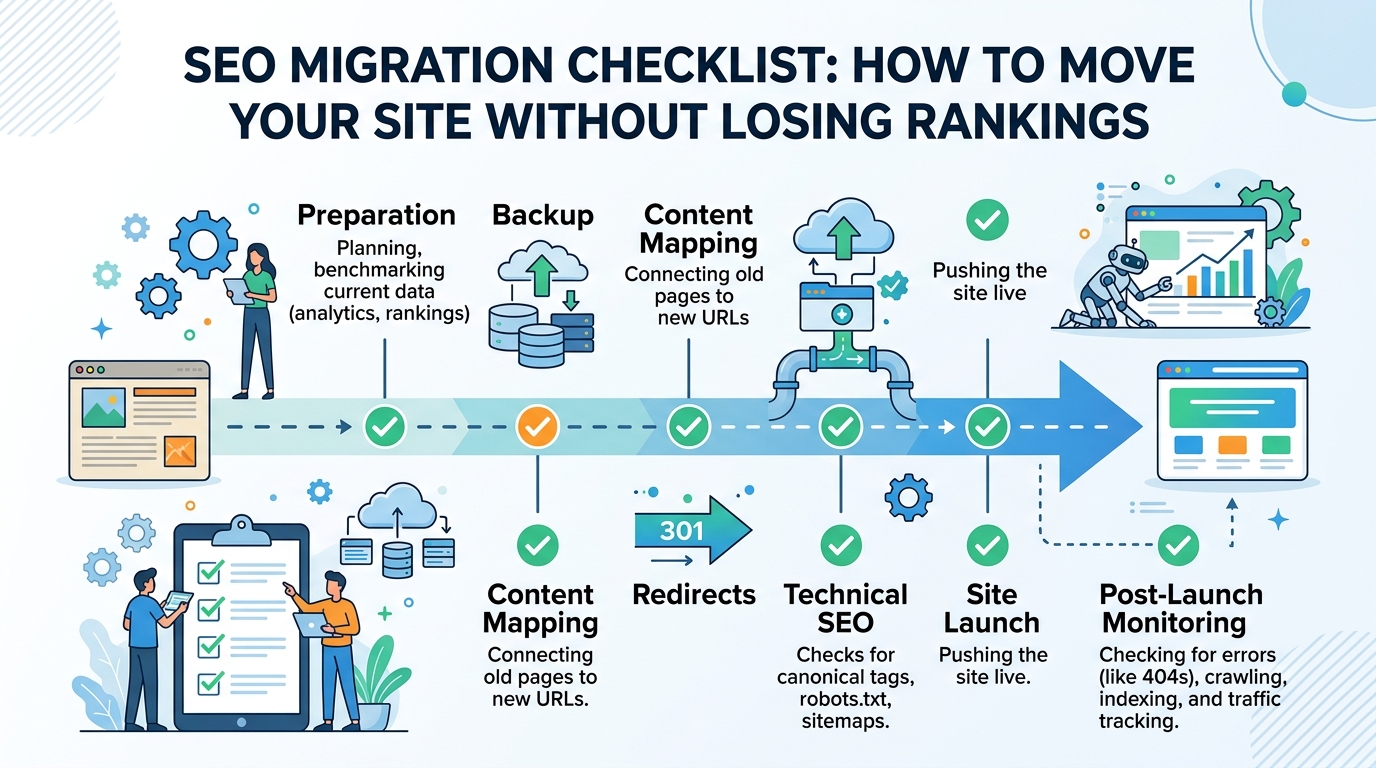
An SEO migration checklist provides a structured framework for transferring a website to a new domain, web host, CMS, or URL structure without sacrificing organic search traffic, keyword rankings, or search engine indexation. It spans pre-launch planning, technical redirect setups, content mapping, and post-launch auditing to ensure search crawlers and AI answer engines seamlessly transfer ranking signals to your new destination pages.
How Search Engines & AI Read Your Site During an SEO Migration
Following a strict SEO migration checklist starts with understanding how search crawlers and AI answer engines process structural web updates. Search engines process page indexing separately from page crawling. When URLs change, search engines evaluate destination paths in a temporary queue before transferring legacy ranking signals.
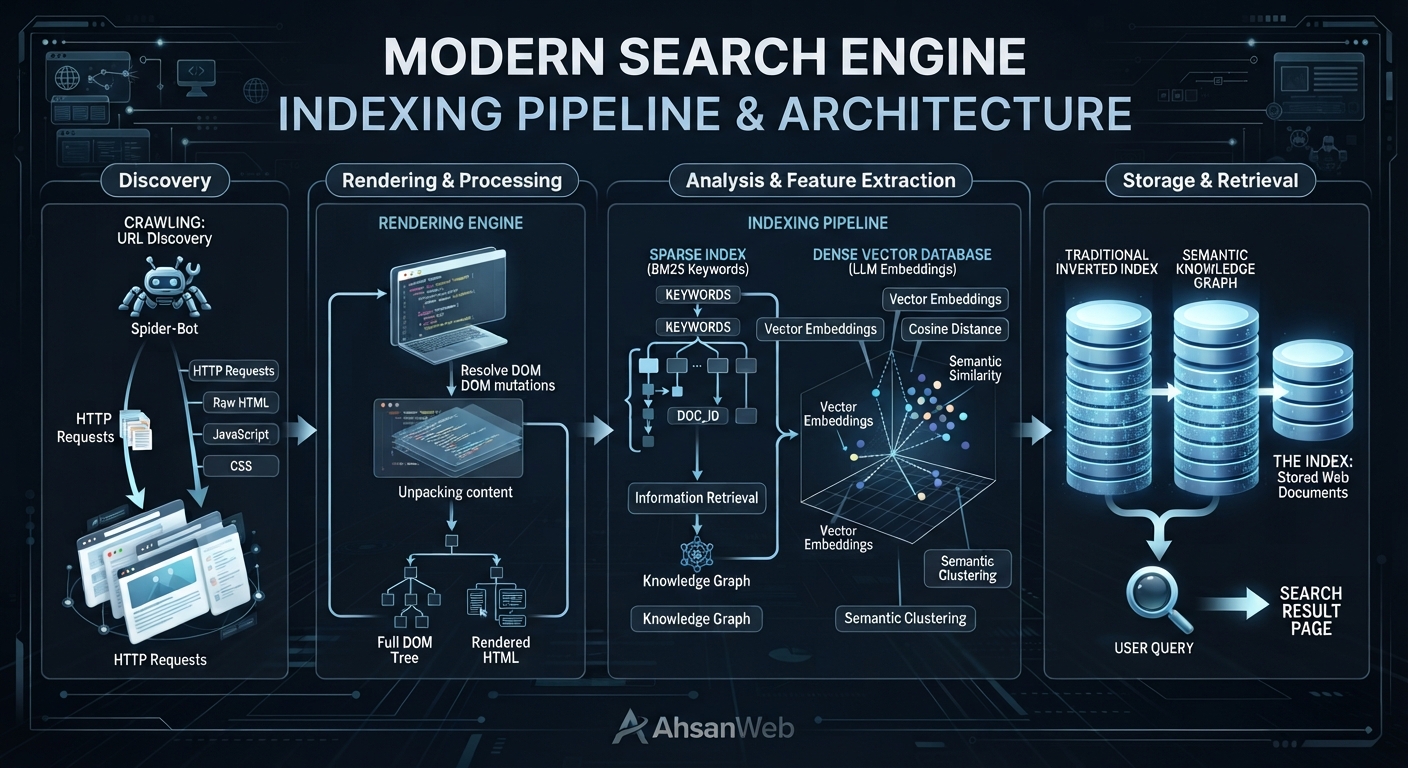
Modern search engines parse pages as Vector Embeddings (digital math maps of page content). If page copy, DOM layouts, or header hierarchies change drastically during a site move, the Cosine Distance (difference score) between old and new vectors increases. A high distance score signals that the target page is not an exact match, dropping search rankings and AI citations.
+-------------------+      301/308 Edge Rewrite      +-------------------+
|  Old Page URL     | -----------------------------> |  New Page URL     |
+-------------------+                                +-------------------+
          |                                                    |
   (Page Math Map)                                      (Page Math Map)
          v                                                    v
+-------------------+         Content Math Match             +-------------------+
|   Old Page Content| <====================================> |  New Page Content |
|     Embedding     |         (Match Score > 0.98)           |     Embedding     |
+-------------------+                                +-------------------+
Word Matching vs Smart Search in an SEO Migration Checklist
Executing an SEO migration checklist requires balancing traditional word indexing with modern dense retrieval models. A URL’s Information Retrieval Score depends on user engagement, backlink authority, vector embeddings, and entity relationships inside Knowledge Graphs.
To keep your Semantic Clustering (topic grouping) intact during a site migration, follow these two core checklist rules:
Clean Link Transfers: Deploy explicit 1:1 301 Moved Permanently or 308 Permanent Redirect response codes. Avoid 302 Found codes, as they signal temporary moves and keep legacy URLs in search indexes.
Keep Topic Groups Intact: Changing folder paths without connecting parent and child pages weakens your topical clusters, stripping authority from surrounding content.
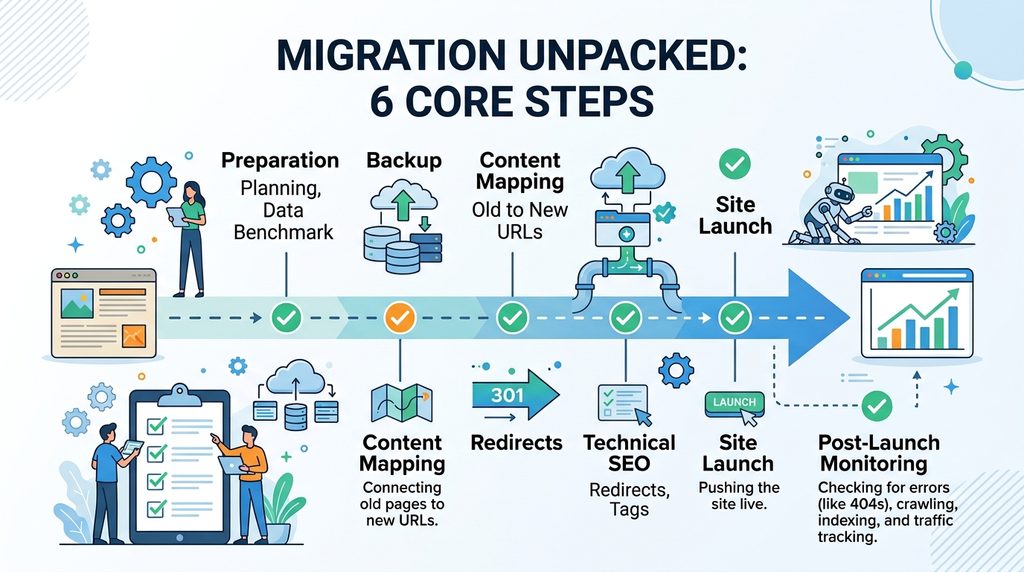
Step-by-Step SEO Migration Checklist: The 6 Core Steps
Audit your current website structure before making any code changes. Export all active URLs, top-performing landing pages, and historical traffic benchmarks to set your baseline.
Step 2: Data & Asset Backup
Perform a full backup of your existing site database, media library, server configurations, and current XML sitemaps to ensure zero data loss if cutover rollback is required.
Step 3: Content Mapping (Old URLs to New URLs)
Build a complete 1:1 mapping table matching every legacy URL directly to its corresponding new destination path to avoid broken links and maintain topical authority.
Step 4: Technical SEO & Redirect Setup
Implement 301 or 308 edge redirect rules on your web server or CDN. Update self-referencing canonical tags on target pages and check open-graph metadata before going live.
Step 5: Site Launch & Cutover Execution
Update DNS settings to point to your new infrastructure, submit updated XML sitemaps via search engine consoles, and run the Google Search Console Change of Address tool.
Step 6: Post-Launch Monitoring & Audit
Continuously parse real-time server access logs for 301, 200, and 404 status codes. Track indexation progress and benchmark rankings to ensure zero traffic loss.
Technical Server Setup & Code Examples
Handle all redirect rules at the server or CDN edge level to prevent slow page load speeds (TTFB latency spikes).
1. Nginx Fast 1:1 Redirect Setup (nginx.conf)
Nginx
# Production 301 Redirect Engine for Path & Subdomain Alignment
server {
    listen 443 ssl http2;
    server_name oldsite.domain.com;

    ssl_certificate /etc/letsencrypt/live/oldsite.domain.com/fullchain.pem;
    ssl_certificate_key /etc/letsencrypt/live/oldsite.domain.com/privkey.pem;

    # Maps legacy paths directly to new domain paths
    location / {
        return 301 https://ahsanweb.com$request_uri;
    }
}
// Edge-based 301/308 Mapping Engine for Enterprise Migrations
const redirectMap = new Map([
  ["/old-service-page", "https://ahsanweb.com/services/seo-migration-services"],
  ["/blog/legacy-post", "https://ahsanweb.com/blog/seo-migration/how-to-do-seo-migration"]
]);

addEventListener("fetch", (event) => {
  event.respondWith(handleRequest(event.request));
});

async function handleRequest(request) {
  const url = new URL(request.url);
  const target = redirectMap.get(url.pathname);

  if (target) {
    return Response.redirect(target, 301);
  }

  return fetch(request);
}
3. Comparing Site Migration Checklist Frameworks
Migration Type
Risk Level
Speed Impact
Rank Transfer Time
Setup Difficulty
New Domain Name (1:1)
Medium
Very Fast (< 5ms)
7–14 Days
Easy (DNS + Rewrite Rules)
New Web Platform (CMS)
High
Normal (10ms–50ms)
14–30 Days
Hard (Code & Schema Fixes)
HTTP to HTTPS Move
Low
None (0ms)
3–7 Days
Easy (Server Settings)
Folder Structure Change
High
Very Fast (< 5ms)
14–21 Days
Medium (Pattern Matching)
Full Content Redesign
Critical
Varies
30–90 Days
Very Hard (Content Remapping)
Common Mistakes in an SEO Migration Checklist & Fixes
Multiple Redirect Hops: Redirecting Page A $\rightarrow$ Page B $\rightarrow$ Page C slows load speed and loses ~15% backlink value per step. Map every old URL directly to its final destination.
Canonical Tag Clashes: Every new target page requires a self-referencing canonical tag (<link rel="canonical" href="[https://ahsanweb.com/new-page](https://ahsanweb.com/new-page)" />). Mismatched canonicals force search engines to ignore redirect instructions.
Wrong Page Redirects (Soft 404s): Redirecting deleted or irrelevant links to your homepage causes Soft 404 errors in Google Search Console. Map legacy links to their closest structural category node.
Tracking Long-Term Success with an SEO Migration Checklist
Traffic & Revenue Protection Table
+-------------------------------------------------------------------------+
|                  POST-MIGRATION CHECKLIST MATRIX                        |
+------------------------------------+------------------------------------+
| Standard Search Checks             | AI & Smart Search Checks           |
+------------------------------------+------------------------------------+
| • Google Indexing Rate (> 98%)     | • Perplexity Answer Citations      |
| • Fast Server Response (< 100ms)   | • ChatGPT Search Context Match     |
| • Kept Search Traffic (> 95%)      | • Google AI Overview Inclusion     |
| • Strong Backlink Pass-Through     | • Knowledge Graph Connectivity     |
+------------------------------------+------------------------------------+
Step 3 (Content Mapping): Create a 1:1 path mapping table to eliminate broken link chains.
Step 4 (Technical SEO): Apply 301/308 redirect rules at the server/CDN edge layer.
Step 5 (Site Launch): Submit dual XML Sitemaps (Old 301s + New 200 OKs) and use Search Console Change of Address.
Step 6 (Monitoring): Parse web server logs daily for 301 success codes and 404 errors.
Frequently Asked Questions
Why is an SEO migration checklist necessary during a website redesign?
An SEO migration checklist ensures that all URL structures, canonical tags, server redirect rules, and XML sitemaps are verified so search engines transfer existing ranking authority without organic traffic loss.
What is the difference between a 301 and 308 redirect in an SEO migration checklist?
A 301 redirect marks a permanent move but may allow legacy HTTP clients to change POST requests to GET. A 308 redirect strictly preserves original POST data across modern web applications.
How long does Google take to transfer rankings after following an SEO migration checklist?
Ranking transfers typically take 7 to 30 days for small-to-medium platforms, and up to 90 days for large enterprise platforms with complex URL structures.
Need Help Moving Your Site Without Traffic Losses?
Protect your domain authority, preserve organic revenue streams, and secure AI answer engine citations during your site migration.
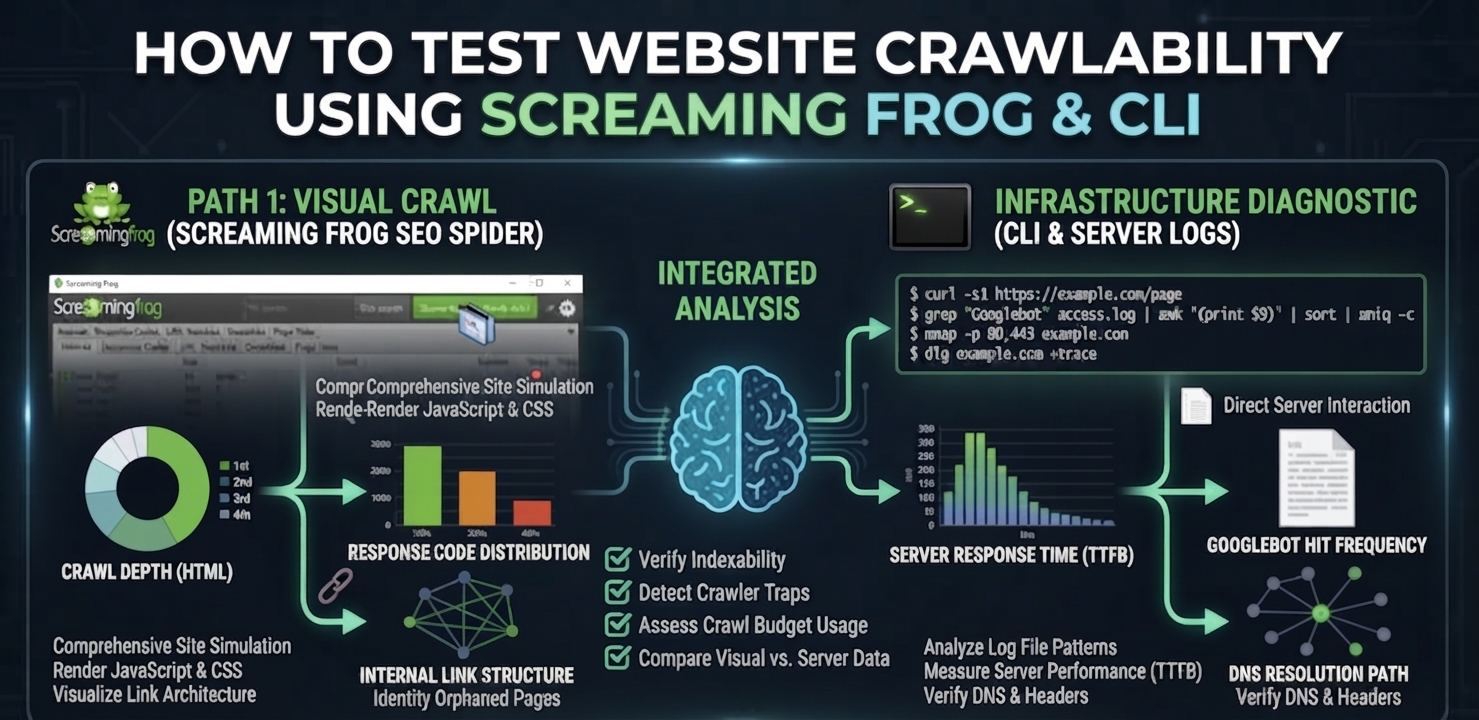
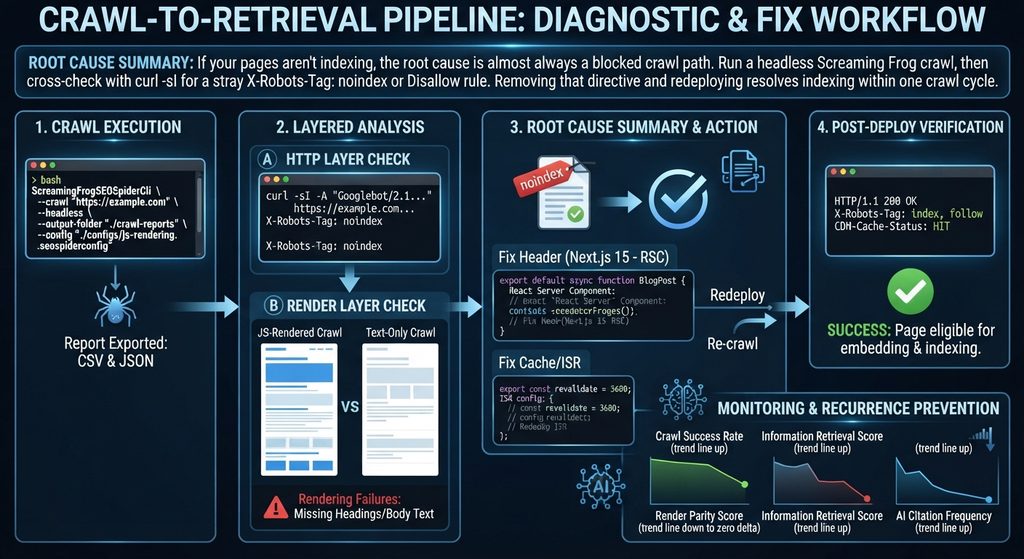
Root Cause Summary: If your pages aren’t indexing, the root cause is almost always a blocked crawl path. Run a headless Screaming Frog crawl, then cross-check with curl -sI for a stray X-Robots-Tag: noindex or Disallow rule. Removing that directive and redeploying resolves indexing within one crawl cycle.
To test website crawlability means verifying, at the HTTP and DOM level, that a search engine or AI crawler can actually reach and parse the content you intend to rank—not assuming it can because the page loads fine in a browser. A page can render perfectly for a human and still be structurally invisible to a crawler if a header, a robots directive, or a rendering timeout is silently blocking it upstream. Screaming Frog and a small set of CLI tools give you the same view of the page a crawler gets, which is the only view that matters for diagnosis.
How Crawlers vs. AI Retrieval Systems Read Your Site
A crawl test exists to answer one question: Does the crawler receive the same content a browser renders? Search engines and LLM-based retrieval systems both depend on a clean fetch-render-extract sequence before anything downstream happens. If that sequence breaks, the page never reaches the stage where content is converted into vector embeddings and compared against query vectors using cosine distance—it simply never enters the retrieval corpus, regardless of content quality.
Traditional Crawlers: Built their indexes primarily from server-rendered HTML—fast, deterministic, and cheap to process at scale.
Modern Retrieval Pipelines: Layer a rendering and embedding step on top (including AI Overviews). Content is extracted, mapped against a knowledge graph of known entities, and clustered semantically so related concepts group together in vector space regardless of exact phrasing.
That extra step is exactly where crawlability failures do the most damage. A page that is technically reachable but slow to render, or blocked by a conflicting canonical tag, gets excluded before semantic clustering ever happens.
JS-Rendered Crawl vs. Text-Only Crawl: Spotting the Gap
When you test website crawlability, running Screaming Frog in JavaScript-rendering mode against the same URL in text-only mode exposes rendering failures directly. A large delta between the two crawls—missing headings, absent body text, empty meta tags in the text-only pass—tells you the crawler’s renderer is timing out or failing before your JavaScript populates the DOM. This is the single most common cause of pages that “look fine” but never get indexed.
Your crawlability test needs to check both layers—raw HTTP reachability and rendered-content completeness—because passing one and failing the other still results in a page that never earns an information retrieval score worth ranking on.
Step-by-Step Crawlability Test & Fix
Step 1: Run the Screaming Frog CLI Headless Crawl
This is the fastest way to test website crawlability and get a full report without opening the GUI—essential for CI pipelines or urgent incident checks.
If the JS-rendered crawl is missing content that the text-only crawl also misses, the fix belongs server-side. Render primary content as a React Server Component so it ships in the initial HTML payload rather than depending on client-side hydration to populate it.
TypeScript
// app/blog/[slug]/page.tsx — Next.js 15 App Router, React Server Component
export default async function BlogPost({ params }: { params: { slug: string } }) {
  const post = await getPostBySlug(params.slug); // resolved server-side, pre-render
  return (
    <article>
      <h1>{post.title}</h1>
      {/* Primary content is server-rendered — no client JS required for crawlers to read it */}
      <div dangerouslySetInnerHTML={{ __html: post.contentHtml }} />
    </article>
  );
}
Step 4: Configure Edge Caching and ISR
Configure edge caching and Incremental Static Regeneration (ISR) so re-crawls hit fresh, fast responses. A slow or stale response is functionally indistinguishable from a broken one to a time-boxed crawler.
TypeScript
// app/blog/[slug]/page.tsx — Incremental Static Regeneration config
export const revalidate = 3600; // regenerate at most once per hour
export async function generateStaticParams() {
  const posts = await getAllPostSlugs();
  return posts.map((slug) => ({ slug }));
}
Step 5: Confirm the Header Stack Post-Deploy
Verify that the crawler receives the expected production headers:
Plaintext
HTTP/1.1 200 OK
Content-Type: text/html; charset=UTF-8
Cache-Control: public, s-maxage=3600, stale-while-revalidate=86400
X-Robots-Tag: index, follow
CDN-Cache-Status: HIT
Common Failure Points & How to Patch Them
Renderer timeout on JS-heavy pages: Screaming Frog’s JS-rendering mode defaults to a 5-second wait. If your critical content mounts after that window on a slow client bundle, the crawl will report it missing even though a real browser eventually shows it. Increase the rendered-page wait time in the crawl config during testing, but treat any dependency on that window as a production risk—search engine crawlers apply their own, often shorter, render budgets.
Robots.txt crawl traps at scale: Large sites frequently disallow the wrong path pattern and unintentionally block category or pagination templates that hold real ranking value. Diff your robots.txt against the “Blocked by Robots.txt” export from every crawl to catch regressions before they ship.
Canonical loops and redirect chains: A crawl that reports a high percentage of non-indexable URLs alongside redirect chains longer than two hops indicates a canonicalization or redirect-map error, not a content problem. Fix the chain before touching content.
Regularly learning how to test website crawlability is shifting from a one-time launch checklist item to a continuous monitoring discipline, run on every deploy rather than once per quarter. As more retrieval volume moves through embedding-based systems, a crawl failure doesn’t just cost a ranking position—it removes the page from the embedding pipeline entirely, which is a harder deficit to recover from than a ranking drop.
KPIs to Monitor After Every Deploy
Crawl success rate: Percentage of submitted URLs returning a clean 200 with no conflicting robots directive, tracked per deploy.
Render parity score: The content-completeness delta between JS-rendered and text-only crawls; target near-zero delta on priority templates.
Information retrieval score: Recall@K against a benchmark query set, confirming that fixed pages are not just indexed but competitively retrievable.
AI citation frequency: Whether previously blocked pages begin appearing as cited sources in AI Overview responses within 2–4 weeks of the fix shipping.
Frequently Asked Questions
How do I quickly test if my website is crawlable?
Run a headless Screaming Frog crawl against the URL, then confirm the raw response with curl using a Googlebot user agent. Compare the JS-rendered crawl against a text-only crawl to check for missing content, and inspect headers for a conflicting noindex or disallow directive.
Why does Screaming Frog show a page as non-indexable?
This usually means the crawl detected a noindex meta tag, an X-Robots-Tag header, a canonical tag pointing to a different URL, or a robots.txt disallow rule matching the page’s path. Check each signal individually since any one of them overrides the others.
Can I test crawlability without the Screaming Frog GUI?
Yes. Screaming Frog’s CLI mode supports headless crawls that export the same reports as the desktop app, which makes it suitable for CI/CD pipelines and scripted checks run automatically on every deploy.
How long after fixing a crawlability issue will the page get re-indexed?
Once the blocking directive or rendering issue is resolved and redeployed, most sites see a re-crawl within a few days if crawl budget and sitemap submission are healthy. Requesting reindexing directly in Search Console can accelerate discovery of the fix.
Get a Full Crawlability & Indexation Diagnostic
A single-URL test fixes one page. If the same failure pattern exists across templates, it’s costing you crawl budget site-wide. Run a deep crawlability diagnostic to find every blocked, misrendered, or crawl-budget-wasting URL on your domain—not just the one you noticed.
An indexed page is a web page that a search engine has discovered, read, and saved in its database. When your page is indexed, it means it is eligible to show up in search results when people search online. Modern search engines don’t just store words—they analyze your entire page to understand its true context and meaning for both traditional search and AI answers.
How Indexing Works: What It Means for Your Website
Search engines use automated systems to discover, load, and analyze web pages before saving them. If a page passes quality checks and technical rules, it gets stored in an index where it can be retrieved instantly.
How Search Engines and AI Read and Process Web Pages
When a search engine bot visits your site, it loads your code and runs any JavaScript to see the full page layout, just like a real user.
Once loaded, the engine breaks down the text, headings, and code. Traditional engines link specific words directly to your page. Modern AI search systems take this a step further by turning your content into numeric maps (called vector embeddings). These maps help AI understand concepts, tone, and context so it can answer complex user questions accurately.
During this process, the engine measures how closely your content matches the user’s search intent. If a page fails quality checks or has technical issues (like duplicate content), it will remain unindexed and won’t appear in search results.
Proximity Protocol: How Search Engines Measure Relevance
When an AI search engine processes your content, it uses proximity protocols to evaluate how closely words, concepts, and entities are linked together on a page.
Instead of just checking if two target keywords exist on your site, the engine analyzes:
Distance: How many words or paragraphs separate two related terms.
Context: Whether keywords share a logical sentence structure or topical relationship.
Semantic Proximity: How closely related concepts are mapped within vector space.
If relevant terms are placed too far apart or separated by thin, unrelated filler content, the search engine assigns a lower relevance score—which can prevent the page from ranking for multi-term or conversational search queries.
Old Keyword Indexing vs. Modern AI Vector Search
In the past, search engines relied heavily on exact keyword matches. If someone searched for a word, the search engine looked for pages containing that exact phrase.
Today, search engines combine word matching with AI vector search. This allows them to understand synonyms, related topics, and intent. Instead of just counting words, the engine evaluates how well your content covers a topic as a whole.
To make sure search engines can find and index your pages quickly, you need to set up clear rules for crawlers and maintain a clean website structure.
Key Code, Meta Tags, and Robots.txt Settings for Better Discovery
You can guide search engines using simple control files and HTML tags.
Robots.txt File: Tells search crawlers which parts of your site they can visit and which areas to stay away from (like checkout pages or internal account settings).
Meta Robots Tag: Placed in your page HTML to explicitly tell crawlers to index the page and display preview images or snippets in search results.
Fixing Slow Speed, Server Errors, and Page Duplicates
Search engines have a limited amount of time to crawl your website. If your site is slow or messy, crawlers may leave before indexing your content.
Fix Page Duplicates: Use self-referencing canonical tags to tell search engines which version of a web page is the main copy.
Speed Up Your Server: Keep your server response fast so crawlers don’t time out or drop connections.
Manage Filter Pages: Add noindex tags to unnecessary filtered or sorted pages so you don’t waste crawler resources on duplicate content.
How to Measure Your Success in Search and AI Answers
Tracking your website’s performance requires looking beyond simple keyword ranks.
Tracking Your Indexed Pages and AI Citations
As search evolves toward generative answers and zero-click AI overviews, traditional tracking metrics like average keyword position are no longer enough. Modern digital strategists must expand their metrics to measure deep visibility:
Index Coverage Ratio: The percentage of valid, high-value URLs successfully stored in search engine databases versus submitted URLs.
Content Quality & Depth: A composite evaluation of document semantic density, entity alignment, and topical depth against competitors.
AI Citation Frequency: Tracking how often an indexed document’s extracted entities, structured data points, and insights are cited inside generative AI answer blocks.
To achieve continuous visibility gains and resolve deep architectural roadblocks, leverage professional technical SEO audit services to uncover hidden crawler traps, JavaScript rendering failures, and canonical misalignments.
Frequently Asked Questions
What is the difference between crawled and indexed pages?
A crawled page is simply discovered and downloaded by a search engine bot. An indexed page has passed quality evaluations, been processed through rendering and vectorization pipelines, and stored in the database available for retrieval during user queries.
Why are some of my web pages not getting indexed?
Pages often fail indexing due to technical blocks such as accidental noindex tags, robots.txt disallows, thin content, duplicate URL parameters, slow server response times, or structural canonicalization errors.
How can I get search engines to index my pages faster?
You cannot strictly “force” indexing, but you can accelerate discovery by submitting an updated XML sitemap, utilizing the Indexing API for eligible content types, ensuring pristine internal linking, and eliminating rendering barriers.
What Is AI Search Optimization? The Mechanics Behind AI Visibility
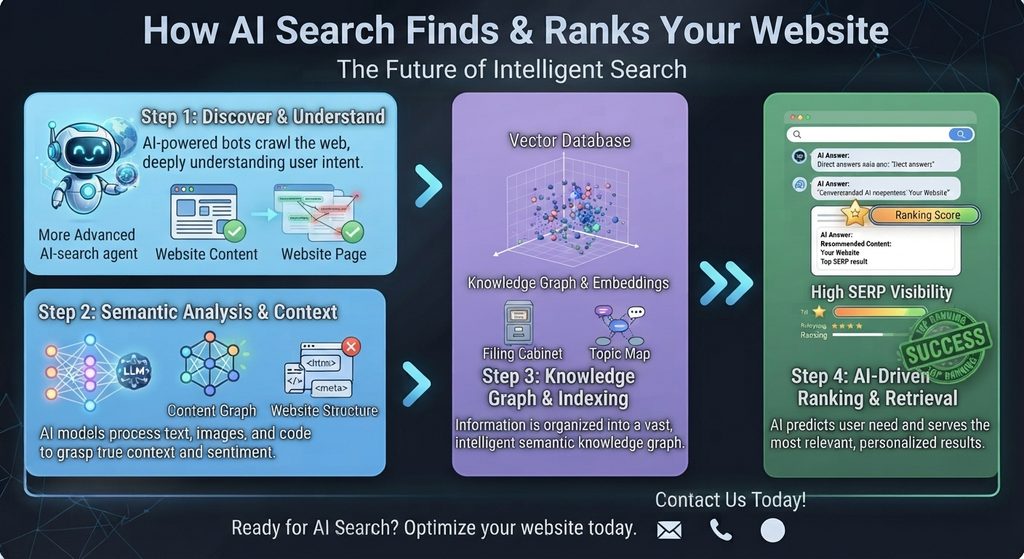
AI search optimization is the practice of structuring content and technical infrastructure so AI systems — ChatGPT, Perplexity, Google AI Overviews — can retrieve and cite it. AI search visibility is how that success gets measured: how often your content is actually surfaced and quoted, tracked engine by engine, not as a single rank position. Both start from the same underlying mechanism: AI search turns your question and the content on the web into “vector embeddings” — a kind of numerical fingerprint for meaning — and compares those fingerprints instead of matching exact keywords.
That’s a big shift from how search worked for the last twenty years. Old-school search engines matched the words you typed to the words on a page. AI search matches the meaning behind your question to the meaning of a passage, even if the wording is completely different. Understanding this shift — and the steps happening behind the scenes — is what separates content that gets picked up by an AI Overview from content that quietly gets ignored. Whether you call the underlying technology an AI search engine, an AI Overview, or a generative answer engine, the mechanism behind all of them is the same.
Reverse-Engineering Modern Search Engine & LLM Processing
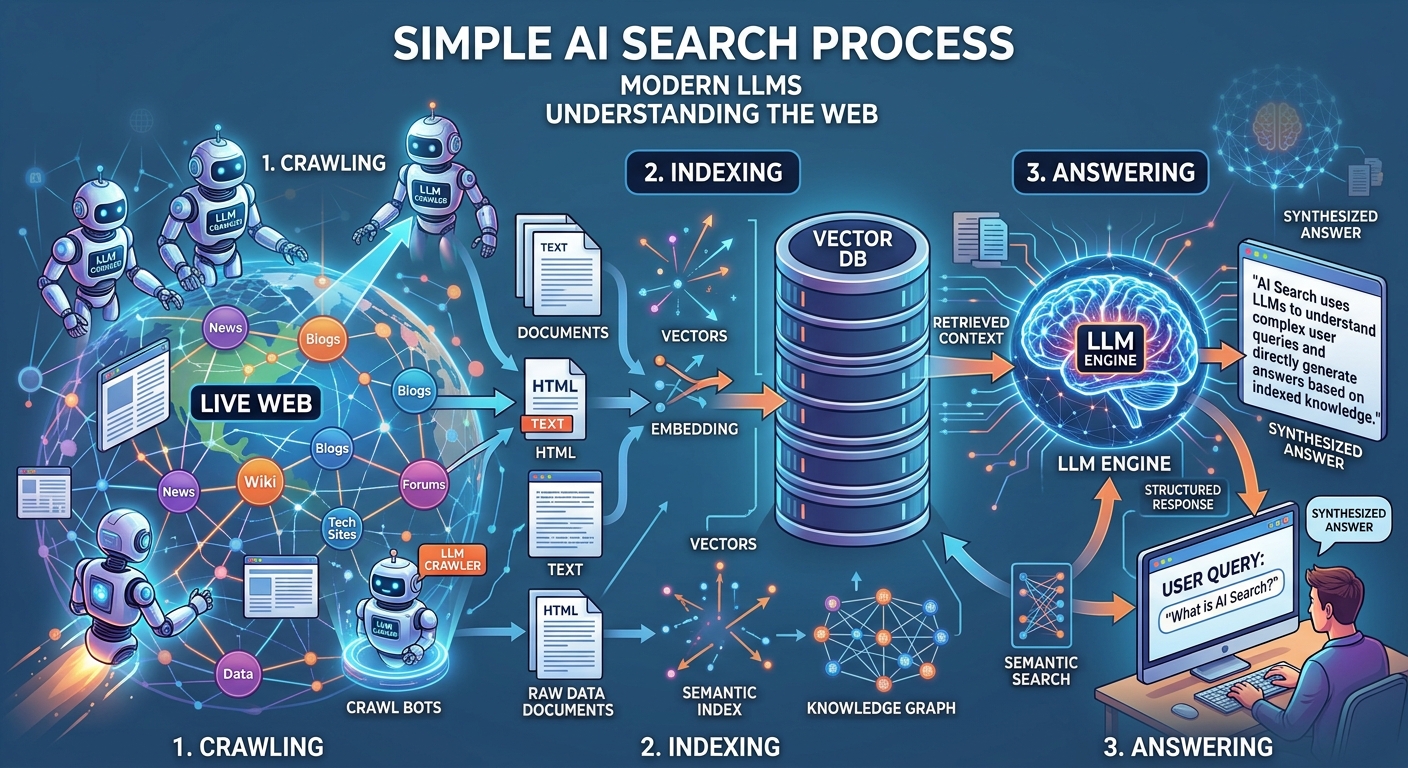
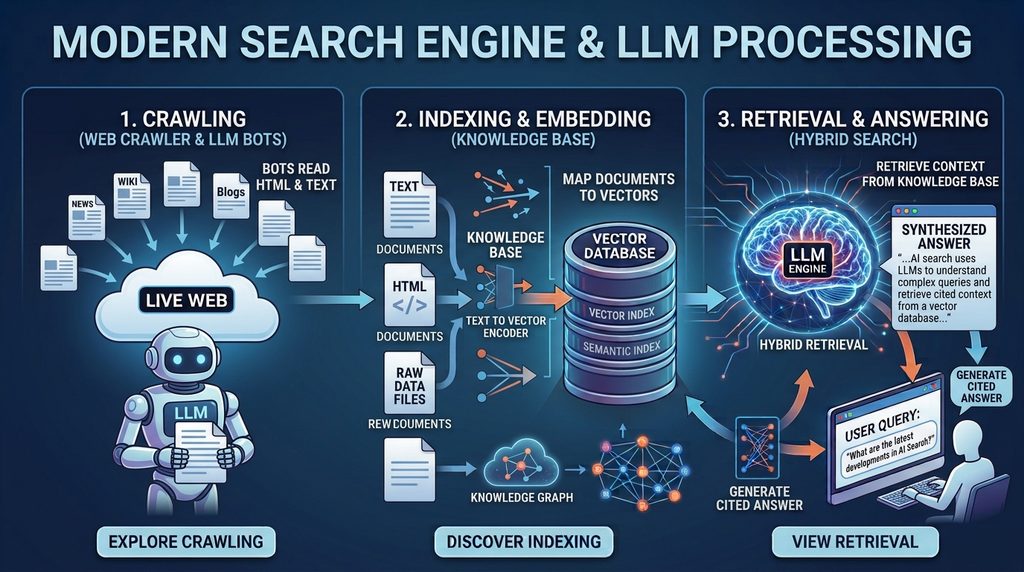
Every AI search tool — Google’s AI Overviews, Perplexity, or a ChatGPT search — follows roughly the same five steps behind the scenes:
Crawl — a bot visits your page and reads the rendered content, similar to classic search, but it pays extra attention to clean HTML structure and structured data.
Chunk — instead of treating your page as one big block, the system splits it into smaller sections (usually 200–500 words) called passages.
Embed — each passage gets converted into a vector: a list of numbers that represents its meaning.
Index — those vectors get stored in a database built for this kind of search, alongside metadata and links to related concepts (a “knowledge graph”).
Retrieve & Generate — when someone asks a question, their question gets turned into a vector too, the system finds the closest-matching passages, and an AI model turns them into one written answer.
Here’s the part that matters most for your content strategy, you’re no longer competing page-against-page. You’re competing passage-against-passage — your one section on shipping costs is competing directly against every other site’s section on shipping costs, not against their whole page.
And this isn’t just theory. Semrush’s tracking shows AI Overviews now show up on roughly 16% of Google searches as of November 2025, after peaking near 25% earlier that year. Even more telling: one study of ChatGPT citations found that pages sitting at position 21 or lower in classic search — well off page one — still got cited almost 90% of the time, as long as the passage itself gave a clear, quotable answer. Ranking on page one still helps, but it’s no longer required to get quoted by an AI.
It also matters which bot is doing the crawling. “AI crawler” isn’t just one bot — it’s several, each built by a different company for a slightly different job:
Crawler
Operator
Purpose
Primary Data Source
Renders JavaScript?
GPTBot
OpenAI
Training-data collection
Live crawl for training
No — server-side HTML only
OAI-SearchBot
OpenAI
Search index / citations for ChatGPT search
Live crawl + Bing’s search index
No
ChatGPT-User
OpenAI
On-demand fetch during a live user session
Training data + live web via OAI-SearchBot
No
ClaudeBot
Anthropic
Training-data collection
Live crawl for training
No
Claude (web search enabled)
Anthropic
Real-time answer grounding
Training data + Brave Search index (Anthropic’s search partner)
No
PerplexityBot
Perplexity
Real-time retrieval at query time
Perplexity’s own real-time index
No
Googlebot (AI Overviews)
Google
Classic crawl, reused for AI Overviews
Google’s own search index
Yes — full rendering
Gemini
Google
Conversational search grounding
Training data + Google’s search index
Varies by surface
Here’s why that’s not just trivia: if you want to show up in ChatGPT, your content also needs to do well in Bing’s index — that’s the live-web source OAI-SearchBot pulls from, not Google’s. Claude works the same way but through Brave Search instead. So a site can be perfectly optimized for Google and still be invisible to someone asking Claude a question with web search turned on.
Here’s the practical takeaway: unlike Googlebot, none of these AI crawlers can run JavaScript. If your main content — the actual text an AI would want to quote — only appears after the page loads via React, Vue, or a similar framework, these bots simply never see it. It doesn’t matter how nice the page looks to a person, or even to Googlebot. Making sure your content is there in the raw HTML (through server-side rendering or a static site) isn’t a nice-to-have for AI search visibility — for these bots, it’s the only thing that works.
This is a distinct problem from Next.js hydration issues, and it’s worth not conflating the two. A hydration mismatch happens when the HTML a Next.js server sends doesn’t match what React expects to render client-side — the content is technically present in the raw HTML that AI crawlers read, but the mismatch can trigger console errors, layout shifts, and in some cases a full client-side re-render that silently swaps the content after load. Since Google’s own crawler does render JavaScript and factors Core Web Vitals like CLS into how it evaluates a page, a hydration mismatch can still hurt AI Overview eligibility even though the AI-only crawlers technically saw the correct initial HTML. Fixing hydration errors and fixing JavaScript-only content injection are two separate audits, and a site can pass one while failing the other.
Information Retrieval Models vs Traditional Indexing
Classic search used something called an inverted index — basically a giant lookup table matching keywords to the pages that contain them. Older ranking systems like TF-IDF or BM25 scored pages mostly by how often and where a keyword appeared, plus how many other sites linked to it.
AI search works differently — it uses dense retrieval. Your question and every passage on the web get placed in the same “meaning space,” and closeness in that space (measured as cosine distance) decides what’s relevant. Two passages can use almost none of the same words and still be treated as a great match, as long as they mean roughly the same thing. That’s how an AI can answer your question using a paragraph that never uses your exact wording.
Most real-world systems don’t pick just one approach — they blend both. This is called hybrid retrieval: combine a classic keyword score (BM25) with a meaning-based vector score, then re-rank the combined results before generating an answer. Knowledge graphs add a third layer on top, linking related concepts together so the system can tell the difference between, say, “Python” the programming language and “python” the snake, based on the surrounding context rather than word similarity alone.
Strategic Implementation & Best Practices for Engineers
Optimizing for AI search means making sure your content and your site’s technical setup survive every step of that five-step process above — not just step one.
Start by giving crawlers clear signals about who wrote the content and what it’s about, instead of leaving the AI to guess from the prose alone:
json
{
  "@context": "https://schema.org",
  "@type": "TechArticle",
  "headline": "What is AI Search? How Modern LLMs Crawl & Index the Web",
  "about": [
    { "@type": "Thing", "name": "Vector Embeddings" },
    { "@type": "Thing", "name": "Knowledge Graphs" },
    { "@type": "Thing", "name": "Information Retrieval" }
  ],
  "proficiencyLevel": "Expert",
  "dependencies": "Vector database, embedding model API",
  "author": {
    "@type": "Person",
    "name": "Tanvir Ahsan",
    "jobTitle": "Enterprise SEO & AI Search Strategist",
    "knowsAbout": ["Generative Engine Optimization", "Vector Search", "Semantic SEO"]
  }
}
Here’s a simple example of what happens behind the scenes. Say you run an online cookware store and want your product pages to show up when someone asks ChatGPT “what’s a good cast iron skillet for beginners.” This Python code takes a product description, turns it into a vector, and stores or searches it — which is basically what an AI search engine is doing to your published pages:
python
import os
from openai import OpenAI
from pinecone import Pinecone

client = OpenAI(api_key=os.environ["OPENAI_API_KEY"])
pc = Pinecone(api_key=os.environ["PINECONE_API_KEY"])
index = pc.Index("cookware-product-catalog")

def embed_chunk(text: str) -> list[float]:
    response = client.embeddings.create(
        model="text-embedding-3-large",
        input=text
    )
    return response.data[0].embedding

def index_product(sku: str, description: str, url: str, entity_tags: list[str]):
    vector = embed_chunk(description)
    index.upsert(vectors=[{
        "id": sku,
        "values": vector,
        "metadata": {"url": url, "text": description, "entities": entity_tags}
    }])

# Example: indexing a product page for AI shopping assistants
index_product(
    sku="CI-SKILLET-10IN",
    description="10-inch pre-seasoned cast iron skillet, ideal for beginners. "
                 "Works on induction, gas, electric, and open flame. "
                 "Naturally non-stick surface that improves with use.",
    url="https://example-cookware.com/products/10in-cast-iron-skillet",
    entity_tags=["cast iron skillet", "beginner cookware", "induction-safe"]
)

def retrieve_top_k(query: str, k: int = 5):
    query_vector = embed_chunk(query)
    results = index.query(vector=query_vector, top_k=k, include_metadata=True)
    return [(match["score"], match["metadata"]["url"]) for match in results["matches"]]

# Example: this is roughly what happens when someone asks an AI
# shopping assistant "best cast iron skillet for a beginner"
retrieve_top_k("best cast iron skillet for a beginner")
Writing in clean, self-contained sections (one idea per 200–400 words, under a clear heading) makes it much easier for this chunking step to pull out your content cleanly. A section that jumps between several unrelated ideas turns into a messy, unclear vector — and messy vectors rarely make it into the AI’s shortlist of best matches.
Edge Cases, Performance Tuning & Scalability
Not every retrieval method performs the same, and the differences get bigger as more people use the system at once. Here’s how the three main approaches compare on a standard test:
Retrieval Method
Recall@10
Mean Reciprocal Rank
Avg. Query Latency
Sparse (BM25 only)
0.61
0.42
8ms
Dense (vector only)
0.78
0.58
35ms
Hybrid (BM25 + vector + re-rank)
0.89
0.71
60ms
Hybrid retrieval gives the best results, but it’s almost twice as slow as vector-only search. That’s exactly why most AI search products only re-rank the top 20–50 candidates instead of the whole index — it’s a balance between accuracy and speed. If you’re building or evaluating one of these systems yourself, that cutoff number is the one setting most worth tuning: too small and you miss good matches, too large and answers start to feel slow.
The end-to-end pipeline, from crawl to generated answer, looks like this:
Looking at the crawler table above, most teams will want control over exactly which AI bots can access which parts of the site — for example, letting the citation-focused bots in while keeping training-only bots away from private or paywalled pages:
At scale, the real bottleneck usually isn’t the embedding model itself — it’s how quickly the index gets updated. If your site publishes a new page but the vector index doesn’t pick it up for hours or days, that page is invisible to AI search during that whole window, no matter how good it is. This is the same underlying problem as render-delay indexing issues, and it’s worth checking how long it actually takes a new page to show up, rather than assuming it’s as fast as classic search.
Worth separating from the indexed-retrieval pipeline above: MCP (Model Context Protocol) is a different pattern entirely. Rather than pre-embedding your content into a static vector index ahead of time, MCP lets an AI agent connect directly to a live tool or data source — a database, an API, a search service — and pull current information at the moment a question is asked. An AI assistant answering through an MCP-connected search tool isn’t matching against a pre-built index at all; it’s querying your system live, the same way a person would call an API. That has a real implication for anything transactional (pricing, inventory, availability): a stale vector index is a known problem with a known fix, but a live MCP connection depends entirely on the underlying service being fast, available, and returning clean, well-structured data on request.
Query Fan-Out: Why One Question Becomes Many Retrievals
A single question rarely turns into just one search behind the scenes. Most AI search systems do something called query fan-out: they break your question into several smaller, related questions, look up passages for each one separately, then combine everything into one answer. Ask “what is AI search and how does it work,” and the system might quietly also search for “vector embeddings,” “retrieval-augmented generation,” and “AI search vs SEO” — then blend all of that into the final response.
What this means in practice: a page that only targets its main keyword is only fighting for a small slice of the opportunity. Content that also answers the obvious follow-up questions around a topic — what it is, how it compares to alternatives, how it actually works — has more chances of getting pulled into the final answer, even when it never directly targets the exact phrase someone typed.
Future Evolution & Measuring Long-Term Organic ROI
AI search doesn’t stay still. The models, the ranking methods, and how citations get decided keep changing at every major provider. That means the old habit of just checking your keyword rankings won’t tell you much anymore — you need to know whether you’re actually being cited.
This is what a specialized generative engine optimization agency focuses on: regularly checking which of your passages are getting picked up, by which AI engines, for which questions — and fixing the ones that aren’t.
Key Performance Indicators & AI Citation Tracking
Regular rank tracking doesn’t work well here, because there’s no fixed position on the page to track anymore. This is really what AI search optimization is about — measuring and improving different signals instead of a rank number.
Citation Share — how often your site actually gets cited in an AI-generated answer (across Google AI Overviews, Perplexity, ChatGPT, and so on), out of all the questions you’re tracking.
Passage Retrieval Rate — how often your specific sections get pulled into the shortlist of candidates, whether or not they end up quoted in the final answer.
Semantic Clustering Coverage — how wide a range of related questions your content shows up for, which tells you how well it covers a full topic instead of just one narrow phrase.
Zero-Click Attribution — the lift in direct traffic or brand searches that comes from being cited, since an AI citation rarely leads to an actual click.
Tracking this well usually needs a dedicated AI search visibility tool — a normal rank tracker has no way to notice that your content got quoted inside a generated answer. Think of it like the difference between “did my ad get clicked” and “did someone mention my product in a conversation they had with a friend” — the second one needs a completely different kind of listening. Purpose-built AI search monitoring tools track citation frequency, passage-level retrieval, and visibility engine-by-engine (Google AI Overviews vs. Perplexity vs. ChatGPT), because a site can be cited constantly in one engine and never show up at all in another, even using the exact same content.
None of this works in isolation from what happens off your own site, either. AI systems look at what other trustworthy sites say about you, not just what you say about yourself — think of it like a job reference. You can write the most impressive résumé in the world, but if nobody else vouches for you, it carries less weight. Mentions and links from relevant publications, a consistent, accurate profile across places like Wikipedia, and genuinely helpful (not promotional) participation in the communities where people discuss your topic — all of that builds the kind of trust an AI system needs before it treats you as a source worth citing. Structuring your content well determines whether it can be found. This off-page trust is a big part of whether it gets believed once it is.
Keeping an eye on these numbers over a 90-day stretch is what separates a page that got lucky once from a site building real, lasting authority.
Ready to Audit Your AI Search Visibility?
If you don’t actually know how often your content gets picked up and cited by AI search engines, you’re flying blind. Start with the Answer Engine Diagnostic ($1,500) for a full check of your citations and passage-level visibility, or scope out a full Enterprise GEO Blueprint for ongoing, long-term authority building.
Frequently Asked Questions
What is the difference between AI search and traditional SEO? Traditional SEO ranks whole pages using keywords and backlinks. AI search picks out individual passages using vector embeddings and meaning-based matching, then blends them into one answer — so the real competition happens at the passage level, not the whole-page level.
How do LLMs decide which sources to cite in an AI Overview? LLMs cite the passages that come back as the closest matches in the vector index, usually after a re-ranking step that blends keyword relevance, meaning-based similarity, and how confident the system is in the source’s authority.
Can a page rank well in Google but be invisible to AI search? Yes, and it happens more than you’d think. Imagine a well-written page that isn’t broken into clear, self-contained sections, or a fast-moving site whose vector index hasn’t caught up with a recent update — either one can rank normally in classic Google search while never once showing up in an AI-generated answer.
What is Generative Engine Optimization (GEO)? GEO means shaping your content, your metadata, and your technical setup so AI systems can actually find and cite it — as opposed to optimizing purely for old-school ranking algorithms.
What is AI search optimization? AI search optimization is the day-to-day work of making sure AI systems can find, understand, and quote your content in their answers. That includes writing in clear passages, adding structured data, making sure AI crawlers can actually see your pages, and regularly checking whether you’re being cited.
How do you track AI search engine citations? You track citations by regularly asking the AI engines you care about — Google AI Overviews, Perplexity, ChatGPT — a set list of questions, and logging whether your site shows up in the answer each time. A normal rank tracker can’t do this, since it has no way to see inside a generated answer.
How do you improve brand visibility in AI search? Break your content into clean, self-contained sections; make sure AI crawlers can actually read your pages (server-side rendering, not just JavaScript); add structured data with clear author and topic signals; and check your citation rate on each AI engine separately, since they don’t all behave the same.
What is query fan-out in AI search? Query fan-out is when an AI system quietly breaks your one question into several smaller related questions, searches for each separately, then combines everything into one answer. For example, asking “how do I train for a 5K” might silently fan out into searches for beginner running plans, injury prevention, and pacing strategy — and content that covers those angles has a better shot at being pulled in, even if it never uses the exact words “train for a 5K.”
Does a Next.js hydration error affect AI search visibility? It can, but differently than a fully JavaScript-rendered page. The content is technically present in the raw HTML AI crawlers read, but a hydration mismatch can cause layout shifts and console errors that hurt Core Web Vitals, which Google’s crawler does factor in when it renders a page for AI Overviews — so hydration bugs and JavaScript-only content injection need separate fixes.
Is ChatGPT a web crawler? No, ChatGPT itself isn’t a crawler. OpenAI operates separate bots for that: GPTBot collects training data, OAI-SearchBot builds the live search index ChatGPT draws from, and ChatGPT-User fetches a specific page in real time only when a live user session needs it. ChatGPT the chat product never crawls the web directly — it relies on those three bots and, for some queries, Bing’s index.
What is MCP (Model Context Protocol) and how does it relate to AI search? MCP lets an AI agent connect directly to a live tool or data source, like a database or API, and pull current information at the moment a question is asked, instead of matching against a pre-built vector index. It matters most for transactional information like pricing or availability, where a static index would otherwise go stale.
Most website owners think about one crawler: Googlebot. They configure their robots.txt for it, check their indexing status in Google Search Console, and measure success by Google rankings.
Meanwhile, their site is being visited — regularly, silently — by GPTBot, PerplexityBot, ClaudeBot, OAI-SearchBot, and Bingbot. Each of these crawlers powers a different AI search product. Each has different capabilities. Each makes different decisions about what content to use and what to ignore.
Optimizing for Googlebot alone is no longer sufficient. This article maps how each major crawler works, where they differ, and what that means for building a site that is visible across all of them.
How Googlebot Processes Your Website
Googlebot is the most sophisticated web crawler in existence. Understanding its full workflow reveals why it remains the benchmark — and why even its sophistication creates specific problems that AI crawlers do not share.
Step 1: Discovery
Googlebot discovers URLs through three main channels:
XML sitemaps submitted via Google Search Console
Internal links followed from already-known pages
External links from other sites pointing to yours
A URL that does not appear in a sitemap and has no links pointing to it is effectively invisible to Googlebot. Discovery is the prerequisite for everything that follows.
Step 2: Fetching
When Googlebot visits a URL, it sends an HTTP GET request. Before fetching, it checks your robots.txt file to confirm the URL is allowed. If disallowed, it stops immediately — no fetch, no index.
The fetch retrieves whatever the server returns: typically an HTML document, plus the headers. This raw server response is what Googlebot receives first.
Step 3: Rendering — The Two-Wave System
This is where Googlebot diverges most significantly from AI crawlers, and where much of the confusion about JavaScript and SEO originates.
Wave 1 — Immediate: Googlebot processes the raw HTML from the server response right away. Any content present in that initial HTML is indexed immediately. This is fast, reliable, and consistent.
Wave 2 — Delayed: Googlebot queues the page for full JavaScript rendering. A headless Chromium instance eventually executes the page’s JavaScript, builds the complete DOM, and that rendered version is indexed. This wave can happen hours, days, or even weeks after Wave 1 — and lower-priority pages may wait longer.
The consequence: content that only exists after JavaScript execution may be indexed eventually, but not quickly. For time-sensitive content, or for sites that rely entirely on JavaScript rendering, this delay is a genuine competitive disadvantage.
Step 4: Indexing
After rendering, Googlebot’s systems analyze the content — text, headings, links, images, structured data, metadata — and store it in Google’s search index. The page is associated with topics, entities, and queries it appears relevant to.
Not every fetched page is indexed. Pages Google judges as low-quality, thin, duplicated, or irrelevant may be crawled but not stored. The noindex directive can also explicitly prevent indexing.
Step 5: Ranking
When a user queries Google, the ranking system evaluates all indexed pages relevant to that query and assigns positions based on hundreds of signals — E-E-A-T, PageRank, Core Web Vitals, relevance, freshness, and many more.
Googlebot’s defining characteristic: it is patient, sophisticated, and persistent. It will retry pages, attempt JavaScript rendering, re-evaluate content over time. It is the most forgiving crawler — and even it has limits that simpler AI crawlers do not approach.
How AI Crawlers Process Your Website
AI crawlers share a common workflow that is simpler than Googlebot’s — and that simplicity is the key fact that shapes everything about AI visibility optimization.
The Common AI Crawler Workflow
Receive a URL to fetch (from a sitemap, a link, or a retrieval query)
Send an HTTP GET request
Check robots.txt for permission
Receive the server’s HTML response
Extract text content from the HTML
Store or use that content (for training or for real-time answer generation)
That is the complete workflow. There is no rendering queue. There is no headless browser. There is no Wave 2. What arrives in the HTTP response is what the crawler sees — nothing more.
GPTBot (OpenAI)
GPTBot serves two purposes: collecting training data for OpenAI’s language models, and supporting real-time retrieval for ChatGPT Search through its companion crawler OAI-SearchBot.
Does not execute JavaScript
Respects robots.txt — you can block it with User-agent: GPTBot / Disallow: /
Identifies itself via user-agent string GPTBot
Crawl frequency: periodic, not continuous
Blocking GPTBot prevents your content from being used in OpenAI model training but does not block OAI-SearchBot (ChatGPT Search retrieval). These are separate bots with separate user-agent strings — a distinction most site owners don’t realize exists.
OAI-SearchBot (OpenAI)
OAI-SearchBot is OpenAI’s real-time retrieval crawler, specifically powering ChatGPT Search. When a user asks ChatGPT Search a question, OAI-SearchBot fetches relevant pages at query time to inform the answer.
Does not execute JavaScript
Operates in near-real time at query time
Speed-sensitive — slow pages may time out and be skipped
Separate from GPTBot: blocking one does not block the other
PerplexityBot (Perplexity AI)
PerplexityBot is a pure retrieval crawler — Perplexity AI does not train its own foundational model in the way OpenAI does. Every query triggers a real-time web fetch.
Does not execute JavaScript
Extremely speed-sensitive: Perplexity’s product promise is instant answers, so pages that respond slowly are deprioritized
High crawl frequency relative to other AI bots — Perplexity queries happen continuously
Fresh content receives priority: <lastmod> dates in sitemaps influence which pages get recrawled
ClaudeBot (Anthropic)
ClaudeBot supports Anthropic’s model training and Claude’s web access capabilities.
Does not execute JavaScript
Respects robots.txt
HTML-only, identical behavior pattern to GPTBot
Bingbot (Microsoft)
Bingbot powers both Bing’s traditional search index and Microsoft Copilot’s answer engine. Of all the AI-adjacent crawlers, Bingbot has the most Googlebot-like capabilities — it has limited JavaScript rendering ability, though far less sophisticated than Googlebot’s two-wave system.
Limited JavaScript rendering (less capable than Googlebot)
Powers both Bing rankings and Copilot citations
Respects robots.txt
Following standard Bing SEO practices largely aligns with Copilot visibility
Rendering Differences: The Critical Comparison
Crawler
JS Execution
Rendering Model
Powered Product
Googlebot
Yes (delayed)
Two-wave
Google Search + AI Overviews
OAI-SearchBot
No
HTML-only
ChatGPT Search
GPTBot
No
HTML-only
OpenAI training
PerplexityBot
No
HTML-only
Perplexity AI
ClaudeBot
No
HTML-only
Anthropic training
Bingbot
Limited
Partial
Bing Search + Copilot
The pattern is unambiguous: every AI-powered product except Google’s relies on HTML-only crawlers. JavaScript-rendered content is invisible to all of them.
This creates a stark implication. A site built with client-side rendering may:
Eventually rank on Google (after Wave 2 rendering, which may take weeks)
Never appear in ChatGPT Search answers (OAI-SearchBot sees nothing)
Never appear in Perplexity answers (PerplexityBot sees nothing)
Never appear in Claude’s web access responses (ClaudeBot sees nothing)
Appear partially in Copilot (Bingbot’s limited rendering may catch some content)
Five products, five audiences, one architectural decision determining visibility across all of them.
Indexing Differences: Persistent vs Real-Time
Beyond rendering, the crawlers differ fundamentally in how they use what they collect.
Google’s Persistent Index
Googlebot feeds a persistent, continuously updated search index. When a page is crawled and indexed, it remains in the index until Googlebot recrawls and re-evaluates it. Rankings fluctuate as the index is refreshed, but indexed pages don’t disappear overnight.
This persistence means older content with strong authority signals can maintain rankings for years. Freshness matters for some queries but not all.
AI Training Crawlers
GPTBot and ClaudeBot collect content that eventually becomes part of model training datasets. This process is periodic and non-real-time — content gathered today contributes to future model training, not to answers being generated right now. There is a meaningful lag between a page being crawled and that content influencing model knowledge.
For most practical purposes, training crawlers are about the long-term knowledge base of the model, not immediate discoverability.
AI Retrieval Crawlers
OAI-SearchBot and PerplexityBot operate in a completely different mode: they fetch pages at the moment a user submits a query. There is no persistent index in the traditional sense — the retrieval system fetches, processes, and uses content on demand.
This real-time model has two implications:
Freshness is critical. A page updated today can be cited in a Perplexity answer today. A page with stale <lastmod> dates may be deprioritized in favor of more recently updated sources.
Speed determines inclusion. A page that takes 4 seconds to respond may time out during a real-time retrieval fetch. Crawl budget is effectively replaced by response-time tolerance — if your page doesn’t respond fast enough, it simply isn’t included.
Why the Same Page Can Rank on Google But Be Invisible to AI Systems
This is the scenario that confuses most site owners — and it has a precise explanation.
Consider a page built with client-side rendering:
Googlebot Wave 1 fetches the empty HTML shell → nothing indexed yet
Googlebot Wave 2 (days later) renders the JavaScript → full content indexed → page eventually ranks
OAI-SearchBot fetches the empty HTML shell → no content extracted → page never cited in ChatGPT Search
PerplexityBot fetches the empty HTML shell → no content extracted → page never cited in Perplexity
ClaudeBot fetches the empty HTML shell → no content for training → page absent from Claude’s knowledge base
The page ranks on Google because Google invested the resources to render it. It is invisible to AI answer engines because they do not make that investment.
This is why Google rankings are no longer a reliable proxy for AI visibility. The two systems evaluate content through fundamentally different mechanisms, and a site architecture that satisfies Google’s two-wave process may completely fail the HTML-only requirement of every AI crawler.
Best Practices for Multi-Crawler Optimization
Optimizing for all crawlers simultaneously is simpler than it sounds, because all crawlers share a common requirement: complete, accessible HTML in the server response. Meeting the most demanding requirement (HTML-only AI crawlers) automatically satisfies all less demanding ones.
Deliver complete HTML in the server response. Use SSR or SSG for all public-facing content pages. No content should require JavaScript execution to appear. This single requirement addresses the crawlability needs of every crawler simultaneously.
Configure robots.txt deliberately. Review which crawlers you want to allow and which to block. By default, allow all. If you choose to block training crawlers (GPTBot, ClaudeBot), do so explicitly. Remember that blocking GPTBot does not block OAI-SearchBot — use separate directives for each.
Maintain an accurate XML sitemap. Include all important public pages. Keep <lastmod> dates accurate and updated when content changes — this is particularly important for PerplexityBot and other freshness-sensitive retrieval crawlers.
Implement JSON-LD schema in the server-rendered <head>. Structured data delivered server-side reaches every crawler. Schema injected by client-side JavaScript reaches none of the AI crawlers.
Optimize server response time. Target under 800ms TTFB before caching, under 200ms with CDN caching. Retrieval crawlers operating in real time have no tolerance for slow responses.
Monitor bot traffic in server logs. Check which crawlers are actually visiting your site. Look for GPTBot, OAI-SearchBot, PerplexityBot, ClaudeBot, and Bingbot in your access logs. A crawler you have never seen in your logs is a product that has never indexed your content.
The Universal Requirement
Every crawler covered in this article — Googlebot, GPTBot, OAI-SearchBot, PerplexityBot, ClaudeBot, Bingbot — will successfully extract content from a well-structured, server-rendered HTML page.
Not a single one of them requires JavaScript execution to discover, extract, and use your content — as long as it is in the HTML.
Optimize for the simplest crawler. Every more capable crawler benefits automatically.
📈 Deep Dive: Anthropic AI Visibility Audit
Curious how these crawler mechanics apply to the world’s leading AI brands? This comprehensive technical blueprint analyzes anthropic.com and claude.ai across technical SEO, JavaScript rendering, and Generative Engine Optimization (GEO).
Want to see exactly which crawlers are visiting your site — and what they’re finding? The Answer Engine Visibility Diagnostic checks your server logs pattern, robots.txt configuration, and HTML output against every major AI crawler. Delivered automatically, no discovery call required.
If you’ve been paying attention to the search landscape in 2026, you’ve probably started asking a version of the same question: Do I focus on Google, or do I focus on AI search?
It’s the wrong question — but it’s an understandable one. The two systems look different, behave differently, and reward different things. Treating them as competing priorities, however, is a mistake that leads to underinvesting in both.
The right question is: How do Google SEO and AI SEO differ, where do they overlap, and how do I build a strategy that serves both?
This article answers all three. By the end, you’ll understand exactly how each system finds and evaluates content, what the shift from ranking to citation means in practice, and why the most effective digital strategies in 2026 treat AI SEO not as a replacement for traditional SEO but as a required layer on top of it.
How Google Finds Content
Google’s process for surfacing content has three distinct stages: crawling, indexing, and ranking. Understanding each stage clarifies what traditional SEO is actually optimizing for.
Crawling
Googlebot — Google’s automated web crawler — discovers pages by following links across the internet and reading XML sitemaps that websites submit. When Googlebot visits a page, it downloads the HTML (and, with a delay, attempts to render any JavaScript) and stores that raw content for processing.
The practical implication: pages that aren’t linked to, aren’t in sitemaps, or are blocked by robots.txt rules simply don’t enter Google’s awareness. Crawlability is the prerequisite for everything else.
Indexing
Once crawled, Google’s systems analyze the page’s content — text, structure, metadata, images, links — and store it in Google’s index, associating it with the topics and queries it appears to address.
Not every crawled page gets indexed. Pages Google judges as low-quality, duplicate, or irrelevant may be crawled but never stored. The indexed page is what competes in search results.
Ranking
When a user submits a query, Google’s ranking algorithms evaluate every indexed page relevant to that query and assign positions based on hundreds of signals. The most significant include:
PageRank and backlinks: How many credible external sites link to this page, and what is the authority of those sites?
E-E-A-T: Does the content demonstrate Experience, Expertise, Authoritativeness, and Trustworthiness?
Relevance: How closely does the page’s content match the user’s query intent?
Core Web Vitals: Does the page load quickly, remain visually stable, and respond promptly to interaction?
Freshness: For time-sensitive queries, how recently was the content published or updated?
The outcome of this process is a ranked list of links. Users see results, evaluate them, and choose where to click. Traffic flows from Google to your page.
What Google rewards, in summary: relevance to the query, authority signals from backlinks and E-E-A-T, technical quality, and freshness where applicable.
How AI Assistants Find Information
AI-powered search systems — ChatGPT Search, Perplexity AI, Google AI Overviews, Microsoft Copilot, Claude — work through a fundamentally different process. There are two mechanisms at play, and most AI search products use a combination of both.
Trained Knowledge
Large language models (LLMs) are trained on enormous datasets of text gathered from across the internet, books, academic papers, and other sources. This training process encodes a vast amount of factual knowledge directly into the model’s parameters.
When a user asks a question, the model can answer from this trained knowledge without consulting any external source. The information it has access to, however, is frozen at its training cutoff date — it does not update in real time.
Live Retrieval
To address the freshness problem and to ground answers in current sources, most AI search products layer a retrieval system on top of trained knowledge. At query time, a crawler fetches relevant pages from the web, extracts their content, and passes that content to the language model as context for generating the answer.
This is how GPTBot (OpenAI), PerplexityBot, ClaudeBot (Anthropic), and Bingbot operate in the context of AI search products. They are not indexing pages for later ranking — they are fetching pages at the moment a user asks a question, to inform the answer being generated right now.
The Critical Difference: Synthesis, Not Links
Here is where AI search diverges most sharply from Google. Google delivers a list of links — the user decides which to visit. AI assistants synthesize information from multiple sources into a single, direct answer — the user may never visit any source at all.
When an AI system generates a response, it is making decisions about:
Which sources to consult (determined by its retrieval system and trained knowledge)
Which content to paraphrase or quote (determined by relevance and clarity)
Whether to attribute the source (determined by the platform’s citation behavior)
How to present the synthesized answer (determined by the query intent)
Being “found” by an AI assistant means your content was retrieved, understood, and judged useful enough to inform the answer. That process rewards different things than traditional ranking.
Ranking vs Citation: The Core Distinction
This is the conceptual shift that matters most for strategy.
Ranking is about position. Your page competes with other pages for a slot in a list of results. Users see your title, your URL, and a snippet — and they decide whether to click.
Citation is about being understood. Your content is evaluated for whether it can answer a specific question clearly and authoritatively. If it can, it becomes an input to the AI’s synthesized response. You may be named as a source, paraphrased without credit, or used as background context — depending on the platform and the nature of the query.
The implication is significant: being cited requires being understood, not just indexed.
A page can rank #1 on Google because it has excellent backlinks and keyword optimization — yet be ignored by AI systems because its content is vague, poorly structured, or buries the answer under excessive preamble.
Conversely, a page that ranks on page two can be cited regularly by AI assistants because it directly answers a specific question with clear, structured, authoritative content.
The Four Citation Scenarios
Think of every page on your site as falling into one of four categories:
Ranks on Google
Does Not Rank
Cited by AI
Best outcome — visible across both channels
AI-only visibility; brand presence without click traffic
Not Cited by AI
Google traffic only; missing AI channel
Invisible — no meaningful visibility in either system
The goal of a combined SEO and GEO strategy is to move as many important pages as possible into the top-left quadrant: pages that rank and get cited.
What Drives Citation
The factors most associated with AI citation differ meaningfully from traditional ranking signals:
Directness: Does the content answer the question in the first paragraph, or does it make the reader hunt for the answer?
Structural clarity: Are headings informative? Are lists and tables used to organize comparable information?
Specificity: Does the content provide concrete details, data, and examples — or stay at a vague, general level?
Completeness: Does the page thoroughly cover its topic, or does it skim the surface?
Authority signals: Is the source credible based on external mentions, author credentials, and consistency of expertise?
Freshness: For time-sensitive queries, when was the content last updated?
Similarities and Differences: A Direct Comparison
Despite their structural differences, Google SEO and AI SEO share more common ground than they diverge. Both reward the same foundational investments — the difference lies in emphasis and measurement.
Dimension
Google SEO
AI SEO (GEO)
Discovery method
Crawl → index → rank
Crawl → retrieve at query time
What the user sees
Ranked list of links
Synthesized answer with cited sources
Success metric
Ranking position, organic traffic
Citation frequency, answer inclusion
Content signals
Keywords, backlinks, E-E-A-T
Clarity, structure, specificity, authority
Technical needs
Fast, crawlable, mobile-friendly
Fast, crawlable, server-rendered HTML
Freshness weight
High for news; lower for evergreen
High for retrieval-based AI systems
Structured data
Enhances rich results
Gives AI explicit machine-readable context
Measurement tools
Search Console, rank trackers
AI querying, brand monitoring, referral traffic
Where they fully overlap: both systems reward fast-loading pages, accessible HTML, genuine topical authority, accurate structured data, and well-written content that serves the user’s actual intent.
Where they diverge: Google tolerates some structural ambiguity and rewards keyword strategy in ways AI systems do not. AI systems weight directness and structural clarity more heavily than keyword placement. And critically, AI systems cannot evaluate content they cannot access in plain HTML — a JavaScript-rendered page that Google eventually indexes may be completely invisible to AI crawlers.
Why Both Matter — And Why You Should Not Choose
The temptation, having understood the differences, is to declare one system more important than the other and concentrate resources there.
Resist it.
Google still dominates search traffic volume. For the vast majority of businesses, Google-driven organic traffic remains the largest single digital acquisition channel. Abandoning traditional SEO practices in favor of GEO alone would be a significant mistake.
AI search is growing rapidly and influencing decisions. Even when users don’t click through from an AI answer, the brand mentions, recommendations, and citations that AI systems produce influence perception and downstream search behavior. Being absent from AI-generated answers is increasingly a competitive disadvantage.
The investment is largely shared. A site that is technically sound (fast, server-rendered, crawlable), content-rich (thorough, structured, authoritative), and built with genuine topical depth will perform well in both systems. The marginal cost of adding GEO to a strong SEO program is far lower than building either from scratch.
The compounding effect is real. A page that ranks well on Google and gets cited by AI systems earns visibility through two independent channels. Over time, AI citation can also drive the external mentions and backlinks that strengthen Google rankings — the two systems reinforce each other.
The practical recommendation: treat GEO as additive optimization on top of a solid SEO foundation, not as a competing strategy.
What This Means for Your Strategy Right Now
Understanding the distinction between ranking and citation leads to three immediate strategic implications:
1. Audit your content for citability, not just keyword coverage. Review your highest-traffic pages and ask: does this page answer a specific question directly, in the first paragraph, in clear and structured language? If not, it may rank on Google but fail to earn AI citations. Updating those pages for directness is one of the highest-leverage content investments available.
2. Verify your technical accessibility for AI crawlers. Google will eventually render your JavaScript. GPTBot and PerplexityBot will not. If your content depends on client-side JavaScript to appear, you have a GEO problem regardless of your Google rankings. Confirm that your pages deliver full content in the server response — that single technical check can reveal a significant visibility gap.
3. Expand your success metrics. If your team measures only rankings and organic traffic, you are missing the AI citation channel entirely. Begin querying ChatGPT Search, Perplexity, and Claude for your target topics on a regular basis. Note which sources they cite. Identify where your content should appear but doesn’t. That gap is your GEO opportunity.
The New Rules of Online Discovery
Search in 2026 operates through two parallel systems: Google’s ranking engine and AI’s citation engine. They share technical foundations, reward similar content quality, and serve the same users — but they measure success differently and respond to different optimization signals.
Ranking is about competing for a position in a list. Citation is about being understood well enough to inform an answer.
Both matter. Neither is sufficient alone.
The businesses building visibility across both channels — by combining strong SEO fundamentals with deliberate GEO practices — are the ones establishing compounding advantages as AI search continues to grow.
If you’ve been paying attention to the search landscape in 2026, you’ve probably started asking a version of the same question: Do I focus on Google, or do I focus on AI search?
It’s the wrong question — but it’s an understandable one. The two systems look different, behave differently, and reward different things. Treating them as competing priorities, however, is a mistake that leads to underinvesting in both.
The right question is: How do Google SEO and AI SEO differ, where do they overlap, and how do I build a strategy that serves both?
This article answers all three. By the end, you’ll understand exactly how each system finds and evaluates content, what the shift from ranking to citation means in practice, and why the most effective digital strategies in 2026 treat AI SEO not as a replacement for traditional SEO but as a required layer on top of it.
How Google Finds Content
Google’s process for surfacing content has three distinct stages: crawling, indexing, and ranking. Understanding each stage clarifies what traditional SEO is actually optimizing for.
Crawling
Googlebot — Google’s automated web crawler — discovers pages by following links across the internet and reading XML sitemaps that websites submit. When Googlebot visits a page, it downloads the HTML (and, with a delay, attempts to render any JavaScript) and stores that raw content for processing.
The practical implication: pages that aren’t linked to, aren’t in sitemaps, or are blocked by robots.txt rules simply don’t enter Google’s awareness. Crawlability is the prerequisite for everything else.
Indexing
Once crawled, Google’s systems analyze the page’s content — text, structure, metadata, images, links — and store it in Google’s index, associating it with the topics and queries it appears to address.
Not every crawled page gets indexed. Pages Google judges as low-quality, duplicate, or irrelevant may be crawled but never stored. The indexed page is what competes in search results.
Ranking
When a user submits a query, Google’s ranking algorithms evaluate every indexed page relevant to that query and assign positions based on hundreds of signals. The most significant include:
PageRank and backlinks: How many credible external sites link to this page, and what is the authority of those sites?
E-E-A-T: Does the content demonstrate Experience, Expertise, Authoritativeness, and Trustworthiness?
Relevance: How closely does the page’s content match the user’s query intent?
Core Web Vitals: Does the page load quickly, remain visually stable, and respond promptly to interaction?
Freshness: For time-sensitive queries, how recently was the content published or updated?
The outcome of this process is a ranked list of links. Users see results, evaluate them, and choose where to click. Traffic flows from Google to your page.
What Google rewards, in summary: relevance to the query, authority signals from backlinks and E-E-A-T, technical quality, and freshness where applicable.
How AI Assistants Find Information
AI-powered search systems — ChatGPT Search, Perplexity AI, Google AI Overviews, Microsoft Copilot, Claude — work through a fundamentally different process. There are two mechanisms at play, and most AI search products use a combination of both.
Trained Knowledge
Large language models (LLMs) are trained on enormous datasets of text gathered from across the internet, books, academic papers, and other sources. This training process encodes a vast amount of factual knowledge directly into the model’s parameters.
When a user asks a question, the model can answer from this trained knowledge without consulting any external source. The information it has access to, however, is frozen at its training cutoff date — it does not update in real time.
Live Retrieval
To address the freshness problem and to ground answers in current sources, most AI search products layer a retrieval system on top of trained knowledge. At query time, a crawler fetches relevant pages from the web, extracts their content, and passes that content to the language model as context for generating the answer.
This is how GPTBot (OpenAI), PerplexityBot, ClaudeBot (Anthropic), and Bingbot operate in the context of AI search products. They are not indexing pages for later ranking — they are fetching pages at the moment a user asks a question, to inform the answer being generated right now.
The Critical Difference: Synthesis, Not Links
Here is where AI search diverges most sharply from Google. Google delivers a list of links — the user decides which to visit. AI assistants synthesize information from multiple sources into a single, direct answer — the user may never visit any source at all.
When an AI system generates a response, it is making decisions about:
Which sources to consult (determined by its retrieval system and trained knowledge)
Which content to paraphrase or quote (determined by relevance and clarity)
Whether to attribute the source (determined by the platform’s citation behavior)
How to present the synthesized answer (determined by the query intent)
Being “found” by an AI assistant means your content was retrieved, understood, and judged useful enough to inform the answer. That process rewards different things than traditional ranking.
Ranking vs Citation: The Core Distinction
This is the conceptual shift that matters most for strategy.
Ranking is about position. Your page competes with other pages for a slot in a list of results. Users see your title, your URL, and a snippet — and they decide whether to click.
Citation is about being understood. Your content is evaluated for whether it can answer a specific question clearly and authoritatively. If it can, it becomes an input to the AI’s synthesized response. You may be named as a source, paraphrased without credit, or used as background context — depending on the platform and the nature of the query.
The implication is significant: being cited requires being understood, not just indexed.
A page can rank #1 on Google because it has excellent backlinks and keyword optimization — yet be ignored by AI systems because its content is vague, poorly structured, or buries the answer under excessive preamble.
Conversely, a page that ranks on page two can be cited regularly by AI assistants because it directly answers a specific question with clear, structured, authoritative content.
The Four Citation Scenarios
Think of every page on your site as falling into one of four categories:
Ranks on Google
Does Not Rank
Cited by AI
Best position — maximum visibility across all channels
Growing channel — AI citations drive some traffic and brand visibility even without Google ranking
Not Cited by AI
Traditional SEO success — traffic from Google only
The goal of a combined SEO and GEO strategy is to move as many important pages as possible into the top-left quadrant: pages that rank and get cited.
What Drives Citation
The factors most associated with AI citation differ meaningfully from traditional ranking signals:
Directness: Does the content answer the question in the first paragraph, or does it make the reader hunt for the answer?
Structural clarity: Are headings informative? Are lists and tables used to organize comparable information?
Specificity: Does the content provide concrete details, data, and examples — or stay at a vague, general level?
Completeness: Does the page thoroughly cover its topic, or does it skim the surface?
Authority signals: Is the source credible based on external mentions, author credentials, and consistency of expertise?
Freshness: For time-sensitive queries, when was the content last updated?
Similarities and Differences: A Direct Comparison
Despite their structural differences, Google SEO and AI SEO share more common ground than they diverge. Both reward the same foundational investments — the difference lies in emphasis and measurement.
Dimension
Google SEO
AI SEO (GEO)
How content is discovered
Crawl → index → rank
Crawl → retrieve at query time, or draw from trained knowledge
What the user sees
A list of ranked links
A synthesized answer, sometimes with cited sources
High for retrieval-based AI (Perplexity); lower for model-trained knowledge
Structured data value
Enhances rich results
Provides explicit machine-readable context for AI systems
Measurement tools
Google Search Console, rank trackers
Manual AI querying, brand monitoring, referral traffic
Where they fully overlap: both systems reward fast-loading pages, accessible HTML, genuine topical authority, accurate structured data, and well-written content that serves the user’s actual intent.
Where they diverge: Google tolerates some structural ambiguity and rewards keyword strategy in ways AI systems do not. AI systems weight directness and structural clarity more heavily than keyword placement. And critically, AI systems cannot evaluate content they cannot access in plain HTML — a JavaScript-rendered page that Google eventually indexes may be completely invisible to AI crawlers.
Why Both Matter — And Why You Should Not Choose
The temptation, having understood the differences, is to declare one system more important than the other and concentrate resources there.
Resist it.
Google still dominates search traffic volume. For the vast majority of businesses, Google-driven organic traffic remains the largest single digital acquisition channel. Abandoning traditional SEO practices in favor of GEO alone would be a significant mistake.
AI search is growing rapidly and influencing decisions. Even when users don’t click through from an AI answer, the brand mentions, recommendations, and citations that AI systems produce influence perception and downstream search behavior. Being absent from AI-generated answers is increasingly a competitive disadvantage.
The investment is largely shared. A site that is technically sound (fast, server-rendered, crawlable), content-rich (thorough, structured, authoritative), and built with genuine topical depth will perform well in both systems. The marginal cost of adding GEO to a strong SEO program is far lower than building either from scratch.
The compounding effect is real. A page that ranks well on Google and gets cited by AI systems earns visibility through two independent channels. Over time, AI citation can also drive the external mentions and backlinks that strengthen Google rankings — the two systems reinforce each other.
The practical recommendation: treat GEO as additive optimization on top of a solid SEO foundation, not as a competing strategy.
What This Means for Your Strategy Right Now
Understanding the distinction between ranking and citation leads to three immediate strategic implications:
1. Audit your content for citability, not just keyword coverage. Review your highest-traffic pages and ask: does this page answer a specific question directly, in the first paragraph, in clear and structured language? If not, it may rank on Google but fail to earn AI citations. Updating those pages for directness is one of the highest-leverage content investments available.
2. Verify your technical accessibility for AI crawlers. Google will eventually render your JavaScript. GPTBot and PerplexityBot will not. If your content depends on client-side JavaScript to appear, you have a GEO problem regardless of your Google rankings. Confirm that your pages deliver full content in the server response — that single technical check can reveal a significant visibility gap.
3. Expand your success metrics. If your team measures only rankings and organic traffic, you are missing the AI citation channel entirely. Begin querying ChatGPT Search, Perplexity, and Claude for your target topics on a regular basis. Note which sources they cite. Identify where your content should appear but doesn’t. That gap is your GEO opportunity.
The New Rules of Online Discovery
Search in 2026 operates through two parallel systems: Google’s ranking engine and AI’s citation engine. They share technical foundations, reward similar content quality, and serve the same users — but they measure success differently and respond to different optimization signals.
Ranking is about competing for a position in a list. Citation is about being understood well enough to inform an answer.
Both matter. Neither is sufficient alone.
The businesses building visibility across both channels — by combining strong SEO fundamentals with deliberate GEO practices — are the ones establishing compounding advantages as AI search continues to grow.
For more than two decades, SEO meant one thing: rank higher on Google. Businesses invested in keywords, backlinks, and technical optimization — all in pursuit of a better position on search engine results pages.
That goal has not disappeared. But in 2026, it is no longer enough.
Artificial intelligence is reshaping how people find information online. Instead of scanning a list of links and clicking through to websites, users are increasingly receiving direct, synthesized answers from AI-powered tools. The question is no longer only where does my page rank? It is also will AI systems trust my content enough to cite it?
This article explains what changed, why it matters, and what your business must do to stay visible in an AI-first search environment.
What Changed in Search
Traditional search presents users with a ranked list of links. A user enters a query, reviews the results, and chooses which website to visit. Traffic flows from the search engine to your page.
AI-powered search works differently. Instead of serving links, AI systems analyze content from multiple sources and generate a direct answer. The user gets a response — sometimes without visiting any website at all.
This is not a future trend. It is already the default experience on tools millions of people use daily: Google AI Overviews, ChatGPT Search, Perplexity AI, and Microsoft Copilot.
The practical consequence is significant. A page that ranks in position one can still lose traffic if an AI summary answers the user’s question before they scroll. Meanwhile, a page that ranks in position eight may be cited by AI systems because it provides the clearest, most authoritative answer.
Website visibility is no longer defined by ranking position alone. It is defined by whether AI systems judge your content trustworthy enough to include in their answers.
The Rise of AI-Powered Discovery
Consider how search behavior is changing. A user researching software in 2022 might search:
“Best accounting software for small businesses”
The same user in 2026 is more likely to ask:
“What accounting software is best for a service business with fewer than 20 employees that needs invoicing and payroll in one tool?”
AI systems can answer this directly — synthesizing information from product pages, reviews, comparison sites, and expert sources — without the user visiting a single website.
This shift has several implications:
Keyword targeting is insufficient on its own. Users phrase queries conversationally, and AI systems interpret intent rather than match exact terms.
Content must answer real questions, not approximate them. Vague, keyword-stuffed content is ignored by AI systems in favor of direct, expert answers.
Brand authority is now a visibility signal. AI systems are more likely to cite sources they have encountered repeatedly across credible contexts — mentions, publications, reviews, and citations all contribute.
The businesses that consistently provide clear, accurate, expert-level answers to specific questions are the ones AI systems will cite. That is the new definition of organic visibility.
Why Rankings Alone Are No Longer Enough
Ranking on page one of Google remains valuable. It should remain part of your strategy. But it is no longer the complete picture of online visibility.
Here is the new reality:
A high-ranking page can lose traffic if an AI summary answers the user’s query above the organic results. Zero-click searches — where users get what they need without clicking — are growing significantly as AI summaries expand.
A lower-ranking page can gain citation visibility if it provides the most specific, well-structured answer to a question. AI systems do not rank-order their sources the way Google does. They select for relevance, clarity, and authority.
This creates both a risk and an opportunity:
Traditional SEO Reality
New AI Search Reality
Position 1 guarantees maximum visibility
Position 1 does not guarantee being cited
Traffic comes from clicks on links
Value also comes from being cited in AI answers
Keyword density signals relevance
Content clarity and specificity signal relevance
Backlinks build authority
Backlinks + citations + mentions build authority
Success measured in rankings
Success measured in rankings and citation frequency
Businesses focused exclusively on traditional ranking metrics are increasingly blind to a growing share of search activity.
Generative Engine Optimization (GEO) is the practice of optimizing content so AI-powered search engines and answer engines can discover, understand, and cite it.
GEO does not replace SEO. It extends it. The same content quality and technical accessibility that help Google rank your pages also help AI systems understand and cite them. But GEO adds a layer of specific practices that traditional SEO does not address.
Creating Authoritative Content
AI systems favor content that demonstrates expertise, depth, and accuracy. A thorough, well-researched 1,500-word answer to a specific question outperforms five generic 300-word posts on loosely related topics. Depth and specificity are the primary currency of GEO.
Structuring Information Clearly
How content is organized determines whether AI systems can extract meaning from it. Clear headings that function as questions, concise opening sentences that answer those questions directly, tables for comparisons, and lists for processes — these structural choices directly influence whether your content gets cited.
AI systems parse HTML sequentially. A well-structured page with logical heading hierarchies (H1 → H2 → H3) and semantic markup gives AI systems an accurate map of your content.
Building Topical Authority
Publishing one excellent piece of content is valuable. Publishing comprehensive, interconnected content across an entire subject area is far more powerful. AI systems recognize topical authority — when a domain consistently provides high-quality information on a subject, it becomes a preferred source.
This is why content clusters (a pillar article supported by deep supporting articles, like this series) are one of the most effective GEO strategies available.
Maintaining Accuracy and Freshness
Outdated or inaccurate content damages credibility with AI systems. Platforms like Perplexity AI weight freshness heavily for time-sensitive queries. Regular content audits and updates signal that your site is a reliable, current source.
Strengthening Brand Signals
AI models are trained on large bodies of text from across the internet. Brands mentioned frequently and positively across credible sources — news articles, industry publications, reviews, and expert citations — carry stronger authority signals into AI systems’ training data.
Digital PR, guest contributions, original research, and thought leadership that earns external citations all build the brand signal that makes AI systems more likely to trust and reference your content.
What Businesses Must Do Next
The shift to AI-powered discovery is not approaching — it is already underway. Businesses that adapt their strategy now will compound their advantage as AI search continues to grow.
The immediate priorities:
Audit your crawlability. Ensure AI crawlers (GPTBot, PerplexityBot, ClaudeBot) can access your content. Check your robots.txt file. Verify your pages deliver complete HTML content in the server response — not via JavaScript that AI crawlers cannot execute.
Shift content strategy toward direct answers. Identify the specific questions your audience is asking. Write content that answers those questions in the first paragraph, then elaborates. Answer-first writing is the single most effective content change you can make for GEO.
Implement structured data. Schema markup (Article, FAQPage, HowTo, Organization) gives AI systems explicit, machine-readable context about your content. This is one of the highest-leverage technical GEO improvements available.
Build topical depth, not just breadth. A content cluster that comprehensively covers a subject area will outperform a scattered collection of one-off posts in AI citation systems.
Measure beyond rankings. Begin monitoring how your brand appears in AI-generated answers. Query ChatGPT, Perplexity, and Claude for your target topics. Track what they say about you and your industry — and whether your content is being cited.
Combine SEO and GEO. Both disciplines share the same foundation: technically accessible, fast, high-quality content. A strong SEO program and a GEO strategy are not competing priorities — they are the same investment applied to two distribution channels.
The New Measure of Online Visibility
The goal of digital marketing has always been to reach the right audience at the moment they need what you offer. For two decades, that meant ranking on Google. In 2026, it also means being the source that AI systems trust enough to cite when generating answers.
The businesses positioned to win are those that prioritize authority, clarity, and technical accessibility — not as separate strategies, but as a unified approach to content that serves both human readers and AI systems equally well.
Rankings still matter. They are not the whole story anymore.
A few years ago, the conversation around “SEO for software engineers” was simple: fix your robots.txt, ensure your URLs are canonical, and don’t break the sitemap.
But as I sit at the intersection of AI Architecture and Technical SEO today, the landscape has fundamentally shifted. Having served as a Technical SEO Specialist at both REEA Digital Limited and SerpCat, and now leading strategies at MonsterClaw LLC, I’ve seen this evolution firsthand. We aren’t just optimizing for a crawler anymore — we are optimizing for Generative Engines.
In a world where ChatGPT, Perplexity, and Gemini are the primary discovery layers, the Technical SEO of yesterday is now the Information Architecture of tomorrow.
🏗️ The Foundation: Why Engineers Are the New SEO Architects
Ben Hoyt once noted that SEO is often seen as a “marketing thing.” At MonsterClaw, we view it as a performance thing.
If your Next.js application isn’t delivering pre-rendered HTML, you’re creating unnecessary friction. Yes, Google can render JavaScript — but why force a billion-dollar crawler to spend its expensive crawl budget on heavy bundles when you can deliver clean, structured HTML on the first response?
The Rule: For a modern engineer, SEO isn’t about keywords — it’s about reducing friction for the crawler.
⚠️ The Architectural Caveat
“Reducing friction” does not mean blindly choosing SSR for everything. SSR shifts rendering load from the client’s browser to your servers. For high-traffic enterprise applications, this means scaling server compute costs and managing edge-caching aggressively.
Furthermore, a fast First Contentful Paint (FCP) is meaningless if your client-side hydration scripts freeze the main thread and spike your Interaction to Next Paint (INP). True engineering excellence means balancing pre-rendering with execution cost — not dogmatically defaulting to SSR because it sounds right.
🛠️ Core Checklist for Technical Excellence
1. SSR & Hydration Strategy
Use Next.js 14+ with App Router. Target an FCP under 1.2s — but don’t stop there. Pair your SSR setup with partial hydration or streaming architectures to keep INP low.
A page that looks loaded but doesn’t respond to user clicks is a failure in both UX and Core Web Vitals. Rendering strategy isn’t a binary SSR/CSR choice; it’s a spectrum of hydration granularity that must be tuned per component.
2. Structured Data (JSON-LD)
This is no longer optional. Schema is the API we provide to search engines and AI systems.
If you aren’t using Person, FAQPage, and SoftwareApplication markup, you’re leaving the interpretation of your content to chance. AI engines rely on structured data far more heavily than traditional crawlers — if your entities aren’t declared, the AI cannot establish your authority.
3. The “Cached-Dynamic” Sitemap
A purely static, manually managed sitemap.xml is dead — but the opposite extreme is also a trap.
Generating a completely live dynamic sitemap on every single crawler request can introduce massive database latency on enterprise sites with millions of nodes. The sweet spot: a headless bridge leveraging ISR (Incremental Static Regeneration) or Redis/edge caching to keep sitemaps near real-time without hammering your production databases.
Real-time accuracy without server cost — that is the engineering target.
🚀 The Next Frontier: GEO (Generative Engine Optimization)
This is where the discipline of AI Architecture intersects with SEO. Traditional SEO focuses on ranking. GEO focuses on citation.
When an LLM synthesizes an answer, it looks for high-authority, well-structured content it can confidently reference. To design for AI discovery, you need two things:
1. Semantic Density Structure content so that an embedding model can cleanly vectorize it. Short, self-contained sections with declarative headings outperform long narrative prose for AI extraction.
2. Knowledge Graph Integration Connect your entities — People, Projects, Brands — using schema so LLMs recognize you as a trustworthy, authoritative source within your domain.
⚖️ The GEO Paradox: The Threat of Zero-Click Searches
As technical architects, we must recognize a systemic risk in optimizing too perfectly for LLMs.
If we structure our JSON-LD and semantic data so precisely that an AI engine like Gemini or Perplexity can synthesize and display our full value proposition directly within its UI — the user has no reason to click through to our site. This is where engineering discipline collides with marketing reality.
The future of GEO isn’t simply about making data easily extractable. It’s about structuring data so that AI engines treat you as the definitive citation, while intentionally designing information loops that compel the user to click the source link for full utility.
Optimize to be cited. Design to be visited.
🏁 Bridging the Gap
At the end of the day, a fast site is a searchable site. Whether you’re building RAG pipelines or optimizing an enterprise WordPress stack.
SEO is a technical discipline masked as a marketing goal.
The engineers who internalize this will build systems that compound their visibility over time — not just in Google, but in every AI layer that sits on top of it.
❓ FAQ: SEO for Software Engineers
Q: Does Google struggle with client-side React? Google can crawl it, but rendering is delayed and expensive. SSR guarantees indexation on the first crawl pass. More precisely: Googlebot’s two-wave rendering system is capable of executing modern JavaScript, but rendering queues introduce an indexing delay. For fast-moving content — news, shifting inventory, time-sensitive pages — SSR ensures the first wave delivers complete content, not a shell.
Q: Does Google struggle if we don’t use SSR? Not technically. The problem isn’t that Google can’t see client-rendered sites — it’s the indexing delay. For evergreen content, that delay may be acceptable. For content where freshness is a ranking or citation signal, SSR removes the risk entirely.
Q: What is the most important tag for an engineer to manage? The <link rel="canonical">. It prevents duplicate content issues that split ranking power across multiple URLs — a problem that compounds at scale and is almost invisible until it costs you.
Q: How does AI change Technical SEO? AI engines like Gemini and ChatGPT rely on structured data (JSON-LD) far more than traditional crawlers do. If your entities aren’t explicitly declared, the AI has no reliable way to establish your authority — it will either guess, attribute incorrectly, or skip your content entirely.
Q: Why use Headless WordPress for SEO? It gives you the best of both worlds: the editorial workflow of WordPress and the performance and DOM control of a Next.js frontend. Content teams stay productive; engineering teams retain full control over rendering, schema, and Core Web Vitals.