For more than two decades, SEO meant one thing: rank higher on Google. Businesses invested in keywords, backlinks, and technical optimization — all in pursuit of a better position on search engine results pages.
That goal has not disappeared. But in 2026, it is no longer enough.
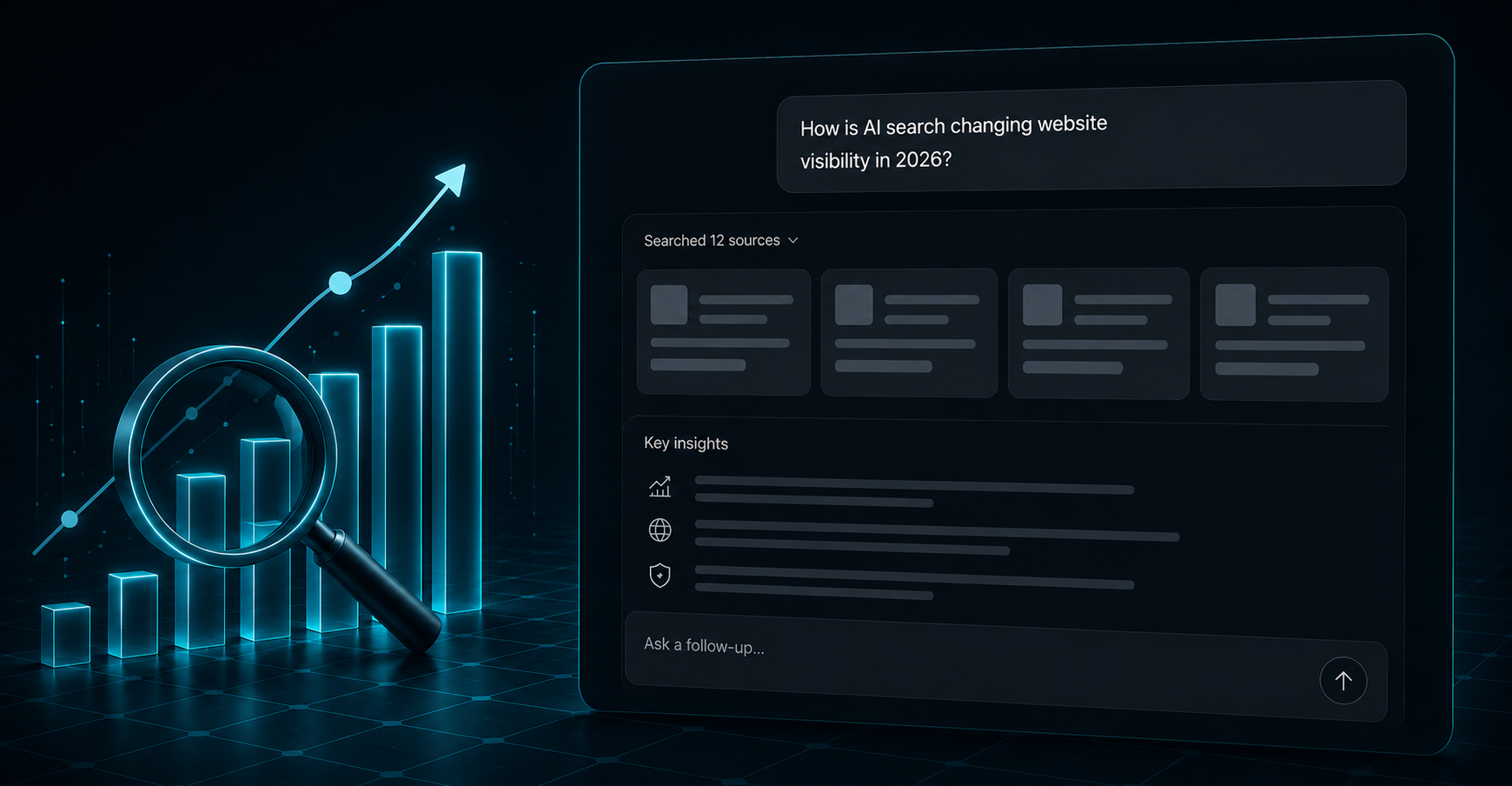
Artificial intelligence is reshaping how people find information online. Instead of scanning a list of links and clicking through to websites, users are increasingly receiving direct, synthesized answers from AI-powered tools. The question is no longer only where does my page rank? It is also will AI systems trust my content enough to cite it?
This article explains what changed, why it matters, and what your business must do to stay visible in an AI-first search environment.
What Changed in Search
Traditional search presents users with a ranked list of links. A user enters a query, reviews the results, and chooses which website to visit. Traffic flows from the search engine to your page.
AI-powered search works differently. Instead of serving links, AI systems analyze content from multiple sources and generate a direct answer. The user gets a response — sometimes without visiting any website at all.
This is not a future trend. It is already the default experience on tools millions of people use daily: Google AI Overviews, ChatGPT Search, Perplexity AI, and Microsoft Copilot.
The practical consequence is significant. A page that ranks in position one can still lose traffic if an AI summary answers the user’s question before they scroll. Meanwhile, a page that ranks in position eight may be cited by AI systems because it provides the clearest, most authoritative answer.
Website visibility is no longer defined by ranking position alone. It is defined by whether AI systems judge your content trustworthy enough to include in their answers.
The Rise of AI-Powered Discovery
Consider how search behavior is changing. A user researching software in 2022 might search:
“Best accounting software for small businesses”
The same user in 2026 is more likely to ask:
“What accounting software is best for a service business with fewer than 20 employees that needs invoicing and payroll in one tool?”
AI systems can answer this directly — synthesizing information from product pages, reviews, comparison sites, and expert sources — without the user visiting a single website.
This shift has several implications:
- Keyword targeting is insufficient on its own. Users phrase queries conversationally, and AI systems interpret intent rather than match exact terms.
- Content must answer real questions, not approximate them. Vague, keyword-stuffed content is ignored by AI systems in favor of direct, expert answers.
- Brand authority is now a visibility signal. AI systems are more likely to cite sources they have encountered repeatedly across credible contexts — mentions, publications, reviews, and citations all contribute.
The businesses that consistently provide clear, accurate, expert-level answers to specific questions are the ones AI systems will cite. That is the new definition of organic visibility.
Why Rankings Alone Are No Longer Enough
Ranking on page one of Google remains valuable. It should remain part of your strategy. But it is no longer the complete picture of online visibility.
Here is the new reality:
A high-ranking page can lose traffic if an AI summary answers the user’s query above the organic results. Zero-click searches — where users get what they need without clicking — are growing significantly as AI summaries expand.
A lower-ranking page can gain citation visibility if it provides the most specific, well-structured answer to a question. AI systems do not rank-order their sources the way Google does. They select for relevance, clarity, and authority.
This creates both a risk and an opportunity:
| Traditional SEO Reality | New AI Search Reality |
|---|---|
| Position 1 guarantees maximum visibility | Position 1 does not guarantee being cited |
| Traffic comes from clicks on links | Value also comes from being cited in AI answers |
| Keyword density signals relevance | Content clarity and specificity signal relevance |
| Backlinks build authority | Backlinks + citations + mentions build authority |
| Success measured in rankings | Success measured in rankings and citation frequency |
Businesses focused exclusively on traditional ranking metrics are increasingly blind to a growing share of search activity.
Understanding GEO (Generative Engine Optimization)
Generative Engine Optimization (GEO) is the practice of optimizing content so AI-powered search engines and answer engines can discover, understand, and cite it.
GEO does not replace SEO. It extends it. The same content quality and technical accessibility that help Google rank your pages also help AI systems understand and cite them. But GEO adds a layer of specific practices that traditional SEO does not address.
Creating Authoritative Content
AI systems favor content that demonstrates expertise, depth, and accuracy. A thorough, well-researched 1,500-word answer to a specific question outperforms five generic 300-word posts on loosely related topics. Depth and specificity are the primary currency of GEO.
Structuring Information Clearly
How content is organized determines whether AI systems can extract meaning from it. Clear headings that function as questions, concise opening sentences that answer those questions directly, tables for comparisons, and lists for processes — these structural choices directly influence whether your content gets cited.
AI systems parse HTML sequentially. A well-structured page with logical heading hierarchies (H1 → H2 → H3) and semantic markup gives AI systems an accurate map of your content.
Building Topical Authority
Publishing one excellent piece of content is valuable. Publishing comprehensive, interconnected content across an entire subject area is far more powerful. AI systems recognize topical authority — when a domain consistently provides high-quality information on a subject, it becomes a preferred source.
This is why content clusters (a pillar article supported by deep supporting articles, like this series) are one of the most effective GEO strategies available.
Maintaining Accuracy and Freshness
Outdated or inaccurate content damages credibility with AI systems. Platforms like Perplexity AI weight freshness heavily for time-sensitive queries. Regular content audits and updates signal that your site is a reliable, current source.
Strengthening Brand Signals
AI models are trained on large bodies of text from across the internet. Brands mentioned frequently and positively across credible sources — news articles, industry publications, reviews, and expert citations — carry stronger authority signals into AI systems’ training data.
Digital PR, guest contributions, original research, and thought leadership that earns external citations all build the brand signal that makes AI systems more likely to trust and reference your content.
What Businesses Must Do Next
The shift to AI-powered discovery is not approaching — it is already underway. Businesses that adapt their strategy now will compound their advantage as AI search continues to grow.
The immediate priorities:
- Audit your crawlability. Ensure AI crawlers (GPTBot, PerplexityBot, ClaudeBot) can access your content. Check your robots.txt file. Verify your pages deliver complete HTML content in the server response — not via JavaScript that AI crawlers cannot execute.
- Shift content strategy toward direct answers. Identify the specific questions your audience is asking. Write content that answers those questions in the first paragraph, then elaborates. Answer-first writing is the single most effective content change you can make for GEO.
- Implement structured data. Schema markup (Article, FAQPage, HowTo, Organization) gives AI systems explicit, machine-readable context about your content. This is one of the highest-leverage technical GEO improvements available.
- Build topical depth, not just breadth. A content cluster that comprehensively covers a subject area will outperform a scattered collection of one-off posts in AI citation systems.
- Measure beyond rankings. Begin monitoring how your brand appears in AI-generated answers. Query ChatGPT, Perplexity, and Claude for your target topics. Track what they say about you and your industry — and whether your content is being cited.
- Combine SEO and GEO. Both disciplines share the same foundation: technically accessible, fast, high-quality content. A strong SEO program and a GEO strategy are not competing priorities — they are the same investment applied to two distribution channels.
The New Measure of Online Visibility
The goal of digital marketing has always been to reach the right audience at the moment they need what you offer. For two decades, that meant ranking on Google. In 2026, it also means being the source that AI systems trust enough to cite when generating answers.
The businesses positioned to win are those that prioritize authority, clarity, and technical accessibility — not as separate strategies, but as a unified approach to content that serves both human readers and AI systems equally well.
Rankings still matter. They are not the whole story anymore.
Next: Google SEO vs AI SEO: Understanding the New Rules of Online Discovery →
This article is part of a 20-article content cluster on SEO, GEO, and AI Visibility. View the complete series →
Leave a Reply