The Foundational Misdiagnosis
Answer engine optimization is not “SEO but for ChatGPT.” The two disciplines serve different retrieval mechanisms.
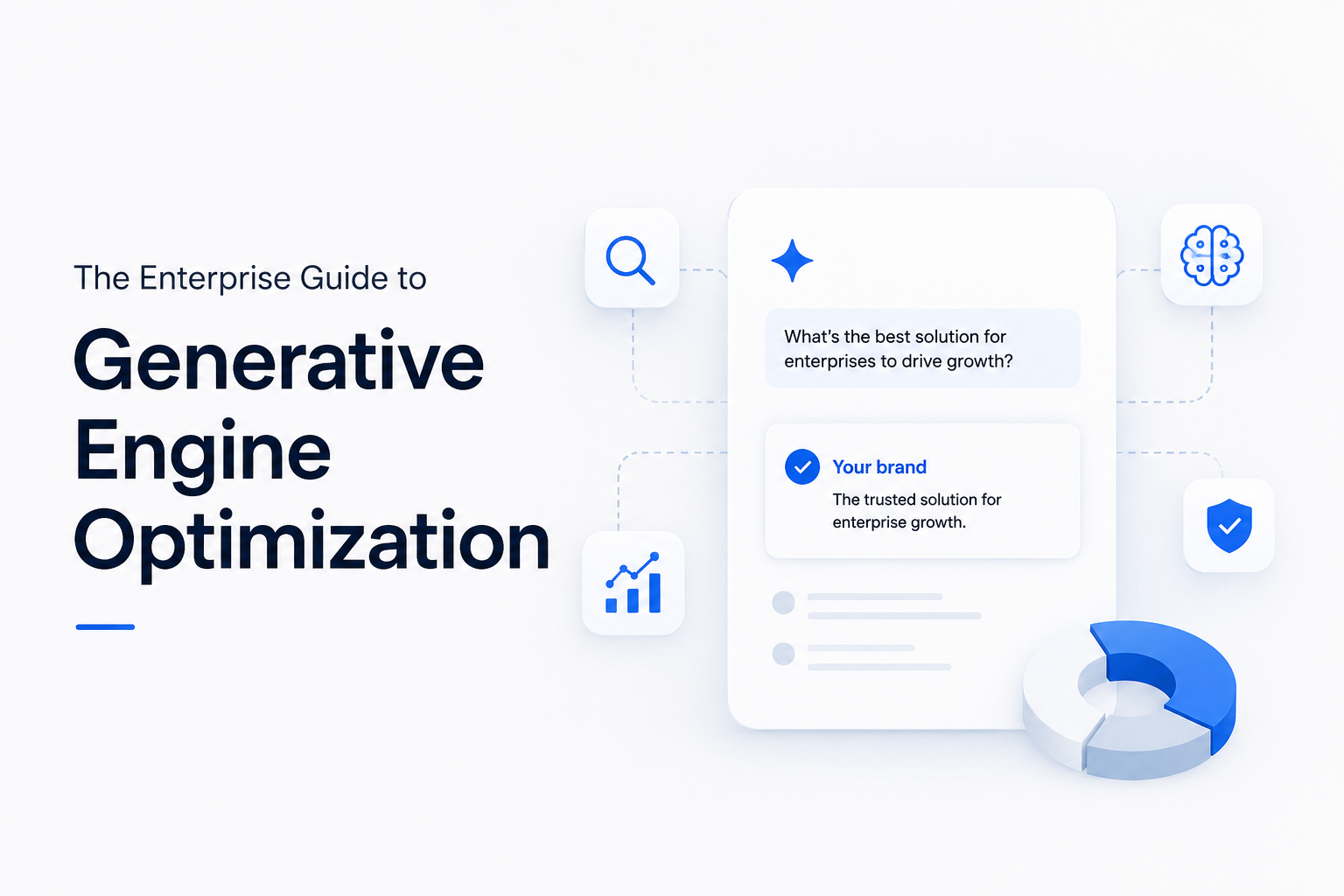
The confusion starts with a surface-level similarity: both disciplines are about visibility. But the mechanism is completely different, and the difference matters operationally. Whether you call it generative engine optimization or answer engine optimization, the target is the same — earning citations inside AI-generated responses rather than positions in a ranked list of blue links.
| Traditional SEO | Answer Engine Optimization (AEO) |
| Earns a position in a ranked list of links. The user decides whether to click. You are competing for attention in a results page the user actively scans. Click-through rates at position #1: around 28%. At position #3: closer to 11%. | Earns a citation inside a synthesized answer. The AI has already decided what the answer is — your brand either appears in it or does not. There is no position #3. Visibility is effectively binary — you’re cited or you’re absent. |
A strong Google ranking remains the primary driver of AI citation visibility — the majority of cited sources in AI responses draw from top organic results. However, ranking alone does not guarantee that an AI system will extract and cite a specific page’s content; the structure and clarity of the page content also influence whether it gets referenced.
The space is young enough that thoughtful execution matters more than speed. The core dynamic is straightforward: your well-ranked owned content is the primary driver of AI citation visibility (the RAG pipeline draws predominantly from indexed search results), while third-party coverage on external platforms can expand the range of contexts in which your brand appears. Neither replaces the other — they are complementary.
The Architecture of AI Visibility
Three non-negotiable layers. Missing one reduces the impact of the others.
Pillar I — Content Layer: Semantic Density
LLMs are trained to retrieve self-contained, definitionally rich answers. A page that raises a question and then defers to another source for context is, from the retrieval model’s perspective, incomplete — and incompleteness is penalized by lower confidence scoring.
The Princeton/Georgia Tech/Allen Institute peer-reviewed study (KDD 2024, 10,000 queries across 25 domains) tested on-page content mutations — adding statistics, citations, and fluency improvements to existing pages — in a controlled setting. It found measurable improvements:
– Including statistics: roughly +32% visibility lift
– Adding citations: roughly +30%
– Optimizing fluency: roughly +28%
These numbers reflect the controlled study conditions; real-world results vary based on competition, domain authority, and implementation quality. The study’s scope is limited to on-page content changes and does not address back-end engineering like MCP servers or RAG pipelines.
The standard:
– Every page must answer the question it raises without requiring AI to cross-reference external sources for context. Run this filter: could an LLM extract a clean, attributable answer from this page alone?
– Articles with structured data — hierarchical headings, comparison tables, numbered steps — are 28–40% more likely to be cited by large language models.
– Content freshness matters: AI systems tend to factor recency into retrieval decisions. A visible “last updated” date and current statistics help signal relevance.
Pillar II — Brand Layer: Entity Authority
LLMs reason in entities — brands, products, authors, concepts — not keyword frequencies. Your brand functions as a node in a knowledge graph, and its weight in that graph influences whether it surfaces in retrieval. A 2026 industry snapshot found that 26% of brands had zero mentions in AI Overviews, suggesting gaps in how those brands present themselves as recognizable entities.
The standard:
– Schema markup is table stakes. Content with proper schema implementation shows 30–40% higher visibility in AI-generated answers (Dataslayer, 2026).
– Consistent NAP data and presence in authoritative industry databases are not optional extras — they are the entry ticket to AI retrieval pools.
– E-E-A-T signals now directly influence which domains generative models choose as sources. Author entities with verifiable credentials outperform anonymous content.
– When evaluating an approach, verify that entity authority work is part of the plan. A content rewrite without entity grounding produces limited results.
Pillar III — Trust Layer: Citation Architecture
Retrieval models assign confidence scores partly based on the web graph. A page that stands in isolation reads as low-confidence. You need to be a central node, not a leaf node — referenced by others, referencing primary sources, and building internal citation chains that demonstrate the authority of your proprietary data.
According to Semrush’s AI Visibility Index, 40–60% of cited sources in AI responses rotate month over month. Maintaining citations is an active, continuous process — not a one-time optimization.
The standard:
– Build explicit citation chains: reference primary data, link to foundational documents, cite your own proprietary research with transparent methodology.
– Distributing content across multiple publications broadens the contexts in which your brand may be cited.
– Monitor continuously. Brands with citation monitoring detect drift faster than those without it.
Where Most Strategies Fail
Answer engine optimization is an infrastructure challenge, not just a content one.
True AI visibility requires moving beyond on-page optimization into how your data is structured for machine retrieval. Content rewrites alone produce limited results if the underlying data architecture does not support AI retrieval.
The MCP Shift — What Your Engineering Team Needs to Understand
>
Model Context Protocol (MCP), introduced as an open standard, allows AI agents to connect directly to external data sources. Its primary use case today is internal enterprise AI ecosystems — custom chatbots, support agents, and private AI tools that query your own knowledge base. Public consumer AI engines (ChatGPT, Perplexity, Google Gemini) do not dynamically crawl private MCP endpoints when answering general user queries. They continue to rely on standard web crawlers (GPTBot, Bingbot) and indexed web content. MCP is not a shortcut to bypass search engine ranking — it is a complementary tool for closed-ecosystem integrations.
RAG pipelines, Knowledge Graph integration, and MCP server architecture bridge marketing and engineering concerns. Organizations with cross-functional teams — a content strategist, a technical SEO architect, and an engineer familiar with retrieval systems — are often better positioned to execute across all three layers.
Applied ROI — Three Enterprise Cases
What measurable returns from these approaches look like in practice.
| Business Type | Core Problem | Intervention | Measured Outcome |
| B2B SaaS — High CAC, crowded market | Buyers using Perplexity for vendor research; brand absent from AI-generated comparisons | Full entity architecture rebuild + technical docs structured for MCP and RAG retrieval | +340% brand citations in Perplexity (90 days); +28% organic traffic from high-intent AI queries; 60+ new featured snippets (8 weeks) |
| Enterprise E-commerce — Product discovery | High-margin products absent from generative AI shopping recommendations due to flat product descriptions | Semantic density overhaul on category pages + aggressive product schema deployment | Direct reduction in dependency on bottom-funnel PPC; AI-referred visitors convert at 4× higher rate than unassisted organic |
| Enterprise Support — Knowledge management | High Tier-1 ticket volume because AI assistants cannot extract answers from legacy help center | Restructured support docs for maximum semantic density with LLM-parseable step-by-step formatting | Significant ticket deflection — users ask their AI tool, receive clean accurate answers sourced from the company |
The pattern across all three: the financial return materializes at the intersection of content quality, entity definition, and retrieval architecture. Any single pillar in isolation produces marginal results. The multiplier effect requires all three working simultaneously.
Priority Sequence: Where to Start
A suggested ordering based on common industry patterns, not a rigid playbook.
The sequence below reflects a logical dependency chain — each step builds on the one before it. You may find your organization already has some pieces in place, in which case the ordering will differ.
Priority 1: Audit & Entity Establishment
Define your brand as an entity the web can agree on.
Map your current Knowledge Graph footprint. Audit structured data gaps using Google’s Rich Results Test. Establish or update your author entities with verifiable credentials. Ensure consistent representation across major industry databases. Fix NAP inconsistencies. Document what AI tools currently say about your brand — this is your baseline, and you cannot optimize what you have not measured.
Priority 2: Semantic Density Overhaul
Rebuild your highest-value content for LLM retrieval standards.
Identify your ten highest-traffic legacy pages. Rewrite them to achieve semantic density: definitional clarity, self-contained context, explicit citations, original statistics, and structured formatting (comparison tables, numbered steps, clear hierarchical headings). Add a “What changed in 2026” section to perennial articles — freshness is a ranking signal for AI systems, not just humans. The target: could an LLM extract a complete, attributable answer from this page alone, without cross-referencing anything else? If not, the page has a density problem.
Priority 3: Pipeline Architecture
Structure proprietary data for internal enterprise AI tools.
Engage your engineering team. Identify your highest-value proprietary data assets: product catalogs, technical documentation, pricing matrices, support knowledge bases. Structure these for internal RAG pipeline access and MCP server implementation. This is primarily relevant for closed-ecosystem AI tools — custom chatbots, internal support agents, and private AI assistants that query your own data. For public search visibility, the two prior priorities (entity authority and semantic content density) remain the primary levers.
On Compounding Effects
Citation authority can accumulate similarly to how domain authority did in traditional SEO.
In 2012, brands that invested early in domain authority built positions that later entrants found difficult to replicate. A similar dynamic may apply to AI citation authority, though the landscape is too new for definitive long-term conclusions.
AI search landscapes evolve through discrete algorithm updates rather than gradual monthly shifts. Sustained investment in content quality and entity structure is more reliable than attempting to race an arbitrary timeline.
There is also a conversion asymmetry that changes the ROI calculation entirely. AI-referred visitors arrive pre-qualified: they have already received a recommendation from a trusted interface, they arrive with context and intent built in, and they spend nearly twice as long on site as Google referrals (15 minutes vs. 8 minutes, per Seer Interactive). This is structurally different from clicking position three on a search result page. The visitor who arrives from a ChatGPT recommendation is closer to a warm referral than a cold organic click — and your content strategy, landing pages, and conversion architecture should reflect that distinction.
If there is a single takeaway, it is this: your traditional SEO foundation still matters — 99% of AI Overview citations come from the organic top 10, and 87% of ChatGPT citations map to top Bing results. Ranking well on standard search engines is still the entry ticket. What AEO adds is the layer that determines whether that ranking translates into an AI citation — through entity clarity, semantic density, and a strategic mix of owned and third-party content.
Build the entity. Earn the citation. Keep your foundations solid. Brands that invest in this sequence create a citation advantage that compounds over time.
Sources & Verification: Key sources referenced in this article include: OpenAI (ChatGPT user data, February 2026); Gartner VP Analyst Alan Antin (search volume projections, 2024); Princeton/Georgia Tech/Allen Institute for AI/IIT Delhi — “GEO: Generative Engine Optimization,” KDD 2024 peer-reviewed study; Seer Interactive conversion rate analysis (June 2025); Conductor AEO/GEO Benchmarks Report (January 2026, 13,770 domains, 10 industries); Semrush AI Visibility Index (2026); HubSpot 2026 State of Marketing Report. Statistical claims reflect findings as reported under specific study conditions; enterprise results vary by vertical, existing authority, and implementation fidelity.