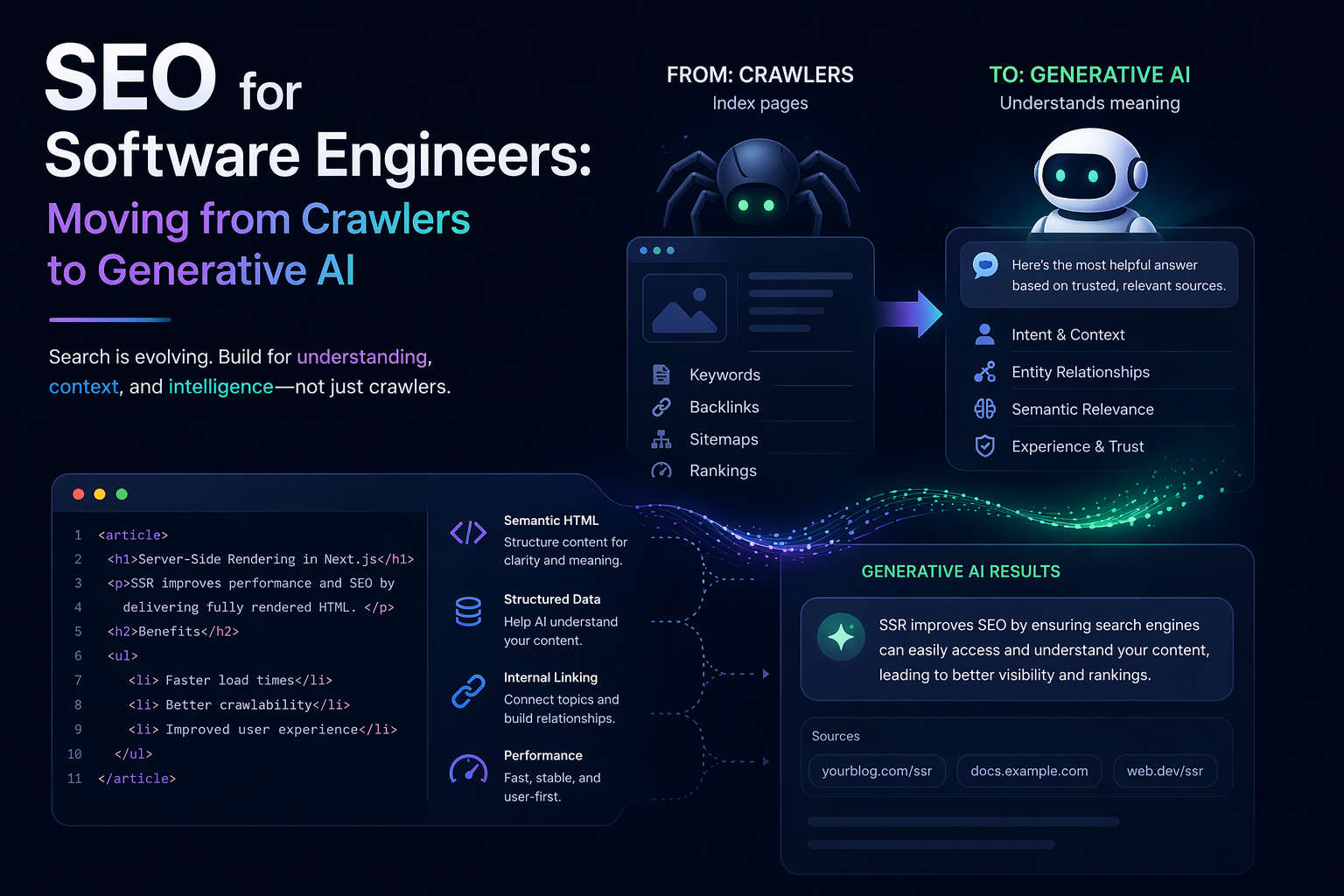
A few years ago, the conversation around “SEO for software engineers” was simple: fix your robots.txt, ensure your URLs are canonical, and don’t break the sitemap.
But as I sit at the intersection of AI Architecture and Technical SEO today, the landscape has fundamentally shifted. Having served as a Technical SEO Specialist at both REEA Digital Limited and SerpCat, and now leading strategies at MonsterClaw LLC, I’ve seen this evolution firsthand. We aren’t just optimizing for a crawler anymore — we are optimizing for Generative Engines.
In a world where ChatGPT, Perplexity, and Gemini are the primary discovery layers, the Technical SEO of yesterday is now the Information Architecture of tomorrow.
🏗️ The Foundation: Why Engineers Are the New SEO Architects
Ben Hoyt once noted that SEO is often seen as a “marketing thing.” At MonsterClaw, we view it as a performance thing.
If your Next.js application isn’t delivering pre-rendered HTML, you’re creating unnecessary friction. Yes, Google can render JavaScript — but why force a billion-dollar crawler to spend its expensive crawl budget on heavy bundles when you can deliver clean, structured HTML on the first response?
The Rule: For a modern engineer, SEO isn’t about keywords — it’s about reducing friction for the crawler.
⚠️ The Architectural Caveat
“Reducing friction” does not mean blindly choosing SSR for everything. SSR shifts rendering load from the client’s browser to your servers. For high-traffic enterprise applications, this means scaling server compute costs and managing edge-caching aggressively.
Furthermore, a fast First Contentful Paint (FCP) is meaningless if your client-side hydration scripts freeze the main thread and spike your Interaction to Next Paint (INP). True engineering excellence means balancing pre-rendering with execution cost — not dogmatically defaulting to SSR because it sounds right.
🛠️ Core Checklist for Technical Excellence
1. SSR & Hydration Strategy
Use Next.js 14+ with App Router. Target an FCP under 1.2s — but don’t stop there. Pair your SSR setup with partial hydration or streaming architectures to keep INP low.
A page that looks loaded but doesn’t respond to user clicks is a failure in both UX and Core Web Vitals. Rendering strategy isn’t a binary SSR/CSR choice; it’s a spectrum of hydration granularity that must be tuned per component.
2. Structured Data (JSON-LD)
This is no longer optional. Schema is the API we provide to search engines and AI systems.
If you aren’t using Person, FAQPage, and SoftwareApplication markup, you’re leaving the interpretation of your content to chance. AI engines rely on structured data far more heavily than traditional crawlers — if your entities aren’t declared, the AI cannot establish your authority.
3. The “Cached-Dynamic” Sitemap
A purely static, manually managed sitemap.xml is dead — but the opposite extreme is also a trap.
Generating a completely live dynamic sitemap on every single crawler request can introduce massive database latency on enterprise sites with millions of nodes. The sweet spot: a headless bridge leveraging ISR (Incremental Static Regeneration) or Redis/edge caching to keep sitemaps near real-time without hammering your production databases.
Real-time accuracy without server cost — that is the engineering target.
🚀 The Next Frontier: GEO (Generative Engine Optimization)
This is where the discipline of AI Architecture intersects with SEO. Traditional SEO focuses on ranking. GEO focuses on citation.
When an LLM synthesizes an answer, it looks for high-authority, well-structured content it can confidently reference. To design for AI discovery, you need two things:
1. Semantic Density Structure content so that an embedding model can cleanly vectorize it. Short, self-contained sections with declarative headings outperform long narrative prose for AI extraction.
2. Knowledge Graph Integration Connect your entities — People, Projects, Brands — using schema so LLMs recognize you as a trustworthy, authoritative source within your domain.
⚖️ The GEO Paradox: The Threat of Zero-Click Searches
As technical architects, we must recognize a systemic risk in optimizing too perfectly for LLMs.
If we structure our JSON-LD and semantic data so precisely that an AI engine like Gemini or Perplexity can synthesize and display our full value proposition directly within its UI — the user has no reason to click through to our site. This is where engineering discipline collides with marketing reality.
The future of GEO isn’t simply about making data easily extractable. It’s about structuring data so that AI engines treat you as the definitive citation, while intentionally designing information loops that compel the user to click the source link for full utility.
Optimize to be cited. Design to be visited.
🏁 Bridging the Gap
At the end of the day, a fast site is a searchable site. Whether you’re building RAG pipelines or optimizing an enterprise WordPress stack.
SEO is a technical discipline masked as a marketing goal.
The engineers who internalize this will build systems that compound their visibility over time — not just in Google, but in every AI layer that sits on top of it.
❓ FAQ: SEO for Software Engineers
Q: Does Google struggle with client-side React? Google can crawl it, but rendering is delayed and expensive. SSR guarantees indexation on the first crawl pass. More precisely: Googlebot’s two-wave rendering system is capable of executing modern JavaScript, but rendering queues introduce an indexing delay. For fast-moving content — news, shifting inventory, time-sensitive pages — SSR ensures the first wave delivers complete content, not a shell.
Q: Does Google struggle if we don’t use SSR? Not technically. The problem isn’t that Google can’t see client-rendered sites — it’s the indexing delay. For evergreen content, that delay may be acceptable. For content where freshness is a ranking or citation signal, SSR removes the risk entirely.
Q: What is the most important tag for an engineer to manage? The <link rel="canonical">. It prevents duplicate content issues that split ranking power across multiple URLs — a problem that compounds at scale and is almost invisible until it costs you.
Q: How does AI change Technical SEO? AI engines like Gemini and ChatGPT rely on structured data (JSON-LD) far more than traditional crawlers do. If your entities aren’t explicitly declared, the AI has no reliable way to establish your authority — it will either guess, attribute incorrectly, or skip your content entirely.
Q: Why use Headless WordPress for SEO? It gives you the best of both worlds: the editorial workflow of WordPress and the performance and DOM control of a Next.js frontend. Content teams stay productive; engineering teams retain full control over rendering, schema, and Core Web Vitals.

Leave a Reply