Category: AI Search & GEO

  • Next.js for SEO: Why Modern Websites Are Moving Beyond Traditional CMS Platforms

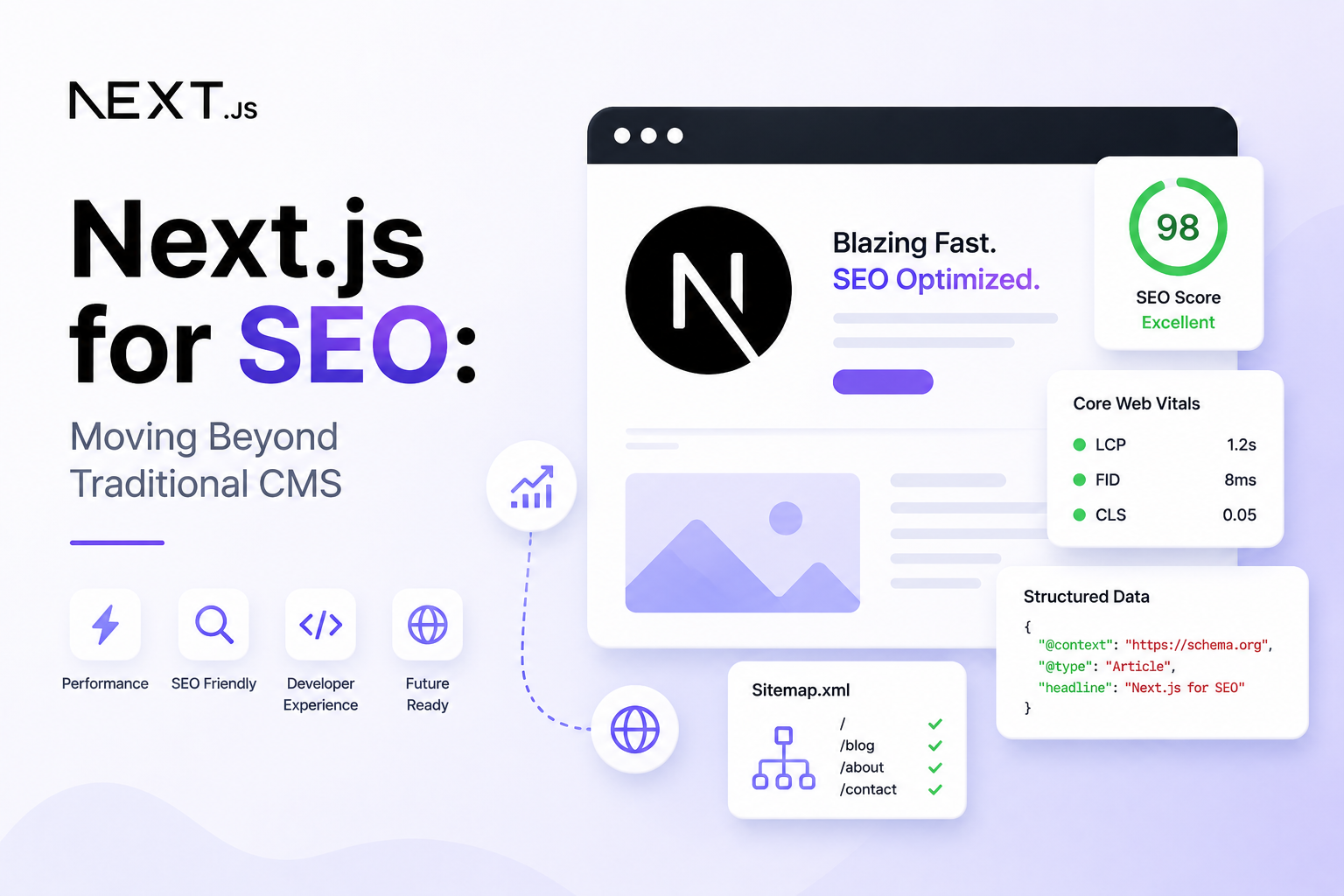
    Next.js for SEO: Why Modern Websites Are Moving Beyond Traditional CMS Platforms

    Something has shifted in how high-performance web teams make platform decisions. Five years ago, the conversation was straightforward: content site means WordPress, web application means React. Today, a growing category of websites — SaaS marketing sites, developer documentation platforms, enterprise product pages, content-heavy publications — is choosing Next.js for both.

    The reason is not that WordPress has gotten worse. It is that Next.js has matured into a platform that delivers on things WordPress cannot: structural performance advantages, granular control over every byte of HTML output, rendering flexibility that adapts per page rather than per site, and AI visibility that comes from the framework’s architecture rather than requiring plugin configuration.

    This article is specifically for development teams and technical founders evaluating Next.js as a platform for SEO and AI search visibility. It explains what Next.js does differently at an architectural level, how those differences translate into ranking and citation advantages, and where the tradeoffs are — because there are real ones.


    What Makes Next.js Different From a Traditional CMS

    Most content management systems — WordPress, Drupal, Joomla — share a fundamental architecture: the CMS manages both the content and the rendering. You write a post in the CMS editor, the CMS stores it in a database, and when a visitor requests the page, the CMS retrieves the content and generates the HTML using its template system.

    Next.js works differently in a way that matters for SEO. It is a React framework — not a CMS — that gives developers complete control over how content is fetched, how pages are rendered, and what HTML is delivered to the browser and to crawlers.

    Not Client-Side React — A Critical Distinction

    The most important thing to understand about Next.js for SEO is what it is not. It is not the same as building a React application with Create React App or Vite, where content is rendered client-side in the browser and AI crawlers receive an empty <div id="root">.

    Next.js solves the client-side rendering problem at the framework level. By default — without any special configuration — Next.js pages render on the server and deliver complete HTML in the HTTP response. Developers who build with Next.js get React’s component model and developer experience without the crawlability penalty of client-side rendering.

    The App Router and React Server Components

    Next.js 13 introduced the App Router, which makes server rendering even more pervasive. With the App Router, React components are server components by default — they run on the server, fetch their data, render their HTML, and send the result to the browser without shipping any JavaScript to the client for those components.

    This is architecturally significant for SEO and AI visibility. A page built with App Router components delivers:

    • Full HTML content in the server response
    • No hydration overhead for content components
    • Smaller JavaScript bundles sent to the browser
    • Faster Time to Interactive for users
    • Complete content availability for all crawlers

    Only interactive components — forms, dropdowns, state-dependent UI — are marked with "use client" and hydrated in the browser. Static and content-focused components stay entirely on the server.

    File-Based Routing

    Next.js uses the file system as its routing layer. A file at app/blog/[slug]/page.tsx automatically creates a route at /blog/[post-slug]. This produces clean, predictable URL structures without plugin configuration or manual permalink settings.

    For SEO, clean URL structure matters for both canonicalization and internal linking legibility. For development teams, file-based routing means URL architecture decisions are made in the file system — visible, auditable, and version-controlled — rather than buried in CMS settings.

    Built-In SEO Primitives

    Next.js provides first-class support for the HTML elements that SEO depends on:

    The Metadata API (App Router) generates <title>, <meta>, Open Graph, and Twitter card tags from a single exported object per page. Metadata is rendered server-side and appears in the raw HTML response — fully accessible to every crawler.

    typescript

    export const metadata = {
      title: 'Next.js for SEO: Complete Guide',
      description: 'How Next.js SSR and SSG deliver AI-crawlable HTML.',
      openGraph: {
        title: 'Next.js for SEO',
        type: 'article',
        publishedTime: '2026-01-15',
      },
    }

    The Image component (next/image) automatically optimizes images: serving WebP to browsers that support it, adding explicit width and height attributes to prevent layout shift, and lazy loading below-fold images without developer configuration.

    Link prefetching for navigation links, automatic code splitting per route, and built-in support for robots.txt and sitemap.xml generation complete the framework’s SEO toolkit.


    SSR, SSG, and ISR: Next.js Rendering Options for SEO

    One of Next.js’s most valuable SEO characteristics is rendering flexibility. Different pages on the same site can use different rendering strategies, chosen based on each page’s specific content and update requirements.

    Server-Side Rendering (SSR)

    SSR in Next.js generates the complete HTML for a page on each request. The server fetches current data, renders the component tree, and returns a fully populated HTML document.

    In the App Router, SSR is the default for any component that fetches data dynamically:

    typescript

    // app/products/[id]/page.tsx
    export default async function ProductPage({ params }) {
      const product = await fetch(
        `https://api.example.com/products/${params.id}`,
        { cache: 'no-store' } // always fresh
      )
      const data = await product.json()
      return <ProductDetail product={data} />
    }

    Best for: Pages with content that changes frequently — pricing pages, inventory, news, real-time data. Content is always current when the crawler arrives.

    Static Site Generation (SSG)

    SSG pre-builds pages at deploy time. The framework generates complete HTML for every page during the build process, and those files are served directly from a CDN edge with no server computation at request time.

    typescript

    // app/blog/[slug]/page.tsx
    export async function generateStaticParams() {
      const posts = await getAllPosts()
      return posts.map(post => ({ slug: post.slug }))
    }

    Best for: Blog posts, documentation, marketing pages, content that changes infrequently. Delivers the fastest possible TTFB — often under 50ms from CDN edge — which is ideal for both user experience and crawler efficiency.

    Incremental Static Regeneration (ISR)

    ISR combines static speed with content freshness. Pages are pre-built statically, but Next.js regenerates them in the background at defined intervals or when content changes are triggered via a revalidation webhook.

    typescript

    // Revalidate every 3600 seconds (1 hour)
    export const revalidate = 3600

    Best for: Content that changes periodically — product catalogues, frequently updated guides, high-traffic landing pages that need occasional updates without full rebuilds.

    The SEO Rendering Decision Matrix

    Content TypeUpdate FrequencyBest RenderingWhy
    Blog postsRarelySSGMaximum speed, full crawlability
    DocumentationMonthlySSG + ISRSpeed with periodic refresh
    Product pagesDailyISRFresh without per-request cost
    Pricing pagesWeeklySSR or ISRAccuracy critical
    News/real-timeContinuousSSRAlways current
    Marketing pagesRarelySSGTop performance, no overhead

    All three methods deliver complete HTML to crawlers. The choice between them is about performance optimization and content freshness — not about crawlability, which all three satisfy equally.


    Performance Advantages That Directly Affect SEO

    Automatic Code Splitting

    Next.js splits JavaScript bundles by route automatically. When a user visits /blog/post-title, they download only the JavaScript needed for that specific page — not the JavaScript for every other page on the site.

    For SEO, this matters through Core Web Vitals. A smaller JavaScript bundle means faster Time to Interactive, which affects Interaction to Next Paint (INP) — a Core Web Vitals metric. WordPress with multiple plugins loads a global JavaScript bundle on every page; Next.js loads only what each page needs.

    Edge Runtime and Global CDN Delivery

    Next.js supports an Edge Runtime that allows server-side rendering to run at CDN edge nodes — the physical server locations closest to the user. Instead of a request traveling from a visitor in Singapore to an origin server in Virginia, the page is rendered and served from a Singapore edge node.

    For AI retrieval crawlers that operate globally and are speed-sensitive, edge rendering means consistently fast response times regardless of the crawler’s geographic origin. PerplexityBot serving a user in Europe receives the same sub-100ms TTFB as a user in the United States.

    Deployed on Vercel — Next.js’s native platform — this edge rendering happens automatically with zero infrastructure configuration. Alternative platforms like Netlify offer similar edge deployment for Next.js.

    Core Web Vitals by Default

    Next.js’s built-in optimizations align directly with Core Web Vitals requirements:

    Core Web Vitals MetricNext.js FeatureImpact
    LCP (Largest Contentful Paint)next/image, SSG + CDNFaster image load
    INP (Interaction to Next Paint)Code splitting, partial hydrationLess JS blocking
    CLS (Cumulative Layout Shift)next/image enforces size attrsNo layout jump
    TTFB (Time to First Byte)Edge rendering, CDNFast first response

    A well-built Next.js site consistently achieves Lighthouse performance scores in the 90–100 range for content pages. Achieving the same scores with WordPress requires deliberate caching configuration, CDN setup, image optimization plugins, and ongoing maintenance. Next.js achieves it through framework architecture.


    AI Visibility Benefits of Next.js

    Complete HTML in Every Server Response

    The fundamental AI visibility requirement is that content exists in the HTML response when the crawler arrives. Every Next.js rendering method — SSR, SSG, ISR — satisfies this requirement completely.

    GPTBot, PerplexityBot, ClaudeBot, and OAI-SearchBot all receive complete, content-rich HTML on their first fetch. No JavaScript execution required. No Wave 2 rendering queue. No crawler timeout from slow responses.

    For development teams switching from a client-side React application to Next.js, this is often the most immediately impactful change: content that was previously invisible to every AI crawler becomes fully accessible overnight.

    Surgical Metadata Control

    WordPress with Yoast or Rank Math provides per-page control over titles, descriptions, and Open Graph tags. Next.js provides the same control, but implemented in code rather than through a CMS interface — which means it can be programmatic, conditional, and fully tested.

    A Next.js blog can generate metadata from post content automatically:

    typescript

    export async function generateMetadata({ params }) {
      const post = await getPost(params.slug)
      return {
        title: post.title,
        description: post.excerpt,
        authors: [{ name: post.author.name }],
        openGraph: {
          publishedTime: post.publishedAt,
          modifiedTime: post.updatedAt,
          type: 'article',
        },
      }
    }

    Every field is derived from the content itself, is guaranteed to be accurate, and is rendered server-side — reaching every crawler without JavaScript dependency.

    Server-Side JSON-LD Schema

    Schema markup in Next.js is implemented directly in page components, rendered server-side, and delivered in the HTML <head>. There is no plugin dependency, no JavaScript injection risk, and no possibility of schema failing to reach AI crawlers.

    typescript

    export default function BlogPost({ post }) {
      const schema = {
        '@context': 'https://schema.org',
        '@type': 'Article',
        headline: post.title,
        author: {
          '@type': 'Person',
          name: post.author.name,
        },
        datePublished: post.publishedAt,
        dateModified: post.updatedAt,
      }
    
      return (
        <>
          <script
            type="application/ld+json"
            dangerouslySetInnerHTML={{ __html: JSON.stringify(schema) }}
          />
          <article>{/* content */}</article>
        </>
      )
    }

    Because this is a server component, the <script> tag with the JSON-LD is present in the raw HTML response. GPTBot reads it on the first fetch. The schema is guaranteed to be accurate because it comes from the same data source as the page content.

    Per-Crawler Rendering Control

    This is a Next.js capability with no equivalent in WordPress — and it is particularly relevant for GEO.

    AI crawlers and Googlebot have different rendering requirements. Googlebot can execute JavaScript and benefits from full SSR with rich interactive context. GPTBot and PerplexityBot are HTML-only parsers that benefit most from the lightest, fastest possible server response. Human visitors benefit from optimal interactivity and perceived performance.

    In Next.js, you can differentiate rendering behavior based on the request’s user-agent, serving each crawler the response format it handles best:

    typescript

    // middleware.ts
    import { NextResponse } from 'next/server'
    
    export function middleware(request) {
      const ua = request.headers.get('user-agent') || ''
      const isAICrawler = /GPTBot|PerplexityBot|ClaudeBot/i.test(ua)
    
      if (isAICrawler) {
        // Rewrite to a pre-rendered static version
        return NextResponse.rewrite(
          new URL('/static' + request.nextUrl.pathname, request.url)
        )
      }
      return NextResponse.next()
    }

    WordPress has no mechanism for this. Its PHP rendering pipeline produces the same response for every request regardless of who is asking. Next.js middleware intercepts the request before rendering and can serve a stripped, pre-rendered HTML response to AI crawlers — maximizing content density and minimizing response time for the bots that matter most for citation.

    This does not mean serving different content to crawlers and users — that is cloaking, which violates Google’s guidelines. It means serving the same content in a format optimized for the receiver: full interactive HTML for humans, lean pre-rendered HTML for AI parsers.

    Dynamic Schema From Page Context

    The existing JSON-LD section above shows Article schema generated from post data. Next.js takes this further: schema can be generated dynamically based on page type, URL parameters, and content structure — something WordPress plugins with fixed schema templates cannot match.

    typescript

    // Generate schema based on page type
    function getSchema(page) {
      if (page.type === 'faq') {
        return {
          '@type': 'FAQPage',
          mainEntity: page.faqs.map(faq => ({
            '@type': 'Question',
            name: faq.question,
            acceptedAnswer: {
              '@type': 'Answer',
              text: faq.answer,
            },
          })),
        }
      }
      if (page.type === 'howto') {
        return {
          '@type': 'HowTo',
          name: page.title,
          step: page.steps.map((step, i) => ({
            '@type': 'HowToStep',
            position: i + 1,
            name: step.title,
            text: step.description,
          })),
        }
      }
      // Default Article schema
      return { '@type': 'Article', headline: page.title }
    }

    Every page gets exactly the schema type that matches its content — automatically, accurately, server-side. No manual schema configuration per post. No plugin template limitations.

    Precise HTML Control for Citation Optimization

    In WordPress, the HTML structure of your pages is determined by your theme, your page builder, and your plugins — a stack of third-party code you configure but don’t write. If the theme adds unnecessary wrapper divs around headings, you can work around it but you can’t fully control it.

    In Next.js, developers write the HTML directly in React components. The heading hierarchy, the semantic landmark elements, the paragraph structure, the list markup — all of it is explicit and intentional. A Next.js team that has read Articles 3 and 7 of this series knows exactly what crawlers see, because they wrote the HTML that crawlers receive.

    This level of control compounds over time. Every structural decision made for readability — clean heading hierarchies, semantic landmark elements, self-contained sections — is also a citation-optimization decision that improves AI discoverability.


    Real-World Use Cases: Who Should Choose Next.js

    SaaS Marketing Sites

    The companies building the tools that developers use — Vercel, Linear, Loom, Clerk, Resend, Supabase — run their marketing sites on Next.js. The pattern is consistent: React expertise on the engineering team, need for high Lighthouse scores, and a marketing site that must perform as well as the product it sells.

    For a SaaS company, the marketing site is a direct revenue driver. A 200ms improvement in page load speed measurable translates to conversion rate improvement. Next.js’s performance defaults justify the development investment for this use case.

    Developer Documentation

    Large documentation sites — particularly those for developer tools and APIs — benefit from Next.js’s SSG capabilities. Thousands of documentation pages can be pre-built and served from CDN edge with sub-100ms TTFB. Content search and navigation remain fully client-side interactive while page content is fully static and crawler-accessible.

    Enterprise Product Pages

    Enterprise companies with dedicated frontend teams use Next.js to maintain performance SLAs that WordPress with its plugin ecosystem cannot reliably guarantee. When a VP of Engineering sets a “no page slower than 200ms TTFB” standard, Next.js with edge rendering is the only web framework that can reliably meet it in production.

    Content Platforms With Developer Publishing Teams

    Technical publications, developer blogs, and content platforms where the publishing team consists of developers — and where content is managed through Git and MDX rather than a CMS editor — are natural Next.js fits. The authoring workflow is code-native, the build pipeline is automated, and the performance output is optimized by default.


    The Honest Tradeoffs

    Next.js is not the right platform for every team or every site. The advantages above are real — and so are these:

    There is no built-in content management interface. Non-developer content teams cannot use Next.js without a separate headless CMS (Contentful, Sanity, Prismic, Payload). This adds system complexity, subscription cost, and integration maintenance.

    The initial development investment is significant. A well-built Next.js site requires experienced React developers, a thoughtful rendering strategy per route, schema implementation in code, and CI/CD pipeline configuration. WordPress can be launched in a day; a production-quality Next.js site takes weeks.

    The talent pool is smaller. WordPress developers are the most abundant web development resource globally. Senior Next.js developers with deep SEO knowledge are significantly harder to find and more expensive to hire.

    Ongoing maintenance differs in character, not in volume. WordPress requires plugin updates, hosting management, and security monitoring. Next.js requires dependency management, build pipeline maintenance, and headless CMS integration upkeep. Neither platform maintains itself.

    The platform decision comes down to a single question: does your team have — or can it hire — the React development expertise to build and maintain a Next.js site?

    When Next.js Wins

    Next.js delivers a structural advantage over WordPress in these specific scenarios:

    ScenarioWhy Next.js Wins
    High-traffic sites needing edge cachingVercel/Cloudflare edge renders near the user; WordPress needs CDN config
    Complex rendering requirementsPer-page SSR/SSG/ISR; WordPress has no equivalent
    Personalized or dynamic contentSSR per-request with user context; WordPress caching breaks personalization
    GEO-focused per-crawler optimizationMiddleware can serve crawler-optimized responses; WordPress cannot
    Teams with JavaScript/React expertiseDevelopers work in their native stack without plugin dependencies
    Performance SLAs under 200ms TTFBEdge runtime guarantees it architecturally; WordPress requires manual work

    The Right Approach for Most Teams

    For teams that need both content management velocity and delivery performance, the recommended path is:

    Start with WordPress for content volume and SEO plugin maturity. WordPress’s block editor, Rank Math schema, automatic sitemaps, and PHP rendering deliver everything needed for strong SEO and AI crawlability without development overhead.

    Layer Next.js as a headless front end when rendering control becomes a competitive requirement. This gives you WordPress’s content management speed — non-developers publishing independently, editorial workflows, media library — with Next.js delivery performance and per-crawler rendering optimization.

    This is the headless WordPress + Next.js architecture covered in Article 15. It is not the right starting point for most teams, but it is the right destination for teams that outgrow what a traditional WordPress front end can deliver.

    That comparison is examined in detail in the next article.


    Building a Next.js site and want to verify its AI crawlability and schema implementation before launch? The Answer Engine Visibility Diagnostic tests every public-facing route against all major AI crawlers, validates your JSON-LD schema, and checks Metadata API output against best practice — delivered automatically as a structured PDF report.


    Next: Next.js vs WordPress: Which Platform Is Better for SEO and AI Search? →

    ← Previous: Common WordPress Mistakes That Hurt AI Discoverability

    This article is part of a 20-article series on SEO, GEO, and AI Visibility. View the complete series →
  • The JavaScript GEO Myth: What Generative Engines Can and Cannot Render

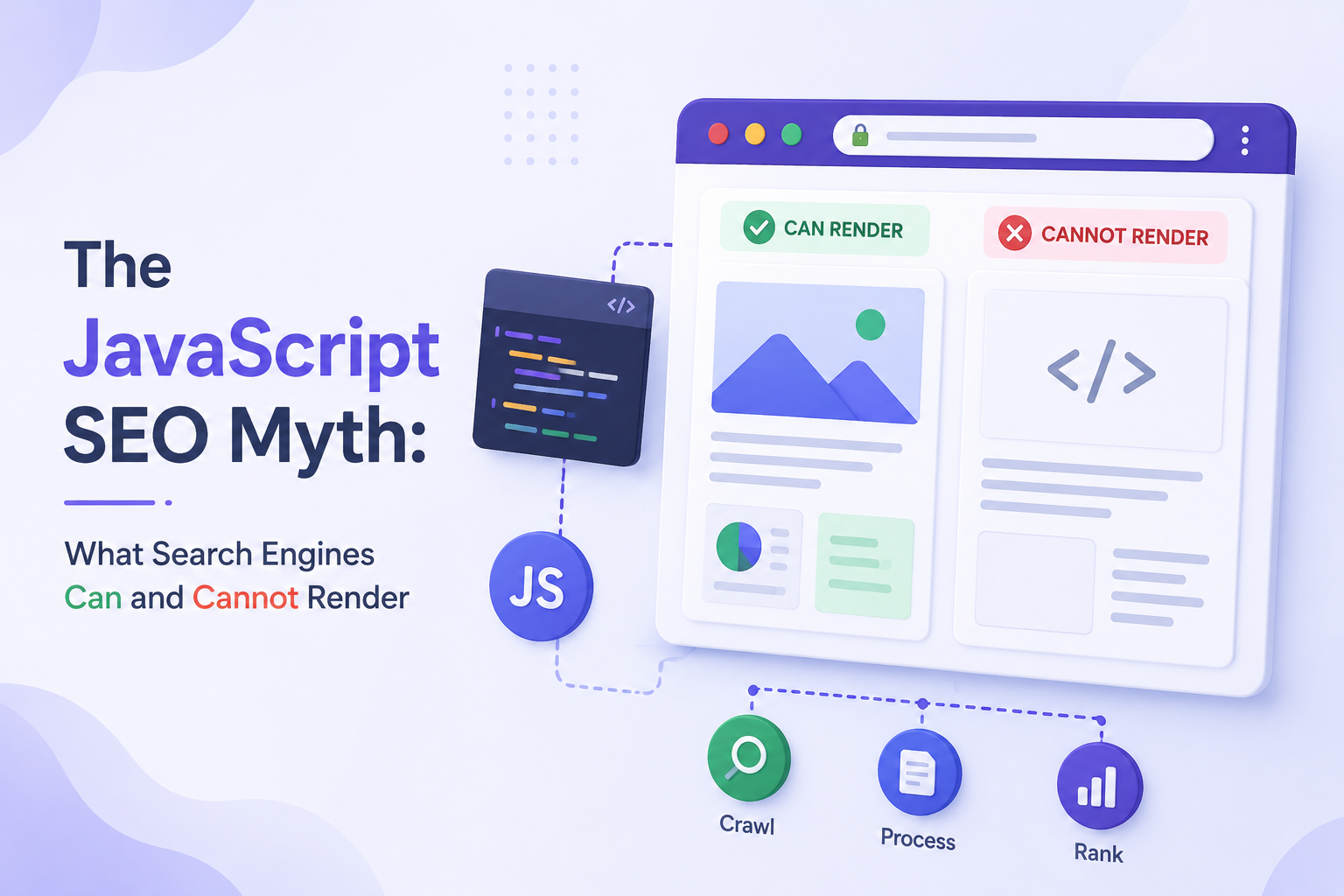
    The JavaScript GEO Myth: What Generative Engines Can and Cannot Render

    “Google can handle JavaScript.”

    This statement is true. It is also one of the most damaging half-truths in modern web development.

    Because of it, teams have shipped client-side rendered React apps and watched their organic traffic stall. Content managers have published hundreds of posts that took weeks to index. Developers have argued against SSR migrations because “Google handles JavaScript fine now.” And throughout all of this, AI search products — which do not handle JavaScript at all — have been invisibly excluded from the conversation.

    This article does not argue that JavaScript is bad or that React is incompatible with SEO. It argues for precision: understanding exactly what generative engines and AI systems can render, cannot render, and render imperfectly — so you can make decisions based on reality rather than reassuring generalities.


    The Five JavaScript SEO Myths

    Myth 1: “Google renders JavaScript just like a browser, so CSR is fine.”

    Reality: False. Google uses a headless Chromium instance to render JavaScript, but this rendering happens in a queue — not in real time. There is a delay between when Googlebot fetches your page and when it renders the JavaScript. That delay can range from hours to weeks depending on your site’s crawl priority.

    A full browser renders JavaScript in milliseconds. Google’s rendering queue can take days. These are not the same thing.

    More critically: Google’s rendering is imperfect. Complex JavaScript interactions, API-dependent content, and certain React patterns can fail to render correctly in Google’s headless environment even when they work perfectly in a real browser.

    Myth 2: “If Google can render it, all generative engines can.”

    Reality: False. Google is uniquely sophisticated among crawlers. GPTBot, PerplexityBot, ClaudeBot, and OAI-SearchBot do not execute JavaScript at all. Bingbot has limited rendering capability. No AI search product matches Google’s rendering capability.

    A site that “works fine for Google” because Google eventually renders its JavaScript may be completely invisible to every AI search product — which now represents a growing and significant share of information discovery.

    Myth 3: “Adding prerendering solves the JavaScript problem.”

    Reality: Partially true, often misconfigured. Prerendering — using a service like Prerender.io to serve pre-built HTML snapshots to crawlers — is a legitimate technical approach. But it introduces complexity that frequently breaks in practice:

    • Prerendering services need to be kept in sync with your actual content. Stale snapshots mean stale indexed content.
    • User-agent detection (serving HTML to bots, JavaScript to humans) can be misconfigured, resulting in crawlers still receiving the JavaScript version.
    • Some AI crawlers have user-agent strings that are not recognized by prerendering configurations, so they bypass the snapshot and receive the empty CSR shell anyway.
    • Google explicitly prefers server-side rendering over prerendering and notes that prerendering is an imperfect solution.

    Prerendering is better than nothing. It is not a substitute for SSR or SSG, and it adds a failure surface that does not exist when you render server-side by default.

    Myth 4: “My React site ranks well, so JavaScript rendering is not an issue.”

    Reality: Correlation, not causation. A React site that ranks well is not evidence that JavaScript rendering is not a problem — it is evidence that Google eventually rendered the content despite the JavaScript, and that the content and authority signals were strong enough to rank.

    Consider what you are comparing it against. How much faster would that same content rank if it were server-rendered and indexed on Wave 1 rather than Wave 2? How often does freshly published content take weeks to appear in results while a server-rendered competitor is indexed within hours?

    More importantly, ranking on Google says nothing about AI visibility. A React site can rank on Google and be absent from every AI-generated answer — because AI crawlers never successfully extracted the content.

    Myth 5: “Schema markup in JavaScript is fine.”

    Reality: Risky and unreliable for AI crawlers. JSON-LD schema injected by client-side JavaScript — a common pattern in React apps using react-helmet, next/head (without server rendering), or similar libraries — reaches Google after its rendering queue processes the page. It does not reach AI crawlers at all.

    Schema that exists only after JavaScript execution is invisible to GPTBot, PerplexityBot, ClaudeBot, and OAI-SearchBot. Those crawlers never see your FAQPage markup, your Article schema, your Organization entity. The structured data you invested in communicating to AI systems is not communicating with them.

    The correct implementation: JSON-LD schema in a <script type="application/ld+json"> tag inside the server-rendered <head>. This ensures every crawler receives it immediately, without any dependency on JavaScript execution.


    JavaScript Rendering Reality: What Google Actually Does

    To move past the myths, here is a precise account of how Google’s JavaScript rendering pipeline actually works in 2026.

    Wave 1: The Immediate Pass

    When Googlebot fetches a URL, it immediately processes whatever HTML the server returns. Content present in this initial HTML response is indexed right away — typically within hours for a crawled page.

    For a server-rendered or statically generated page, Wave 1 captures everything: all body content, headings, metadata, schema, internal links. The page is fully indexed in a single pass.

    For a client-side rendered page, Wave 1 captures: the page title (if it’s in the shell), perhaps a generic meta description, and the JavaScript bundle references. None of the actual content is indexed at this stage.

    The Rendering Queue

    Pages that require JavaScript rendering are placed in a queue. Google’s rendering infrastructure processes this queue using headless Chromium — essentially a browser without a visible interface.

    The queue is not immediate. Googlebot has billions of pages to manage. Your JavaScript-rendered page is one item in a very long queue. High-authority, frequently crawled sites may see their pages rendered within hours. Lower-priority sites may wait days or weeks.

    Google does not publish queue processing times. The delay is variable and not under your control.

    Wave 2: The Rendered Pass

    When the headless browser processes your page in the queue, it executes JavaScript, waits for the DOM to stabilize, and captures the rendered HTML. This rendered version is then indexed — updating or supplementing what was captured in Wave 1.

    If your content only exists after JavaScript execution, Wave 2 is the moment your content enters Google’s index.

    The critical implication: any content that depends on JavaScript rendering can only be indexed as fast as the rendering queue moves. You cannot accelerate this. You cannot guarantee it will happen within any particular timeframe. Server rendering eliminates this uncertainty entirely.

    What Google’s Own Documentation Says

    Google’s developer documentation explicitly recommends server-rendering or pre-rendering for content you need indexed reliably. The guidance is not “JavaScript is fine” — it is “if your content matters for indexing, ensure it is available in the initial server response.”

    This is the authoritative position from the system that actually does attempt JavaScript rendering. The message from the most capable crawler is: don’t depend on us to render your critical content.


    Google vs AI Crawlers: A Precise Comparison

    CapabilityGooglebotGPTBotOAI-SearchBotPerplexityBotClaudeBotBingbot
    Fetches HTMLYesYesYesYesYesYes
    Executes JavaScriptYes (delayed)NoNoNoNoLimited
    Renders React/Vue/AngularYes (delayed)NoNoNoNoRarely
    Reads server-rendered HTMLYesYesYesYesYesYes
    Reads schema in <head>YesYesYesYesYesYes
    Reads JS-injected schemaYes (delayed)NoNoNoNoRarely

    Understanding the gap between Google’s capabilities and AI crawlers’ capabilities clarifies why a unified approach matters.

    The bottom three rows tell the entire story. Everything that depends on JavaScript execution — content, schema, metadata — reaches Googlebot eventually. It reaches no AI crawler at all.

    The Double Battle of CSR Sites

    A client-side rendered site is simultaneously fighting two battles:

    Battle 1 with Google: Content is indexed in Wave 2 (delayed), not Wave 1 (immediate). This creates indexing lag that harms freshness signals and competitive positioning for time-sensitive content.

    Battle 2 with AI search: Content is never indexed at all. AI crawlers fetch the empty shell, extract nothing, and the page is absent from AI-generated answers regardless of its Google ranking.

    Winning Battle 1 (eventually ranking on Google) provides no protection against losing Battle 2 (being invisible to AI systems). These are independent failures with a single architectural root cause.


    Testing JavaScript Renderability: Four Methods

    Before making architectural changes, confirm what crawlers actually see on your site. These tests require no specialist tools.

    Method 1: curl (Fastest Diagnosis)

    bash

    curl -s https://yoursite.com/your-key-page

    Read the output. Search for text you know appears on the page — a heading, a sentence from your intro paragraph, a product name. If you cannot find it in the curl output, that content is JavaScript-rendered and invisible to AI crawlers.

    Method 2: Disable JavaScript in Chrome

    1. Open Chrome DevTools (F12)
    2. Command palette: Cmd+Shift+P (Mac) or Ctrl+Shift+P (Windows)
    3. Type “Disable JavaScript” → select it
    4. Reload the page

    What you see is approximately what AI crawlers see. A blank page or a loading spinner is a failed crawl for every AI search product.

    Method 3: Google Search Console URL Inspection

    The URL Inspection tool shows two views: “Crawled page” (raw HTML) and “Rendered page” (after JavaScript execution). Compare them.

    Content that appears in the rendered view but not the crawled view is:

    • Delayed in Google indexing (Wave 2 dependent)
    • Invisible to all AI crawlers (permanently)

    Method 4: View Page Source vs Inspect Element

    Right-click on your page and select “View Page Source” — this shows the actual server response. Then right-click and select “Inspect” — this shows the current DOM state after JavaScript has run.

    Compare the two. Body text, headings, product descriptions that appear in “Inspect” but not in “View Page Source” are JavaScript-rendered and crawler-invisible.


    Practical Recommendations

    Armed with accurate understanding of the rendering landscape, these recommendations follow directly:

    Default to SSR or SSG for all public content pages. This eliminates both the Google Wave 2 delay and the AI crawler invisibility problem simultaneously. It is the single architectural decision that resolves the most visibility risk.

    Implement schema markup server-side. JSON-LD in the server-rendered <head> reaches every crawler. Never rely on JavaScript injection for structured data on pages where AI citation matters.

    Keep critical metadata server-rendered. Title tag, meta description, Open Graph tags, and canonical URL should all be present in the raw HTML response. Dynamic metadata that depends on JavaScript is fragile and unreliable across the crawler landscape.

    If CSR is necessary, use dynamic rendering carefully. Dynamic rendering (serving pre-rendered HTML to bots, JavaScript to humans) is imperfect but better than pure CSR. Maintain it rigorously — stale snapshots are as bad as empty pages. Ensure your prerendering configuration recognizes all major AI crawler user-agents.

    Audit your site by page type. List every category of page on your site (homepage, blog posts, product pages, landing pages, category pages). For each type, run the curl test and confirm the important content is present. Prioritize fixing the highest-traffic, highest-value page types first.


    The Truth About JavaScript and Search

    JavaScript is not the enemy of SEO. Dynamic, interactive experiences built with JavaScript frameworks can be fully visible to generative engines and AI systems — when the rendering strategy is correct.

    The myth is not that JavaScript is incompatible with search. The myth is that “Google can handle it” means everything is fine. It means Google will eventually handle it, with a delay, imperfectly, with no guarantee of timeline.

    And it means nothing at all for the AI search products that are reshaping how millions of users discover information.

    The standard for 2026 is simple: content that matters for visibility should exist in the server response. Not eventually. Not after JavaScript runs. In the response, when the crawler arrives.


    Running a JavaScript-heavy site and unsure what crawlers actually see? The Express Technical Audit runs automated Lighthouse, curl, and JavaScript-disabled tests across your key pages and returns a full renderability report — including which content is invisible to AI crawlers and exactly how to fix it. Results in under 5 minutes, no call required.


    Next: WordPress SEO Explained: Why It Still Dominates Content Marketing →

    ← Previous: How Googlebot, GPTBot, and Other Crawlers Process Your Website

    This article is part of a 20-article series on SEO, GEO, and AI Visibility. View the complete series →
  • How Googlebot, GPTBot, and Other Crawlers Process Website

    How Googlebot, GPTBot, and Other Crawlers Process Website

    Most website owners think about one crawler: Googlebot. They configure their robots.txt for it, check their indexing status in Google Search Console, and measure success by Google rankings.

    Meanwhile, their site is being visited — regularly, silently — by GPTBot, PerplexityBot, ClaudeBot, OAI-SearchBot, and Bingbot. Each of these crawlers powers a different AI search product. Each has different capabilities. Each makes different decisions about what content to use and what to ignore.

    Optimizing for Googlebot alone is no longer sufficient. This article maps how each major crawler works, where they differ, and what that means for building a site that is visible across all of them.


    How Googlebot Processes Your Website

    Googlebot is the most sophisticated web crawler in existence. Understanding its full workflow reveals why it remains the benchmark — and why even its sophistication creates specific problems that AI crawlers do not share.

    Step 1: Discovery

    Googlebot discovers URLs through three main channels:

    • XML sitemaps submitted via Google Search Console
    • Internal links followed from already-known pages
    • External links from other sites pointing to yours

    A URL that does not appear in a sitemap and has no links pointing to it is effectively invisible to Googlebot. Discovery is the prerequisite for everything that follows.

    Step 2: Fetching

    When Googlebot visits a URL, it sends an HTTP GET request. Before fetching, it checks your robots.txt file to confirm the URL is allowed. If disallowed, it stops immediately — no fetch, no index.

    The fetch retrieves whatever the server returns: typically an HTML document, plus the headers. This raw server response is what Googlebot receives first.

    Step 3: Rendering — The Two-Wave System

    This is where Googlebot diverges most significantly from AI crawlers, and where much of the confusion about JavaScript and SEO originates.

    Wave 1 — Immediate: Googlebot processes the raw HTML from the server response right away. Any content present in that initial HTML is indexed immediately. This is fast, reliable, and consistent.

    Wave 2 — Delayed: Googlebot queues the page for full JavaScript rendering. A headless Chromium instance eventually executes the page’s JavaScript, builds the complete DOM, and that rendered version is indexed. This wave can happen hours, days, or even weeks after Wave 1 — and lower-priority pages may wait longer.

    The consequence: content that only exists after JavaScript execution may be indexed eventually, but not quickly. For time-sensitive content, or for sites that rely entirely on JavaScript rendering, this delay is a genuine competitive disadvantage.

    Step 4: Indexing

    After rendering, Googlebot’s systems analyze the content — text, headings, links, images, structured data, metadata — and store it in Google’s search index. The page is associated with topics, entities, and queries it appears relevant to.

    Not every fetched page is indexed. Pages Google judges as low-quality, thin, duplicated, or irrelevant may be crawled but not stored. The noindex directive can also explicitly prevent indexing.

    Step 5: Ranking

    When a user queries Google, the ranking system evaluates all indexed pages relevant to that query and assigns positions based on hundreds of signals — E-E-A-T, PageRank, Core Web Vitals, relevance, freshness, and many more.

    Googlebot’s defining characteristic: it is patient, sophisticated, and persistent. It will retry pages, attempt JavaScript rendering, re-evaluate content over time. It is the most forgiving crawler — and even it has limits that simpler AI crawlers do not approach.


    How AI Crawlers Process Your Website

    AI crawlers share a common workflow that is simpler than Googlebot’s — and that simplicity is the key fact that shapes everything about AI visibility optimization.

    The Common AI Crawler Workflow

    1. Receive a URL to fetch (from a sitemap, a link, or a retrieval query)
    2. Send an HTTP GET request
    3. Check robots.txt for permission
    4. Receive the server’s HTML response
    5. Extract text content from the HTML
    6. Store or use that content (for training or for real-time answer generation)

    That is the complete workflow. There is no rendering queue. There is no headless browser. There is no Wave 2. What arrives in the HTTP response is what the crawler sees — nothing more.

    GPTBot (OpenAI)

    GPTBot serves two purposes: collecting training data for OpenAI’s language models, and supporting real-time retrieval for ChatGPT Search through its companion crawler OAI-SearchBot.

    • Does not execute JavaScript
    • Respects robots.txt — you can block it with User-agent: GPTBot / Disallow: /
    • Identifies itself via user-agent string GPTBot
    • Crawl frequency: periodic, not continuous

    Blocking GPTBot prevents your content from being used in OpenAI model training but does not block OAI-SearchBot (ChatGPT Search retrieval). These are separate bots with separate user-agent strings — a distinction most site owners don’t realize exists.

    OAI-SearchBot (OpenAI)

    OAI-SearchBot is OpenAI’s real-time retrieval crawler, specifically powering ChatGPT Search. When a user asks ChatGPT Search a question, OAI-SearchBot fetches relevant pages at query time to inform the answer.

    • Does not execute JavaScript
    • Operates in near-real time at query time
    • Speed-sensitive — slow pages may time out and be skipped
    • Separate from GPTBot: blocking one does not block the other

    PerplexityBot (Perplexity AI)

    PerplexityBot is a pure retrieval crawler — Perplexity AI does not train its own foundational model in the way OpenAI does. Every query triggers a real-time web fetch.

    • Does not execute JavaScript
    • Extremely speed-sensitive: Perplexity’s product promise is instant answers, so pages that respond slowly are deprioritized
    • High crawl frequency relative to other AI bots — Perplexity queries happen continuously
    • Fresh content receives priority: <lastmod> dates in sitemaps influence which pages get recrawled

    ClaudeBot (Anthropic)

    ClaudeBot supports Anthropic’s model training and Claude’s web access capabilities.

    • Does not execute JavaScript
    • Respects robots.txt
    • HTML-only, identical behavior pattern to GPTBot

    Bingbot (Microsoft)

    Bingbot powers both Bing’s traditional search index and Microsoft Copilot’s answer engine. Of all the AI-adjacent crawlers, Bingbot has the most Googlebot-like capabilities — it has limited JavaScript rendering ability, though far less sophisticated than Googlebot’s two-wave system.

    • Limited JavaScript rendering (less capable than Googlebot)
    • Powers both Bing rankings and Copilot citations
    • Respects robots.txt
    • Following standard Bing SEO practices largely aligns with Copilot visibility

    Rendering Differences: The Critical Comparison

    CrawlerJS ExecutionRendering ModelPowered Product
    GooglebotYes (delayed)Two-waveGoogle Search + AI Overviews
    OAI-SearchBotNoHTML-onlyChatGPT Search
    GPTBotNoHTML-onlyOpenAI training
    PerplexityBotNoHTML-onlyPerplexity AI
    ClaudeBotNoHTML-onlyAnthropic training
    BingbotLimitedPartialBing Search + Copilot

    The pattern is unambiguous: every AI-powered product except Google’s relies on HTML-only crawlers. JavaScript-rendered content is invisible to all of them.

    This creates a stark implication. A site built with client-side rendering may:

    • Eventually rank on Google (after Wave 2 rendering, which may take weeks)
    • Never appear in ChatGPT Search answers (OAI-SearchBot sees nothing)
    • Never appear in Perplexity answers (PerplexityBot sees nothing)
    • Never appear in Claude’s web access responses (ClaudeBot sees nothing)
    • Appear partially in Copilot (Bingbot’s limited rendering may catch some content)

    Five products, five audiences, one architectural decision determining visibility across all of them.


    Indexing Differences: Persistent vs Real-Time

    Beyond rendering, the crawlers differ fundamentally in how they use what they collect.

    Google’s Persistent Index

    Googlebot feeds a persistent, continuously updated search index. When a page is crawled and indexed, it remains in the index until Googlebot recrawls and re-evaluates it. Rankings fluctuate as the index is refreshed, but indexed pages don’t disappear overnight.

    This persistence means older content with strong authority signals can maintain rankings for years. Freshness matters for some queries but not all.

    AI Training Crawlers

    GPTBot and ClaudeBot collect content that eventually becomes part of model training datasets. This process is periodic and non-real-time — content gathered today contributes to future model training, not to answers being generated right now. There is a meaningful lag between a page being crawled and that content influencing model knowledge.

    For most practical purposes, training crawlers are about the long-term knowledge base of the model, not immediate discoverability.

    AI Retrieval Crawlers

    OAI-SearchBot and PerplexityBot operate in a completely different mode: they fetch pages at the moment a user submits a query. There is no persistent index in the traditional sense — the retrieval system fetches, processes, and uses content on demand.

    This real-time model has two implications:

    Freshness is critical. A page updated today can be cited in a Perplexity answer today. A page with stale <lastmod> dates may be deprioritized in favor of more recently updated sources.

    Speed determines inclusion. A page that takes 4 seconds to respond may time out during a real-time retrieval fetch. Crawl budget is effectively replaced by response-time tolerance — if your page doesn’t respond fast enough, it simply isn’t included.


    Why the Same Page Can Rank on Google But Be Invisible to AI Systems

    This is the scenario that confuses most site owners — and it has a precise explanation.

    Consider a page built with client-side rendering:

    1. Googlebot Wave 1 fetches the empty HTML shell → nothing indexed yet
    2. Googlebot Wave 2 (days later) renders the JavaScript → full content indexed → page eventually ranks
    3. OAI-SearchBot fetches the empty HTML shell → no content extracted → page never cited in ChatGPT Search
    4. PerplexityBot fetches the empty HTML shell → no content extracted → page never cited in Perplexity
    5. ClaudeBot fetches the empty HTML shell → no content for training → page absent from Claude’s knowledge base

    The page ranks on Google because Google invested the resources to render it. It is invisible to AI answer engines because they do not make that investment.

    This is why Google rankings are no longer a reliable proxy for AI visibility. The two systems evaluate content through fundamentally different mechanisms, and a site architecture that satisfies Google’s two-wave process may completely fail the HTML-only requirement of every AI crawler.


    Best Practices for Multi-Crawler Optimization

    Optimizing for all crawlers simultaneously is simpler than it sounds, because all crawlers share a common requirement: complete, accessible HTML in the server response. Meeting the most demanding requirement (HTML-only AI crawlers) automatically satisfies all less demanding ones.

    Deliver complete HTML in the server response. Use SSR or SSG for all public-facing content pages. No content should require JavaScript execution to appear. This single requirement addresses the crawlability needs of every crawler simultaneously.

    Configure robots.txt deliberately. Review which crawlers you want to allow and which to block. By default, allow all. If you choose to block training crawlers (GPTBot, ClaudeBot), do so explicitly. Remember that blocking GPTBot does not block OAI-SearchBot — use separate directives for each.

    Maintain an accurate XML sitemap. Include all important public pages. Keep <lastmod> dates accurate and updated when content changes — this is particularly important for PerplexityBot and other freshness-sensitive retrieval crawlers.

    Implement JSON-LD schema in the server-rendered <head>. Structured data delivered server-side reaches every crawler. Schema injected by client-side JavaScript reaches none of the AI crawlers.

    Optimize server response time. Target under 800ms TTFB before caching, under 200ms with CDN caching. Retrieval crawlers operating in real time have no tolerance for slow responses.

    Monitor bot traffic in server logs. Check which crawlers are actually visiting your site. Look for GPTBot, OAI-SearchBot, PerplexityBot, ClaudeBot, and Bingbot in your access logs. A crawler you have never seen in your logs is a product that has never indexed your content.


    The Universal Requirement

    Every crawler covered in this article — Googlebot, GPTBot, OAI-SearchBot, PerplexityBot, ClaudeBot, Bingbot — will successfully extract content from a well-structured, server-rendered HTML page.

    Not a single one of them requires JavaScript execution to discover, extract, and use your content — as long as it is in the HTML.

    Optimize for the simplest crawler. Every more capable crawler benefits automatically.


    📈 Deep Dive: Anthropic AI Visibility Audit

    Curious how these crawler mechanics apply to the world’s leading AI brands? This comprehensive technical blueprint analyzes anthropic.com and claude.ai across technical SEO, JavaScript rendering, and Generative Engine Optimization (GEO).

    Access the Complete Anthropic.com SEO Audit

    Want to see exactly which crawlers are visiting your site — and what they’re finding? The Answer Engine Visibility Diagnostic checks your server logs pattern, robots.txt configuration, and HTML output against every major AI crawler. Delivered automatically, no discovery call required.


    Next: The JavaScript SEO Myth: What Search Engines Can and Cannot Render →

    ← Previous: Why Server-Side Rendering Matters for Generative Engine Optimization

    This article is part of a 20-article series on SEO, GEO, and AI Visibility. View the complete series →

  • Why SSR Matters for Generative Engine Optimization

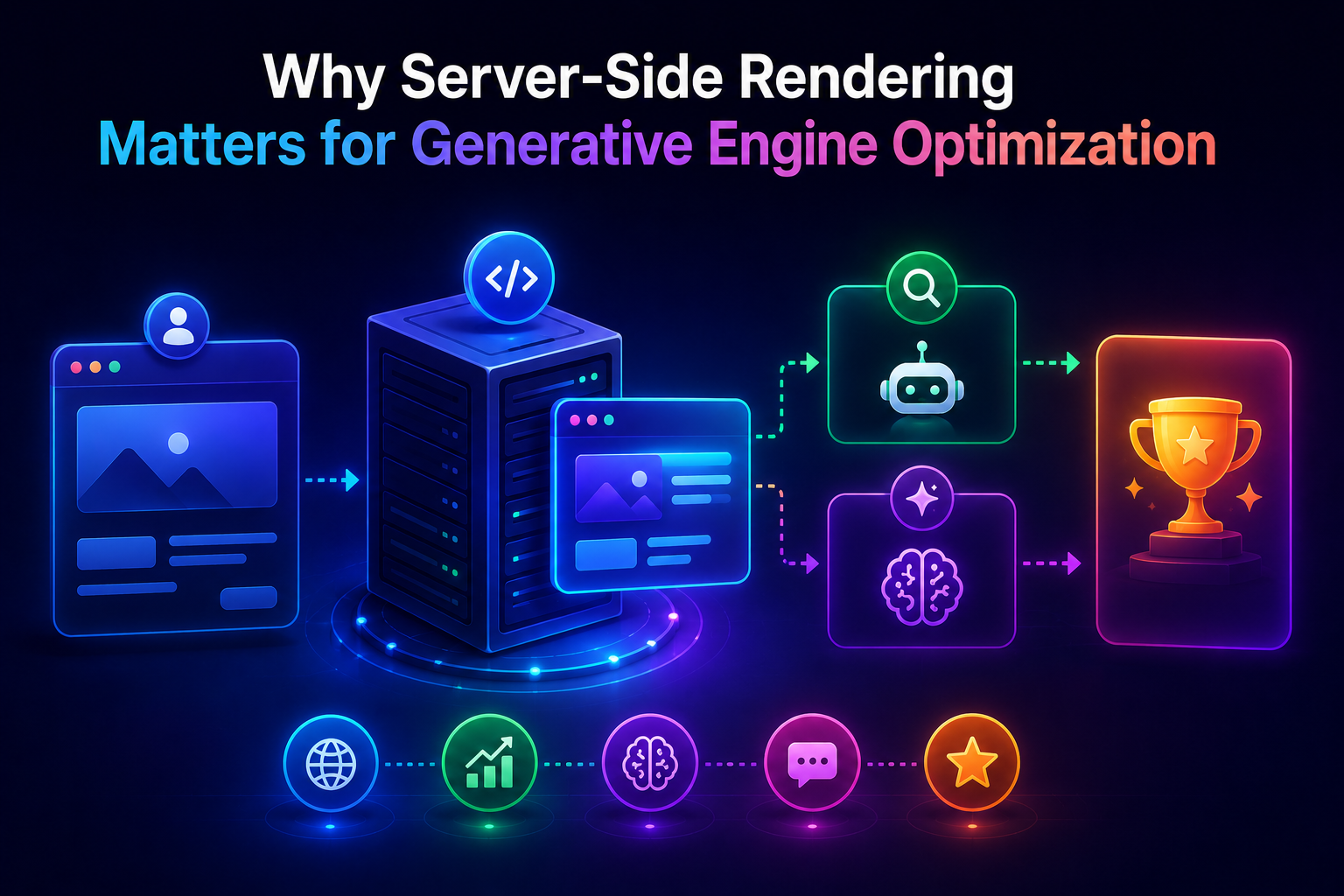
    Why SSR Matters for Generative Engine Optimization

    Generative Engine Optimization is usually framed as a content problem. Better answers, clearer structure, question-based headings.

    That advice is right — but it only works if crawlers can read your page in the first place. If your content lives inside JavaScript, no amount of writing quality will help. The crawler sees an empty page and moves on.

    Server-side rendering is the technical foundation that makes GEO possible. This article explains exactly why.


    AI-Friendly HTML: What Crawlers Actually Parse

    AI crawlers are not browsers. They do not render visual layouts, apply CSS, or execute JavaScript. They parse HTML — and specifically, they extract meaning from the structural elements within it.

    When GPTBot, PerplexityBot, or ClaudeBot visits a page, it reads through the HTML document sequentially, extracting information from specific elements:

    HTML ElementWhat the Crawler Extracts
    <title>The page’s primary topic
    <meta name="description">A summary of the page content
    <h1>The main subject of the page
    <h2>, <h3>Section topics and structure
    <p>Body content, answers, explanations
    <ul>, <ol>Lists of items, steps, features
    <table>Structured comparative data
    <script type="ld+json">Explicit schema metadata
    <a href>Links to related content

    Server-rendered pages deliver all of these elements in the initial HTTP response. The crawler receives a complete map of the page’s content and structure the moment it fetches the URL.

    Client-side rendered pages deliver none of them — because those elements are built by JavaScript in the browser, after the HTTP response has already been sent.

    Semantic Structure as AI Comprehension

    Beyond the presence of content, the quality of the HTML structure determines how well AI systems understand it.

    A page with a single H1 that accurately names the topic, H2s that break the content into clearly labeled sections, and H3s that subdivide those sections into specific subtopics gives AI systems an explicit content map. They can identify which part of the page answers which question, extract the most relevant section for a specific query, and cite it accurately.

    A page with inconsistent heading structure — multiple H1s, headings used for styling rather than structure, important content buried in generic wrapper divs — forces AI systems to guess at the content’s organization. The result is less accurate extraction, lower citation probability, and a higher chance of being paraphrased incorrectly.

    SSR ensures the HTML structure is complete and available. The semantic quality of that structure is then a content and development decision — one that sits on top of the SSR foundation.


    Faster Content Discovery: Why Speed Affects Citation Surface Area

    AI crawlers, like all crawlers, operate within time constraints. A crawler visiting your site will not wait indefinitely for a page to respond. If your server takes too long to return the HTML, the crawler times out and moves on — and that page goes uncrawled.

    This is why the speed of your server response directly affects how much of your content AI systems have ever seen.

    How SSR Supports Crawl Speed

    A well-implemented SSR setup with caching delivers pages extremely quickly:

    • Edge caching: SSR responses cached at CDN edge nodes can be served in under 100ms globally, comparable to static file delivery.
    • Consistent response times: A cached SSR response is deterministic — the crawler always receives the same fast response, never waiting for database queries or API calls.
    • Predictable resource usage: Crawlers can fetch more pages per session when each page responds quickly and consistently.

    The result is a larger effective crawl surface — more pages visited, more content extracted, more opportunities for AI systems to encounter and potentially cite your work.

    The Compounding Effect on Citation Surface Area

    Think of your website’s “citation surface area” as the total volume of content that AI systems have successfully crawled and can potentially cite. Every page that gets crawled completely adds to that surface area. Every page that times out, returns an error, or delivers empty HTML subtracts from it.

    A fast, fully server-rendered site with 200 blog posts and 50 product pages has a citation surface area of 250 pages. The same site with slow server responses or JavaScript-dependent content might have an effective surface area of 30 pages — the ones that happened to respond fast enough for the crawler to complete the fetch.

    SSR with caching maximizes citation surface area by ensuring every page responds quickly and delivers complete content every time.


    Better Context Extraction: How AI Systems Read Your Pages

    The way AI systems extract context from a page follows a predictable sequence. Understanding this sequence explains why server-rendered HTML is not just required for crawlability, but actively advantageous for GEO.

    The Context Extraction Sequence

    When an AI crawler reads your page, it processes the HTML roughly in this order:

    1. <title> tag — establishes the primary topic
    2. <meta name="description"> — provides a concise summary
    3. Structured data in <head> — gives explicit, machine-readable metadata
    4. <h1> — confirms the main subject
    5. First paragraph after H1 — the most important content on the page; often used as the citation excerpt
    6. <h2> sections in sequence — maps the full scope of the content
    7. Body paragraphs under each H2 — the detail that supports each section
    8. <h3> subsections — finer-grained structure within sections

    SSR ensures this entire sequence is present and complete in the server response. The crawler reads through the full document, builds an accurate model of what the page covers and what it says, and can match specific sections to specific queries with high confidence.

    The Context Fragmentation Problem in CSR

    When AI crawlers encounter a CSR page, they do not get this sequence. They get the <title>, perhaps a generic meta description, and then nothing. The H1, the intro paragraph, the H2 sections — all of it is absent because it lives in JavaScript.

    This creates context fragmentation: the crawler has the topic (from the title) but none of the content. It cannot determine what questions the page answers, how thoroughly it covers the subject, or whether any part of it is worth citing.

    The practical consequence is that CSR pages are classified as thin or irrelevant even when their actual content is comprehensive and authoritative. The classifier never sees the content. It makes its judgment on the empty shell.


    Structured Content Delivery: Schema Markup Done Right

    Schema markup — structured data written in JSON-LD format — is one of the most powerful tools in GEO. It gives AI systems explicit, machine-readable metadata about your content: what type of content it is, who wrote it, when it was published, what questions it answers, and what steps it contains.

    Why Schema Markup Belongs in the Server Response

    Schema markup is most effective when it is delivered in the <head> of the server-rendered HTML document. This means:

    html

    <head>
      <script type="application/ld+json">
      {
        "@context": "https://schema.org",
        "@type": "Article",
        "headline": "Why SSR Matters for GEO",
        "author": {
          "@type": "Person",
          "name": "Your Name"
        },
        "datePublished": "2026-01-15",
        "dateModified": "2026-03-20"
      }
      </script>
    </head>

    When schema is in the server-rendered <head>, every crawler that fetches the page receives it immediately. There is no ambiguity about whether the crawler will see it.

    When schema is injected by client-side JavaScript — a common pattern in React apps that use react-helmet or similar libraries — AI crawlers that do not execute JavaScript never see the schema. The structured metadata that would have helped them understand and cite the content is invisible.

    High-Value Schema Types for GEO

    The schema types most likely to improve AI citation rates are those that explicitly structure the content AI systems are looking for:

    FAQPage — marks up question-and-answer content. AI systems are built to answer questions; FAQPage schema tells them directly which content contains the question and which contains the answer.

    json

    {
      "@type": "FAQPage",
      "mainEntity": [{
        "@type": "Question",
        "name": "What is server-side rendering?",
        "acceptedAnswer": {
          "@type": "Answer",
          "text": "SSR is a technique where the server generates
            complete HTML before sending it to the browser,
            making content immediately available to crawlers."
        }
      }]
    }

    Article — provides publication date, modification date, and author information. Freshness signals are critical for retrieval-based AI systems like Perplexity.

    HowTo — marks up step-by-step instructional content with explicit step names and descriptions. Ideal for technical guides.

    Organization — establishes brand identity, website, and social profiles. Helps AI systems correctly identify and attribute your content.

    All of these schema types must be in the server-rendered HTML to reliably reach AI crawlers. SSR makes this straightforward. CSR makes it unreliable.


    GEO Benefits of SSR: The Complete Picture

    Bringing everything together, here is what SSR specifically contributes to each dimension of GEO performance:

    Crawlability

    SSR ensures every public page delivers complete, readable HTML to every crawler that visits. There are no pages that appear empty, no content that requires JavaScript execution to access, no sections that are invisible because they were loaded lazily.

    GEO impact: Maximum citation surface area — every page you’ve published is available for AI systems to read and potentially cite.

    Content Comprehension

    Complete HTML with proper semantic structure (H1 → H2 → H3, lists, tables, paragraphs) gives AI systems an accurate map of every page’s content and organization.

    GEO impact: Better topic classification, more accurate citation excerpts, higher probability of being matched to relevant queries.

    Schema Effectiveness

    Schema markup in the server-rendered <head> is guaranteed to reach every crawler. FAQPage, Article, HowTo, and Organization schema work as intended.

    GEO impact: AI systems receive explicit metadata about your content type, authorship, publication date, and content structure — reducing ambiguity and increasing citation confidence.

    Freshness Signals

    SSR pages can serve real-time data and updated content on every request. Combined with accurate dateModified in Article schema, AI retrieval systems receive strong freshness signals.

    GEO impact: Higher citation probability for queries where freshness matters — news, product information, technology topics, current events.

    Performance

    Fast TTFB from cached SSR responses maximizes crawl efficiency. More pages get crawled completely per session.

    GEO impact: Larger effective citation surface area — crawlers can cover more of your site in less time.


    Implementing SSR for GEO: The Practical Checklist

    If you are building or migrating a content site with GEO in mind, these are the SSR implementation requirements that matter most:

    • All public content pages use SSR or SSG — no CSR for pages that need to be visible
    • Complete <head> content (title, description, canonical, Open Graph) is in the server response
    • JSON-LD schema is in the server-rendered <head>, not injected by client JavaScript
    • Server response time is under 800ms before caching; under 200ms with CDN caching
    • Semantic heading structure (one H1, logical H2 → H3 hierarchy) is server-rendered
    • All body content — every paragraph, list, and table — is present in the initial HTML
    • robots.txt allows major AI crawlers (GPTBot, PerplexityBot, ClaudeBot, OAI-SearchBot)
    • XML sitemap is accurate and includes <lastmod> dates for all content pages

    The Foundation Everything Else Builds On

    Content strategy, schema markup, internal linking, topical authority — all of the practices that make GEO work are built on a single technical foundation: the ability of crawlers to read your content.

    SSR provides that foundation. It is not one optimization among many. It is the prerequisite that determines whether any other optimization has a chance of working.

    Get the rendering right first. Then build everything else on top of it.


    Next: How Googlebot, GPTBot, and Other Crawlers Process Your Website →

    ← Previous: SSR vs CSR vs SSG: Which Rendering Method Wins for SEO and AI?

    This article is part of a 20-article series on SEO, GEO, and AI Visibility. View the complete series →
  • What AI Crawlers Actually See When They Visit Your Website

    What AI Crawlers Actually See When They Visit Your Website

    If you’ve been paying attention to the search landscape in 2026, you’ve probably started asking a version of the same question: Do I focus on Google, or do I focus on AI search?

    It’s the wrong question — but it’s an understandable one. The two systems look different, behave differently, and reward different things. Treating them as competing priorities, however, is a mistake that leads to underinvesting in both.

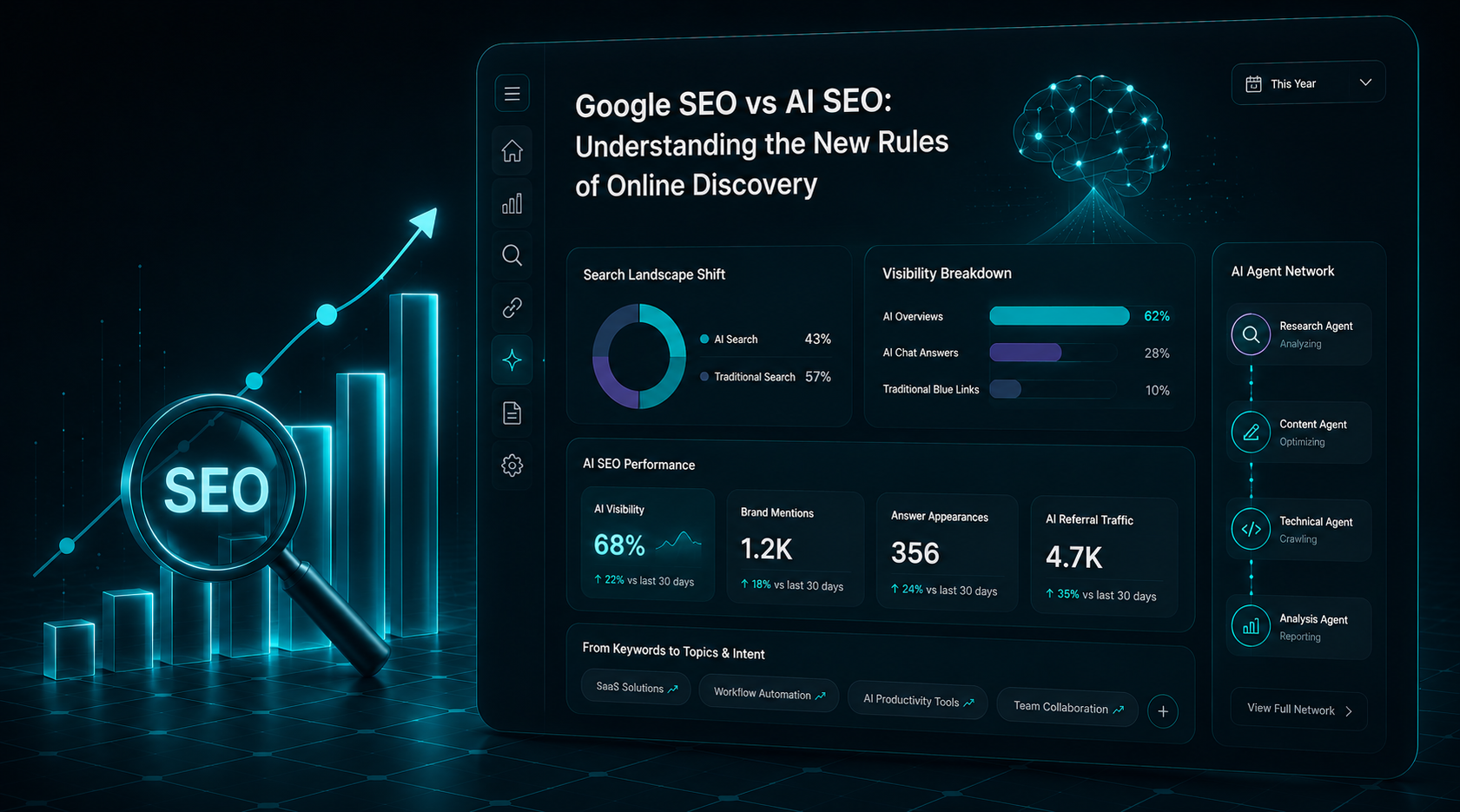
    The right question is: How do Google SEO and AI SEO differ, where do they overlap, and how do I build a strategy that serves both?

    This article answers all three. By the end, you’ll understand exactly how each system finds and evaluates content, what the shift from ranking to citation means in practice, and why the most effective digital strategies in 2026 treat AI SEO not as a replacement for traditional SEO but as a required layer on top of it.


    How Google Finds Content

    Google’s process for surfacing content has three distinct stages: crawling, indexing, and ranking. Understanding each stage clarifies what traditional SEO is actually optimizing for.

    Crawling

    Googlebot — Google’s automated web crawler — discovers pages by following links across the internet and reading XML sitemaps that websites submit. When Googlebot visits a page, it downloads the HTML (and, with a delay, attempts to render any JavaScript) and stores that raw content for processing.

    The practical implication: pages that aren’t linked to, aren’t in sitemaps, or are blocked by robots.txt rules simply don’t enter Google’s awareness. Crawlability is the prerequisite for everything else.

    Indexing

    Once crawled, Google’s systems analyze the page’s content — text, structure, metadata, images, links — and store it in Google’s index, associating it with the topics and queries it appears to address.

    Not every crawled page gets indexed. Pages Google judges as low-quality, duplicate, or irrelevant may be crawled but never stored. The indexed page is what competes in search results.

    Ranking

    When a user submits a query, Google’s ranking algorithms evaluate every indexed page relevant to that query and assign positions based on hundreds of signals. The most significant include:

    • PageRank and backlinks: How many credible external sites link to this page, and what is the authority of those sites?
    • E-E-A-T: Does the content demonstrate Experience, Expertise, Authoritativeness, and Trustworthiness?
    • Relevance: How closely does the page’s content match the user’s query intent?
    • Core Web Vitals: Does the page load quickly, remain visually stable, and respond promptly to interaction?
    • Freshness: For time-sensitive queries, how recently was the content published or updated?

    The outcome of this process is a ranked list of links. Users see results, evaluate them, and choose where to click. Traffic flows from Google to your page.

    What Google rewards, in summary: relevance to the query, authority signals from backlinks and E-E-A-T, technical quality, and freshness where applicable.


    How AI Assistants Find Information

    AI-powered search systems — ChatGPT Search, Perplexity AI, Google AI Overviews, Microsoft Copilot, Claude — work through a fundamentally different process. There are two mechanisms at play, and most AI search products use a combination of both.

    Trained Knowledge

    Large language models (LLMs) are trained on enormous datasets of text gathered from across the internet, books, academic papers, and other sources. This training process encodes a vast amount of factual knowledge directly into the model’s parameters.

    When a user asks a question, the model can answer from this trained knowledge without consulting any external source. The information it has access to, however, is frozen at its training cutoff date — it does not update in real time.

    Live Retrieval

    To address the freshness problem and to ground answers in current sources, most AI search products layer a retrieval system on top of trained knowledge. At query time, a crawler fetches relevant pages from the web, extracts their content, and passes that content to the language model as context for generating the answer.

    This is how GPTBot (OpenAI), PerplexityBot, ClaudeBot (Anthropic), and Bingbot operate in the context of AI search products. They are not indexing pages for later ranking — they are fetching pages at the moment a user asks a question, to inform the answer being generated right now.

    The Critical Difference: Synthesis, Not Links

    Here is where AI search diverges most sharply from Google. Google delivers a list of links — the user decides which to visit. AI assistants synthesize information from multiple sources into a single, direct answer — the user may never visit any source at all.

    When an AI system generates a response, it is making decisions about:

    • Which sources to consult (determined by its retrieval system and trained knowledge)
    • Which content to paraphrase or quote (determined by relevance and clarity)
    • Whether to attribute the source (determined by the platform’s citation behavior)
    • How to present the synthesized answer (determined by the query intent)

    Being “found” by an AI assistant means your content was retrieved, understood, and judged useful enough to inform the answer. That process rewards different things than traditional ranking.


    Ranking vs Citation: The Core Distinction

    This is the conceptual shift that matters most for strategy.

    Ranking is about position. Your page competes with other pages for a slot in a list of results. Users see your title, your URL, and a snippet — and they decide whether to click.

    Citation is about being understood. Your content is evaluated for whether it can answer a specific question clearly and authoritatively. If it can, it becomes an input to the AI’s synthesized response. You may be named as a source, paraphrased without credit, or used as background context — depending on the platform and the nature of the query.

    The implication is significant: being cited requires being understood, not just indexed.

    A page can rank #1 on Google because it has excellent backlinks and keyword optimization — yet be ignored by AI systems because its content is vague, poorly structured, or buries the answer under excessive preamble.

    Conversely, a page that ranks on page two can be cited regularly by AI assistants because it directly answers a specific question with clear, structured, authoritative content.

    The Four Citation Scenarios

    Think of every page on your site as falling into one of four categories:

    Ranks on GoogleDoes Not Rank
    Cited by AIBest outcome — visible across both channelsAI-only visibility; brand presence without click traffic
    Not Cited by AIGoogle traffic only; missing AI channelInvisible — no meaningful visibility in either system

    The goal of a combined SEO and GEO strategy is to move as many important pages as possible into the top-left quadrant: pages that rank and get cited.

    What Drives Citation

    The factors most associated with AI citation differ meaningfully from traditional ranking signals:

    • Directness: Does the content answer the question in the first paragraph, or does it make the reader hunt for the answer?
    • Structural clarity: Are headings informative? Are lists and tables used to organize comparable information?
    • Specificity: Does the content provide concrete details, data, and examples — or stay at a vague, general level?
    • Completeness: Does the page thoroughly cover its topic, or does it skim the surface?
    • Authority signals: Is the source credible based on external mentions, author credentials, and consistency of expertise?
    • Freshness: For time-sensitive queries, when was the content last updated?

    Similarities and Differences: A Direct Comparison

    Despite their structural differences, Google SEO and AI SEO share more common ground than they diverge. Both reward the same foundational investments — the difference lies in emphasis and measurement.

    DimensionGoogle SEOAI SEO (GEO)
    Discovery methodCrawl → index → rankCrawl → retrieve at query time
    What the user seesRanked list of linksSynthesized answer with cited sources
    Success metricRanking position, organic trafficCitation frequency, answer inclusion
    Content signalsKeywords, backlinks, E-E-A-TClarity, structure, specificity, authority
    Technical needsFast, crawlable, mobile-friendlyFast, crawlable, server-rendered HTML
    Freshness weightHigh for news; lower for evergreenHigh for retrieval-based AI systems
    Structured dataEnhances rich resultsGives AI explicit machine-readable context
    Measurement toolsSearch Console, rank trackersAI querying, brand monitoring, referral traffic

    Where they fully overlap: both systems reward fast-loading pages, accessible HTML, genuine topical authority, accurate structured data, and well-written content that serves the user’s actual intent.

    Where they diverge: Google tolerates some structural ambiguity and rewards keyword strategy in ways AI systems do not. AI systems weight directness and structural clarity more heavily than keyword placement. And critically, AI systems cannot evaluate content they cannot access in plain HTML — a JavaScript-rendered page that Google eventually indexes may be completely invisible to AI crawlers.


    Why Both Matter — And Why You Should Not Choose

    The temptation, having understood the differences, is to declare one system more important than the other and concentrate resources there.

    Resist it.

    Google still dominates search traffic volume. For the vast majority of businesses, Google-driven organic traffic remains the largest single digital acquisition channel. Abandoning traditional SEO practices in favor of GEO alone would be a significant mistake.

    AI search is growing rapidly and influencing decisions. Even when users don’t click through from an AI answer, the brand mentions, recommendations, and citations that AI systems produce influence perception and downstream search behavior. Being absent from AI-generated answers is increasingly a competitive disadvantage.

    The investment is largely shared. A site that is technically sound (fast, server-rendered, crawlable), content-rich (thorough, structured, authoritative), and built with genuine topical depth will perform well in both systems. The marginal cost of adding GEO to a strong SEO program is far lower than building either from scratch.

    The compounding effect is real. A page that ranks well on Google and gets cited by AI systems earns visibility through two independent channels. Over time, AI citation can also drive the external mentions and backlinks that strengthen Google rankings — the two systems reinforce each other.

    The practical recommendation: treat GEO as additive optimization on top of a solid SEO foundation, not as a competing strategy.


    What This Means for Your Strategy Right Now

    Understanding the distinction between ranking and citation leads to three immediate strategic implications:

    1. Audit your content for citability, not just keyword coverage. Review your highest-traffic pages and ask: does this page answer a specific question directly, in the first paragraph, in clear and structured language? If not, it may rank on Google but fail to earn AI citations. Updating those pages for directness is one of the highest-leverage content investments available.

    2. Verify your technical accessibility for AI crawlers. Google will eventually render your JavaScript. GPTBot and PerplexityBot will not. If your content depends on client-side JavaScript to appear, you have a GEO problem regardless of your Google rankings. Confirm that your pages deliver full content in the server response — that single technical check can reveal a significant visibility gap.

    3. Expand your success metrics. If your team measures only rankings and organic traffic, you are missing the AI citation channel entirely. Begin querying ChatGPT Search, Perplexity, and Claude for your target topics on a regular basis. Note which sources they cite. Identify where your content should appear but doesn’t. That gap is your GEO opportunity.


    The New Rules of Online Discovery

    Search in 2026 operates through two parallel systems: Google’s ranking engine and AI’s citation engine. They share technical foundations, reward similar content quality, and serve the same users — but they measure success differently and respond to different optimization signals.

    Ranking is about competing for a position in a list. Citation is about being understood well enough to inform an answer.

    Both matter. Neither is sufficient alone.

    The businesses building visibility across both channels — by combining strong SEO fundamentals with deliberate GEO practices — are the ones establishing compounding advantages as AI search continues to grow.


    Next: What AI Crawlers Actually See When They Visit Your Website →

    ← Previous: The Future of SEO: How AI Search Is Changing Website Visibility in 2026

    This article is part of a 20-article series on SEO, GEO, and AI Visibility. View the complete series →

  • Google SEO vs AI SEO: Understanding the New Rules of Online Discovery

    Google SEO vs AI SEO: Understanding the New Rules of Online Discovery

    If you’ve been paying attention to the search landscape in 2026, you’ve probably started asking a version of the same question: Do I focus on Google, or do I focus on AI search?

    It’s the wrong question — but it’s an understandable one. The two systems look different, behave differently, and reward different things. Treating them as competing priorities, however, is a mistake that leads to underinvesting in both.

    The right question is: How do Google SEO and AI SEO differ, where do they overlap, and how do I build a strategy that serves both?

    This article answers all three. By the end, you’ll understand exactly how each system finds and evaluates content, what the shift from ranking to citation means in practice, and why the most effective digital strategies in 2026 treat AI SEO not as a replacement for traditional SEO but as a required layer on top of it.


    How Google Finds Content

    Google’s process for surfacing content has three distinct stages: crawling, indexing, and ranking. Understanding each stage clarifies what traditional SEO is actually optimizing for.

    Crawling

    Googlebot — Google’s automated web crawler — discovers pages by following links across the internet and reading XML sitemaps that websites submit. When Googlebot visits a page, it downloads the HTML (and, with a delay, attempts to render any JavaScript) and stores that raw content for processing.

    The practical implication: pages that aren’t linked to, aren’t in sitemaps, or are blocked by robots.txt rules simply don’t enter Google’s awareness. Crawlability is the prerequisite for everything else.

    Indexing

    Once crawled, Google’s systems analyze the page’s content — text, structure, metadata, images, links — and store it in Google’s index, associating it with the topics and queries it appears to address.

    Not every crawled page gets indexed. Pages Google judges as low-quality, duplicate, or irrelevant may be crawled but never stored. The indexed page is what competes in search results.

    Ranking

    When a user submits a query, Google’s ranking algorithms evaluate every indexed page relevant to that query and assign positions based on hundreds of signals. The most significant include:

    • PageRank and backlinks: How many credible external sites link to this page, and what is the authority of those sites?
    • E-E-A-T: Does the content demonstrate Experience, Expertise, Authoritativeness, and Trustworthiness?
    • Relevance: How closely does the page’s content match the user’s query intent?
    • Core Web Vitals: Does the page load quickly, remain visually stable, and respond promptly to interaction?
    • Freshness: For time-sensitive queries, how recently was the content published or updated?

    The outcome of this process is a ranked list of links. Users see results, evaluate them, and choose where to click. Traffic flows from Google to your page.

    What Google rewards, in summary: relevance to the query, authority signals from backlinks and E-E-A-T, technical quality, and freshness where applicable.


    How AI Assistants Find Information

    AI-powered search systems — ChatGPT Search, Perplexity AI, Google AI Overviews, Microsoft Copilot, Claude — work through a fundamentally different process. There are two mechanisms at play, and most AI search products use a combination of both.

    Trained Knowledge

    Large language models (LLMs) are trained on enormous datasets of text gathered from across the internet, books, academic papers, and other sources. This training process encodes a vast amount of factual knowledge directly into the model’s parameters.

    When a user asks a question, the model can answer from this trained knowledge without consulting any external source. The information it has access to, however, is frozen at its training cutoff date — it does not update in real time.

    Live Retrieval

    To address the freshness problem and to ground answers in current sources, most AI search products layer a retrieval system on top of trained knowledge. At query time, a crawler fetches relevant pages from the web, extracts their content, and passes that content to the language model as context for generating the answer.

    This is how GPTBot (OpenAI), PerplexityBot, ClaudeBot (Anthropic), and Bingbot operate in the context of AI search products. They are not indexing pages for later ranking — they are fetching pages at the moment a user asks a question, to inform the answer being generated right now.

    The Critical Difference: Synthesis, Not Links

    Here is where AI search diverges most sharply from Google. Google delivers a list of links — the user decides which to visit. AI assistants synthesize information from multiple sources into a single, direct answer — the user may never visit any source at all.

    When an AI system generates a response, it is making decisions about:

    • Which sources to consult (determined by its retrieval system and trained knowledge)
    • Which content to paraphrase or quote (determined by relevance and clarity)
    • Whether to attribute the source (determined by the platform’s citation behavior)
    • How to present the synthesized answer (determined by the query intent)

    Being “found” by an AI assistant means your content was retrieved, understood, and judged useful enough to inform the answer. That process rewards different things than traditional ranking.


    Ranking vs Citation: The Core Distinction

    This is the conceptual shift that matters most for strategy.

    Ranking is about position. Your page competes with other pages for a slot in a list of results. Users see your title, your URL, and a snippet — and they decide whether to click.

    Citation is about being understood. Your content is evaluated for whether it can answer a specific question clearly and authoritatively. If it can, it becomes an input to the AI’s synthesized response. You may be named as a source, paraphrased without credit, or used as background context — depending on the platform and the nature of the query.

    The implication is significant: being cited requires being understood, not just indexed.

    A page can rank #1 on Google because it has excellent backlinks and keyword optimization — yet be ignored by AI systems because its content is vague, poorly structured, or buries the answer under excessive preamble.

    Conversely, a page that ranks on page two can be cited regularly by AI assistants because it directly answers a specific question with clear, structured, authoritative content.

    The Four Citation Scenarios

    Think of every page on your site as falling into one of four categories:

    Ranks on GoogleDoes Not Rank
    Cited by AIBest position — maximum visibility across all channelsGrowing channel — AI citations drive some traffic and brand visibility even without Google ranking
    Not Cited by AITraditional SEO success — traffic from Google onlyInvisible — neither channel delivers meaningful visibility

    The goal of a combined SEO and GEO strategy is to move as many important pages as possible into the top-left quadrant: pages that rank and get cited.

    What Drives Citation

    The factors most associated with AI citation differ meaningfully from traditional ranking signals:

    • Directness: Does the content answer the question in the first paragraph, or does it make the reader hunt for the answer?
    • Structural clarity: Are headings informative? Are lists and tables used to organize comparable information?
    • Specificity: Does the content provide concrete details, data, and examples — or stay at a vague, general level?
    • Completeness: Does the page thoroughly cover its topic, or does it skim the surface?
    • Authority signals: Is the source credible based on external mentions, author credentials, and consistency of expertise?
    • Freshness: For time-sensitive queries, when was the content last updated?

    Similarities and Differences: A Direct Comparison

    Despite their structural differences, Google SEO and AI SEO share more common ground than they diverge. Both reward the same foundational investments — the difference lies in emphasis and measurement.

    DimensionGoogle SEOAI SEO (GEO)
    How content is discoveredCrawl → index → rankCrawl → retrieve at query time, or draw from trained knowledge
    What the user seesA list of ranked linksA synthesized answer, sometimes with cited sources
    Success metricRanking position, organic trafficCitation frequency, answer inclusion, brand mention
    Primary content signalsKeywords, backlinks, E-E-A-TClarity, structure, specificity, authority
    Technical requirementsFast, crawlable, mobile-friendly, HTTPSFast, crawlable, server-rendered HTML, semantic markup
    Freshness weightHigh for news/time-sensitive; lower for evergreenHigh for retrieval-based AI (Perplexity); lower for model-trained knowledge
    Structured data valueEnhances rich resultsProvides explicit machine-readable context for AI systems
    Measurement toolsGoogle Search Console, rank trackersManual AI querying, brand monitoring, referral traffic

    Where they fully overlap: both systems reward fast-loading pages, accessible HTML, genuine topical authority, accurate structured data, and well-written content that serves the user’s actual intent.

    Where they diverge: Google tolerates some structural ambiguity and rewards keyword strategy in ways AI systems do not. AI systems weight directness and structural clarity more heavily than keyword placement. And critically, AI systems cannot evaluate content they cannot access in plain HTML — a JavaScript-rendered page that Google eventually indexes may be completely invisible to AI crawlers.


    Why Both Matter — And Why You Should Not Choose

    The temptation, having understood the differences, is to declare one system more important than the other and concentrate resources there.

    Resist it.

    Google still dominates search traffic volume. For the vast majority of businesses, Google-driven organic traffic remains the largest single digital acquisition channel. Abandoning traditional SEO practices in favor of GEO alone would be a significant mistake.

    AI search is growing rapidly and influencing decisions. Even when users don’t click through from an AI answer, the brand mentions, recommendations, and citations that AI systems produce influence perception and downstream search behavior. Being absent from AI-generated answers is increasingly a competitive disadvantage.

    The investment is largely shared. A site that is technically sound (fast, server-rendered, crawlable), content-rich (thorough, structured, authoritative), and built with genuine topical depth will perform well in both systems. The marginal cost of adding GEO to a strong SEO program is far lower than building either from scratch.

    The compounding effect is real. A page that ranks well on Google and gets cited by AI systems earns visibility through two independent channels. Over time, AI citation can also drive the external mentions and backlinks that strengthen Google rankings — the two systems reinforce each other.

    The practical recommendation: treat GEO as additive optimization on top of a solid SEO foundation, not as a competing strategy.


    What This Means for Your Strategy Right Now

    Understanding the distinction between ranking and citation leads to three immediate strategic implications:

    1. Audit your content for citability, not just keyword coverage. Review your highest-traffic pages and ask: does this page answer a specific question directly, in the first paragraph, in clear and structured language? If not, it may rank on Google but fail to earn AI citations. Updating those pages for directness is one of the highest-leverage content investments available.

    2. Verify your technical accessibility for AI crawlers. Google will eventually render your JavaScript. GPTBot and PerplexityBot will not. If your content depends on client-side JavaScript to appear, you have a GEO problem regardless of your Google rankings. Confirm that your pages deliver full content in the server response — that single technical check can reveal a significant visibility gap.

    3. Expand your success metrics. If your team measures only rankings and organic traffic, you are missing the AI citation channel entirely. Begin querying ChatGPT Search, Perplexity, and Claude for your target topics on a regular basis. Note which sources they cite. Identify where your content should appear but doesn’t. That gap is your GEO opportunity.


    The New Rules of Online Discovery

    Search in 2026 operates through two parallel systems: Google’s ranking engine and AI’s citation engine. They share technical foundations, reward similar content quality, and serve the same users — but they measure success differently and respond to different optimization signals.

    Ranking is about competing for a position in a list. Citation is about being understood well enough to inform an answer.

    Both matter. Neither is sufficient alone.

    The businesses building visibility across both channels — by combining strong SEO fundamentals with deliberate GEO practices — are the ones establishing compounding advantages as AI search continues to grow.


    Next: What AI Crawlers Actually See When They Visit Your Website →

    ← Previous: The Future of SEO: How AI Search Is Changing Website Visibility in 2026

    This article is part of a 20-article series on SEO, GEO, and AI Visibility. View the complete series →
  • The Future of SEO: How AI Search Is Changing Website Visibility in 2026

    The Future of SEO: How AI Search Is Changing Website Visibility in 2026

    For more than two decades, SEO meant one thing: rank higher on Google. Businesses invested in keywords, backlinks, and technical optimization — all in pursuit of a better position on search engine results pages.

    That goal has not disappeared. But in 2026, it is no longer enough.

    Artificial intelligence is reshaping how people find information online. Instead of scanning a list of links and clicking through to websites, users are increasingly receiving direct, synthesized answers from AI-powered tools. The question is no longer only where does my page rank? It is also will AI systems trust my content enough to cite it?

    This article explains what changed, why it matters, and what your business must do to stay visible in an AI-first search environment.


    What Changed in Search

    Traditional search presents users with a ranked list of links. A user enters a query, reviews the results, and chooses which website to visit. Traffic flows from the search engine to your page.

    AI-powered search works differently. Instead of serving links, AI systems analyze content from multiple sources and generate a direct answer. The user gets a response — sometimes without visiting any website at all.

    This is not a future trend. It is already the default experience on tools millions of people use daily: Google AI Overviews, ChatGPT Search, Perplexity AI, and Microsoft Copilot.

    The practical consequence is significant. A page that ranks in position one can still lose traffic if an AI summary answers the user’s question before they scroll. Meanwhile, a page that ranks in position eight may be cited by AI systems because it provides the clearest, most authoritative answer.

    Website visibility is no longer defined by ranking position alone. It is defined by whether AI systems judge your content trustworthy enough to include in their answers.


    The Rise of AI-Powered Discovery

    Consider how search behavior is changing. A user researching software in 2022 might search:

    “Best accounting software for small businesses”

    The same user in 2026 is more likely to ask:

    “What accounting software is best for a service business with fewer than 20 employees that needs invoicing and payroll in one tool?”

    AI systems can answer this directly — synthesizing information from product pages, reviews, comparison sites, and expert sources — without the user visiting a single website.

    This shift has several implications:

    • Keyword targeting is insufficient on its own. Users phrase queries conversationally, and AI systems interpret intent rather than match exact terms.
    • Content must answer real questions, not approximate them. Vague, keyword-stuffed content is ignored by AI systems in favor of direct, expert answers.
    • Brand authority is now a visibility signal. AI systems are more likely to cite sources they have encountered repeatedly across credible contexts — mentions, publications, reviews, and citations all contribute.

    The businesses that consistently provide clear, accurate, expert-level answers to specific questions are the ones AI systems will cite. That is the new definition of organic visibility.


    Why Rankings Alone Are No Longer Enough

    Ranking on page one of Google remains valuable. It should remain part of your strategy. But it is no longer the complete picture of online visibility.

    Here is the new reality:

    A high-ranking page can lose traffic if an AI summary answers the user’s query above the organic results. Zero-click searches — where users get what they need without clicking — are growing significantly as AI summaries expand.

    A lower-ranking page can gain citation visibility if it provides the most specific, well-structured answer to a question. AI systems do not rank-order their sources the way Google does. They select for relevance, clarity, and authority.

    This creates both a risk and an opportunity:

    Traditional SEO RealityNew AI Search Reality
    Position 1 guarantees maximum visibilityPosition 1 does not guarantee being cited
    Traffic comes from clicks on linksValue also comes from being cited in AI answers
    Keyword density signals relevanceContent clarity and specificity signal relevance
    Backlinks build authorityBacklinks + citations + mentions build authority
    Success measured in rankingsSuccess measured in rankings and citation frequency

    Businesses focused exclusively on traditional ranking metrics are increasingly blind to a growing share of search activity.


    Understanding GEO (Generative Engine Optimization)

    Generative Engine Optimization (GEO) is the practice of optimizing content so AI-powered search engines and answer engines can discover, understand, and cite it.

    GEO does not replace SEO. It extends it. The same content quality and technical accessibility that help Google rank your pages also help AI systems understand and cite them. But GEO adds a layer of specific practices that traditional SEO does not address.

    Creating Authoritative Content

    AI systems favor content that demonstrates expertise, depth, and accuracy. A thorough, well-researched 1,500-word answer to a specific question outperforms five generic 300-word posts on loosely related topics. Depth and specificity are the primary currency of GEO.

    Structuring Information Clearly

    How content is organized determines whether AI systems can extract meaning from it. Clear headings that function as questions, concise opening sentences that answer those questions directly, tables for comparisons, and lists for processes — these structural choices directly influence whether your content gets cited.

    AI systems parse HTML sequentially. A well-structured page with logical heading hierarchies (H1 → H2 → H3) and semantic markup gives AI systems an accurate map of your content.

    Building Topical Authority

    Publishing one excellent piece of content is valuable. Publishing comprehensive, interconnected content across an entire subject area is far more powerful. AI systems recognize topical authority — when a domain consistently provides high-quality information on a subject, it becomes a preferred source.

    This is why content clusters (a pillar article supported by deep supporting articles, like this series) are one of the most effective GEO strategies available.

    Maintaining Accuracy and Freshness

    Outdated or inaccurate content damages credibility with AI systems. Platforms like Perplexity AI weight freshness heavily for time-sensitive queries. Regular content audits and updates signal that your site is a reliable, current source.

    Strengthening Brand Signals

    AI models are trained on large bodies of text from across the internet. Brands mentioned frequently and positively across credible sources — news articles, industry publications, reviews, and expert citations — carry stronger authority signals into AI systems’ training data.

    Digital PR, guest contributions, original research, and thought leadership that earns external citations all build the brand signal that makes AI systems more likely to trust and reference your content.


    What Businesses Must Do Next

    The shift to AI-powered discovery is not approaching — it is already underway. Businesses that adapt their strategy now will compound their advantage as AI search continues to grow.

    The immediate priorities:

    1. Audit your crawlability. Ensure AI crawlers (GPTBot, PerplexityBot, ClaudeBot) can access your content. Check your robots.txt file. Verify your pages deliver complete HTML content in the server response — not via JavaScript that AI crawlers cannot execute.
    2. Shift content strategy toward direct answers. Identify the specific questions your audience is asking. Write content that answers those questions in the first paragraph, then elaborates. Answer-first writing is the single most effective content change you can make for GEO.
    3. Implement structured data. Schema markup (Article, FAQPage, HowTo, Organization) gives AI systems explicit, machine-readable context about your content. This is one of the highest-leverage technical GEO improvements available.
    4. Build topical depth, not just breadth. A content cluster that comprehensively covers a subject area will outperform a scattered collection of one-off posts in AI citation systems.
    5. Measure beyond rankings. Begin monitoring how your brand appears in AI-generated answers. Query ChatGPT, Perplexity, and Claude for your target topics. Track what they say about you and your industry — and whether your content is being cited.
    6. Combine SEO and GEO. Both disciplines share the same foundation: technically accessible, fast, high-quality content. A strong SEO program and a GEO strategy are not competing priorities — they are the same investment applied to two distribution channels.

    The New Measure of Online Visibility

    The goal of digital marketing has always been to reach the right audience at the moment they need what you offer. For two decades, that meant ranking on Google. In 2026, it also means being the source that AI systems trust enough to cite when generating answers.

    The businesses positioned to win are those that prioritize authority, clarity, and technical accessibility — not as separate strategies, but as a unified approach to content that serves both human readers and AI systems equally well.

    Rankings still matter. They are not the whole story anymore.


    Next: Google SEO vs AI SEO: Understanding the New Rules of Online Discovery →

    This article is part of a 20-article content cluster on SEO, GEO, and AI Visibility. View the complete series →
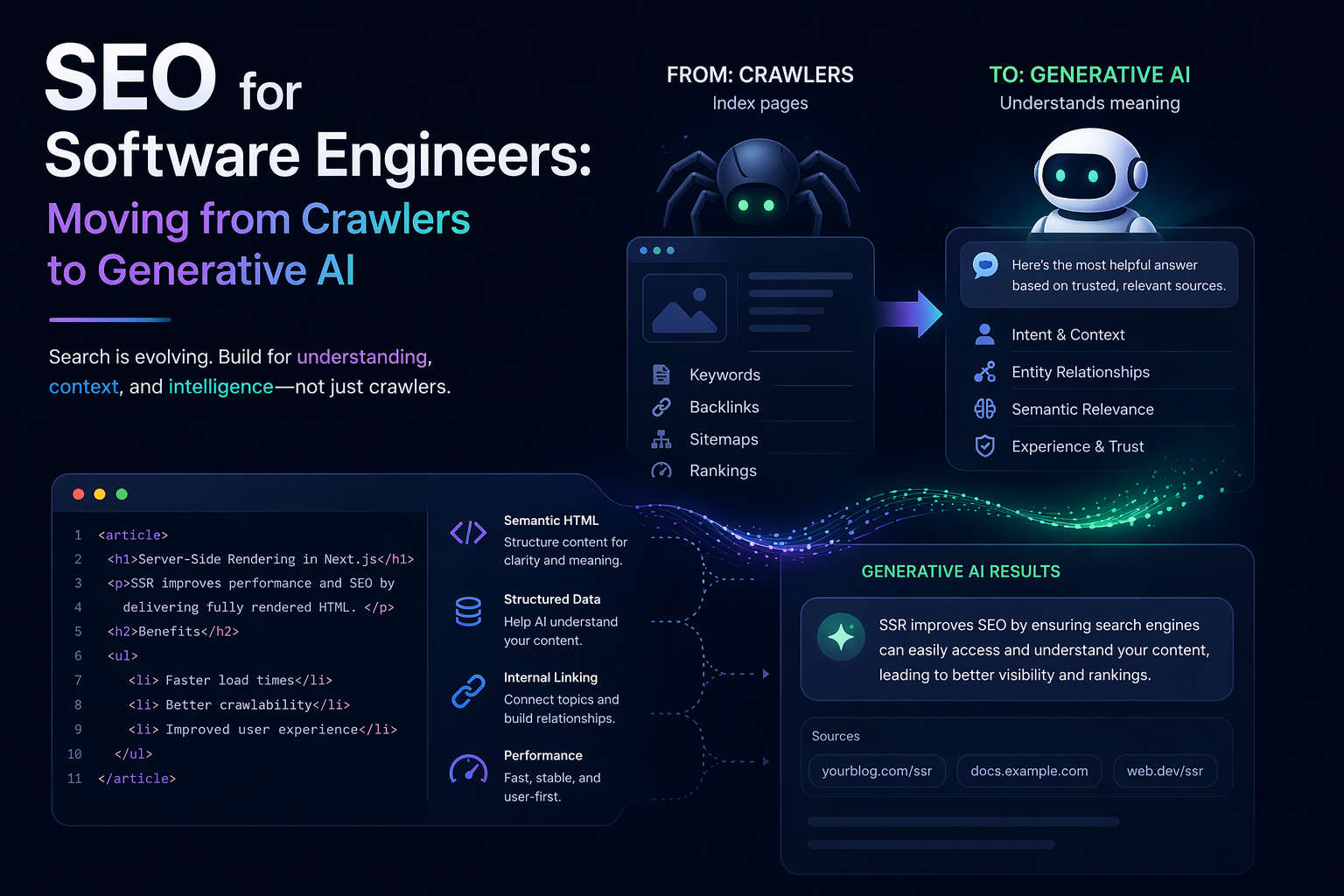
  • Why AI Cites Your Competitors Instead of You

    Why AI Cites Your Competitors Instead of You

    The Foundational Misdiagnosis

    Answer engine optimization is not “SEO but for ChatGPT.” The two disciplines serve different retrieval mechanisms.

    The confusion starts with a surface-level similarity: both disciplines are about visibility. But the mechanism is completely different, and the difference matters operationally. Whether you call it generative engine optimization or answer engine optimization, the target is the same — earning citations inside AI-generated responses rather than positions in a ranked list of blue links.

    Traditional SEO Answer Engine Optimization (AEO)
    Earns a position in a ranked list of links. The user decides whether to click. You are competing for attention in a results page the user actively scans. Click-through rates at position #1: around 28%. At position #3: closer to 11%. Earns a citation inside a synthesized answer. The AI has already decided what the answer is — your brand either appears in it or does not. There is no position #3. Visibility is effectively binary — you’re cited or you’re absent.

    A strong Google ranking remains the primary driver of AI citation visibility — the majority of cited sources in AI responses draw from top organic results. However, ranking alone does not guarantee that an AI system will extract and cite a specific page’s content; the structure and clarity of the page content also influence whether it gets referenced.

    The space is young enough that thoughtful execution matters more than speed. The core dynamic is straightforward: your well-ranked owned content is the primary driver of AI citation visibility (the RAG pipeline draws predominantly from indexed search results), while third-party coverage on external platforms can expand the range of contexts in which your brand appears. Neither replaces the other — they are complementary.


    The Architecture of AI Visibility

    Three non-negotiable layers. Missing one reduces the impact of the others.

    Pillar I — Content Layer: Semantic Density

    LLMs are trained to retrieve self-contained, definitionally rich answers. A page that raises a question and then defers to another source for context is, from the retrieval model’s perspective, incomplete — and incompleteness is penalized by lower confidence scoring.

    The Princeton/Georgia Tech/Allen Institute peer-reviewed study (KDD 2024, 10,000 queries across 25 domains) tested on-page content mutations — adding statistics, citations, and fluency improvements to existing pages — in a controlled setting. It found measurable improvements:

    – Including statistics: roughly +32% visibility lift

    – Adding citations: roughly +30%

    – Optimizing fluency: roughly +28%

    These numbers reflect the controlled study conditions; real-world results vary based on competition, domain authority, and implementation quality. The study’s scope is limited to on-page content changes and does not address back-end engineering like MCP servers or RAG pipelines.

    The standard:

    – Every page must answer the question it raises without requiring AI to cross-reference external sources for context. Run this filter: could an LLM extract a clean, attributable answer from this page alone?

    – Articles with structured data — hierarchical headings, comparison tables, numbered steps — are 28–40% more likely to be cited by large language models.

    – Content freshness matters: AI systems tend to factor recency into retrieval decisions. A visible “last updated” date and current statistics help signal relevance.

    Pillar II — Brand Layer: Entity Authority

    LLMs reason in entities — brands, products, authors, concepts — not keyword frequencies. Your brand functions as a node in a knowledge graph, and its weight in that graph influences whether it surfaces in retrieval. A 2026 industry snapshot found that 26% of brands had zero mentions in AI Overviews, suggesting gaps in how those brands present themselves as recognizable entities.

    The standard:

    – Schema markup is table stakes. Content with proper schema implementation shows 30–40% higher visibility in AI-generated answers (Dataslayer, 2026).

    – Consistent NAP data and presence in authoritative industry databases are not optional extras — they are the entry ticket to AI retrieval pools.

    – E-E-A-T signals now directly influence which domains generative models choose as sources. Author entities with verifiable credentials outperform anonymous content.

    – When evaluating an approach, verify that entity authority work is part of the plan. A content rewrite without entity grounding produces limited results.

    Pillar III — Trust Layer: Citation Architecture

    Retrieval models assign confidence scores partly based on the web graph. A page that stands in isolation reads as low-confidence. You need to be a central node, not a leaf node — referenced by others, referencing primary sources, and building internal citation chains that demonstrate the authority of your proprietary data.

    According to Semrush’s AI Visibility Index, 40–60% of cited sources in AI responses rotate month over month. Maintaining citations is an active, continuous process — not a one-time optimization.

    The standard:

    – Build explicit citation chains: reference primary data, link to foundational documents, cite your own proprietary research with transparent methodology.

    – Distributing content across multiple publications broadens the contexts in which your brand may be cited.

    – Monitor continuously. Brands with citation monitoring detect drift faster than those without it.


    Where Most Strategies Fail

    Answer engine optimization is an infrastructure challenge, not just a content one.

    True AI visibility requires moving beyond on-page optimization into how your data is structured for machine retrieval. Content rewrites alone produce limited results if the underlying data architecture does not support AI retrieval.

    The MCP Shift — What Your Engineering Team Needs to Understand

    >

    Model Context Protocol (MCP), introduced as an open standard, allows AI agents to connect directly to external data sources. Its primary use case today is internal enterprise AI ecosystems — custom chatbots, support agents, and private AI tools that query your own knowledge base. Public consumer AI engines (ChatGPT, Perplexity, Google Gemini) do not dynamically crawl private MCP endpoints when answering general user queries. They continue to rely on standard web crawlers (GPTBot, Bingbot) and indexed web content. MCP is not a shortcut to bypass search engine ranking — it is a complementary tool for closed-ecosystem integrations.

    RAG pipelines, Knowledge Graph integration, and MCP server architecture bridge marketing and engineering concerns. Organizations with cross-functional teams — a content strategist, a technical SEO architect, and an engineer familiar with retrieval systems — are often better positioned to execute across all three layers.


    Applied ROI — Three Enterprise Cases

    What measurable returns from these approaches look like in practice.

    Business Type Core Problem Intervention Measured Outcome
    B2B SaaS — High CAC, crowded market Buyers using Perplexity for vendor research; brand absent from AI-generated comparisons Full entity architecture rebuild + technical docs structured for MCP and RAG retrieval +340% brand citations in Perplexity (90 days); +28% organic traffic from high-intent AI queries; 60+ new featured snippets (8 weeks)
    Enterprise E-commerce — Product discovery High-margin products absent from generative AI shopping recommendations due to flat product descriptions Semantic density overhaul on category pages + aggressive product schema deployment Direct reduction in dependency on bottom-funnel PPC; AI-referred visitors convert at 4× higher rate than unassisted organic
    Enterprise Support — Knowledge management High Tier-1 ticket volume because AI assistants cannot extract answers from legacy help center Restructured support docs for maximum semantic density with LLM-parseable step-by-step formatting Significant ticket deflection — users ask their AI tool, receive clean accurate answers sourced from the company

    The pattern across all three: the financial return materializes at the intersection of content quality, entity definition, and retrieval architecture. Any single pillar in isolation produces marginal results. The multiplier effect requires all three working simultaneously.


    Priority Sequence: Where to Start

    A suggested ordering based on common industry patterns, not a rigid playbook.

    The sequence below reflects a logical dependency chain — each step builds on the one before it. You may find your organization already has some pieces in place, in which case the ordering will differ.

    Priority 1: Audit & Entity Establishment

    Define your brand as an entity the web can agree on.

    Map your current Knowledge Graph footprint. Audit structured data gaps using Google’s Rich Results Test. Establish or update your author entities with verifiable credentials. Ensure consistent representation across major industry databases. Fix NAP inconsistencies. Document what AI tools currently say about your brand — this is your baseline, and you cannot optimize what you have not measured.

    Priority 2: Semantic Density Overhaul

    Rebuild your highest-value content for LLM retrieval standards.

    Identify your ten highest-traffic legacy pages. Rewrite them to achieve semantic density: definitional clarity, self-contained context, explicit citations, original statistics, and structured formatting (comparison tables, numbered steps, clear hierarchical headings). Add a “What changed in 2026” section to perennial articles — freshness is a ranking signal for AI systems, not just humans. The target: could an LLM extract a complete, attributable answer from this page alone, without cross-referencing anything else? If not, the page has a density problem.

    Priority 3: Pipeline Architecture

    Structure proprietary data for internal enterprise AI tools.

    Engage your engineering team. Identify your highest-value proprietary data assets: product catalogs, technical documentation, pricing matrices, support knowledge bases. Structure these for internal RAG pipeline access and MCP server implementation. This is primarily relevant for closed-ecosystem AI tools — custom chatbots, internal support agents, and private AI assistants that query your own data. For public search visibility, the two prior priorities (entity authority and semantic content density) remain the primary levers.


    On Compounding Effects

    Citation authority can accumulate similarly to how domain authority did in traditional SEO.

    In 2012, brands that invested early in domain authority built positions that later entrants found difficult to replicate. A similar dynamic may apply to AI citation authority, though the landscape is too new for definitive long-term conclusions.

    AI search landscapes evolve through discrete algorithm updates rather than gradual monthly shifts. Sustained investment in content quality and entity structure is more reliable than attempting to race an arbitrary timeline.

    There is also a conversion asymmetry that changes the ROI calculation entirely. AI-referred visitors arrive pre-qualified: they have already received a recommendation from a trusted interface, they arrive with context and intent built in, and they spend nearly twice as long on site as Google referrals (15 minutes vs. 8 minutes, per Seer Interactive). This is structurally different from clicking position three on a search result page. The visitor who arrives from a ChatGPT recommendation is closer to a warm referral than a cold organic click — and your content strategy, landing pages, and conversion architecture should reflect that distinction.


    If there is a single takeaway, it is this: your traditional SEO foundation still matters — 99% of AI Overview citations come from the organic top 10, and 87% of ChatGPT citations map to top Bing results. Ranking well on standard search engines is still the entry ticket. What AEO adds is the layer that determines whether that ranking translates into an AI citation — through entity clarity, semantic density, and a strategic mix of owned and third-party content.

    Build the entity. Earn the citation. Keep your foundations solid. Brands that invest in this sequence create a citation advantage that compounds over time.


    Sources & Verification: Key sources referenced in this article include: OpenAI (ChatGPT user data, February 2026); Gartner VP Analyst Alan Antin (search volume projections, 2024); Princeton/Georgia Tech/Allen Institute for AI/IIT Delhi — “GEO: Generative Engine Optimization,” KDD 2024 peer-reviewed study; Seer Interactive conversion rate analysis (June 2025); Conductor AEO/GEO Benchmarks Report (January 2026, 13,770 domains, 10 industries); Semrush AI Visibility Index (2026); HubSpot 2026 State of Marketing Report. Statistical claims reflect findings as reported under specific study conditions; enterprise results vary by vertical, existing authority, and implementation fidelity.

  • SEO for Software Engineers: Moving from Crawlers to Generative AI

    SEO for Software Engineers: Moving from Crawlers to Generative AI

    A few years ago, the conversation around “SEO for software engineers” was simple: fix your robots.txt, ensure your URLs are canonical, and don’t break the sitemap.

    But as I sit at the intersection of AI Architecture and Technical SEO today, the landscape has fundamentally shifted. Having served as a Technical SEO Specialist at both REEA Digital Limited and SerpCat, and now leading strategies at MonsterClaw LLC, I’ve seen this evolution firsthand. We aren’t just optimizing for a crawler anymore — we are optimizing for Generative Engines.

    In a world where ChatGPT, Perplexity, and Gemini are the primary discovery layers, the Technical SEO of yesterday is now the Information Architecture of tomorrow.


    🏗️ The Foundation: Why Engineers Are the New SEO Architects

    Ben Hoyt once noted that SEO is often seen as a “marketing thing.” At MonsterClaw, we view it as a performance thing.

    If your Next.js application isn’t delivering pre-rendered HTML, you’re creating unnecessary friction. Yes, Google can render JavaScript — but why force a billion-dollar crawler to spend its expensive crawl budget on heavy bundles when you can deliver clean, structured HTML on the first response?

    The Rule: For a modern engineer, SEO isn’t about keywords — it’s about reducing friction for the crawler.

    ⚠️ The Architectural Caveat

    “Reducing friction” does not mean blindly choosing SSR for everything. SSR shifts rendering load from the client’s browser to your servers. For high-traffic enterprise applications, this means scaling server compute costs and managing edge-caching aggressively.

    Furthermore, a fast First Contentful Paint (FCP) is meaningless if your client-side hydration scripts freeze the main thread and spike your Interaction to Next Paint (INP). True engineering excellence means balancing pre-rendering with execution cost — not dogmatically defaulting to SSR because it sounds right.


    🛠️ Core Checklist for Technical Excellence

    1. SSR & Hydration Strategy

    Use Next.js 14+ with App Router. Target an FCP under 1.2s — but don’t stop there. Pair your SSR setup with partial hydration or streaming architectures to keep INP low.

    A page that looks loaded but doesn’t respond to user clicks is a failure in both UX and Core Web Vitals. Rendering strategy isn’t a binary SSR/CSR choice; it’s a spectrum of hydration granularity that must be tuned per component.

    2. Structured Data (JSON-LD)

    This is no longer optional. Schema is the API we provide to search engines and AI systems.

    If you aren’t using Person, FAQPage, and SoftwareApplication markup, you’re leaving the interpretation of your content to chance. AI engines rely on structured data far more heavily than traditional crawlers — if your entities aren’t declared, the AI cannot establish your authority.

    3. The “Cached-Dynamic” Sitemap

    A purely static, manually managed sitemap.xml is dead — but the opposite extreme is also a trap.

    Generating a completely live dynamic sitemap on every single crawler request can introduce massive database latency on enterprise sites with millions of nodes. The sweet spot: a headless bridge leveraging ISR (Incremental Static Regeneration) or Redis/edge caching to keep sitemaps near real-time without hammering your production databases.

    Real-time accuracy without server cost — that is the engineering target.


    🚀 The Next Frontier: GEO (Generative Engine Optimization)

    This is where the discipline of AI Architecture intersects with SEO. Traditional SEO focuses on ranking. GEO focuses on citation.

    When an LLM synthesizes an answer, it looks for high-authority, well-structured content it can confidently reference. To design for AI discovery, you need two things:

    1. Semantic Density Structure content so that an embedding model can cleanly vectorize it. Short, self-contained sections with declarative headings outperform long narrative prose for AI extraction.

    2. Knowledge Graph Integration Connect your entities — People, Projects, Brands — using schema so LLMs recognize you as a trustworthy, authoritative source within your domain.


    ⚖️ The GEO Paradox: The Threat of Zero-Click Searches

    As technical architects, we must recognize a systemic risk in optimizing too perfectly for LLMs.

    If we structure our JSON-LD and semantic data so precisely that an AI engine like Gemini or Perplexity can synthesize and display our full value proposition directly within its UI — the user has no reason to click through to our site. This is where engineering discipline collides with marketing reality.

    The future of GEO isn’t simply about making data easily extractable. It’s about structuring data so that AI engines treat you as the definitive citation, while intentionally designing information loops that compel the user to click the source link for full utility.

    Optimize to be cited. Design to be visited.


    🏁 Bridging the Gap

    At the end of the day, a fast site is a searchable site. Whether you’re building RAG pipelines or optimizing an enterprise WordPress stack, remember:

    SEO is a technical discipline masked as a marketing goal.

    The engineers who internalize this will build systems that compound their visibility over time — not just in Google, but in every AI layer that sits on top of it.


    ❓ FAQ: SEO for Software Engineers

    Q: Does Google struggle with client-side React? Google can crawl it, but rendering is delayed and expensive. SSR guarantees indexation on the first crawl pass. More precisely: Googlebot’s two-wave rendering system is capable of executing modern JavaScript, but rendering queues introduce an indexing delay. For fast-moving content — news, shifting inventory, time-sensitive pages — SSR ensures the first wave delivers complete content, not a shell.

    Q: Does Google struggle if we don’t use SSR? Not technically. The problem isn’t that Google can’t see client-rendered sites — it’s the indexing delay. For evergreen content, that delay may be acceptable. For content where freshness is a ranking or citation signal, SSR removes the risk entirely.

    Q: What is the most important tag for an engineer to manage? The <link rel="canonical">. It prevents duplicate content issues that split ranking power across multiple URLs — a problem that compounds at scale and is almost invisible until it costs you.

    Q: How does AI change Technical SEO? AI engines like Gemini and ChatGPT rely on structured data (JSON-LD) far more than traditional crawlers do. If your entities aren’t explicitly declared, the AI has no reliable way to establish your authority — it will either guess, attribute incorrectly, or skip your content entirely.

    Q: Why use Headless WordPress for SEO? It gives you the best of both worlds: the editorial workflow of WordPress and the performance and DOM control of a Next.js frontend. Content teams stay productive; engineering teams retain full control over rendering, schema, and Core Web Vitals.