What Is AI Search Optimization? The Mechanics Behind AI Visibility
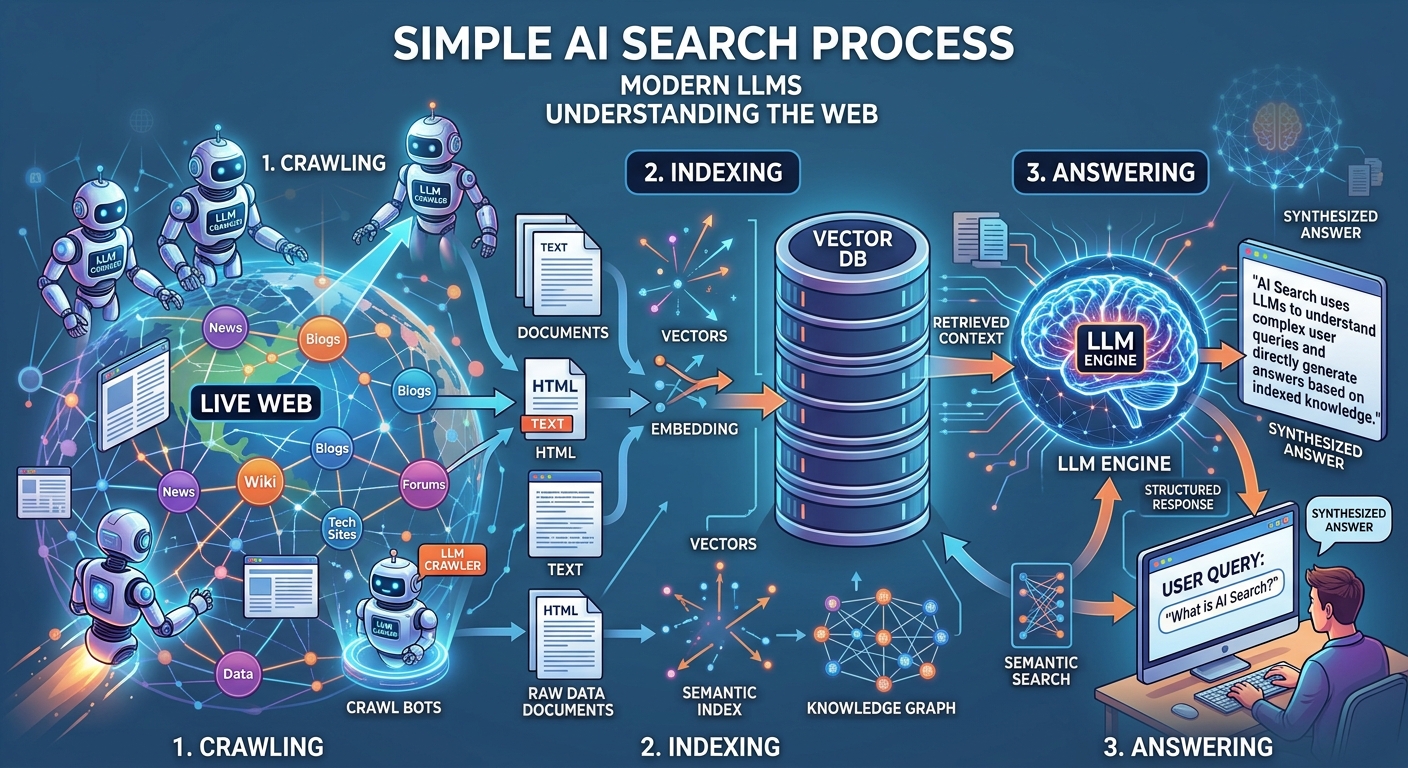
AI search optimization is the practice of structuring content and technical infrastructure so AI systems — ChatGPT, Perplexity, Google AI Overviews — can retrieve and cite it. AI search visibility is how that success gets measured: how often your content is actually surfaced and quoted, tracked engine by engine, not as a single rank position. Both start from the same underlying mechanism: AI search turns your question and the content on the web into “vector embeddings” — a kind of numerical fingerprint for meaning — and compares those fingerprints instead of matching exact keywords.
That’s a big shift from how search worked for the last twenty years. Old-school search engines matched the words you typed to the words on a page. AI search matches the meaning behind your question to the meaning of a passage, even if the wording is completely different. Understanding this shift — and the steps happening behind the scenes — is what separates content that gets picked up by an AI Overview from content that quietly gets ignored. Whether you call the underlying technology an AI search engine, an AI Overview, or a generative answer engine, the mechanism behind all of them is the same.
Reverse-Engineering Modern Search Engine & LLM Processing
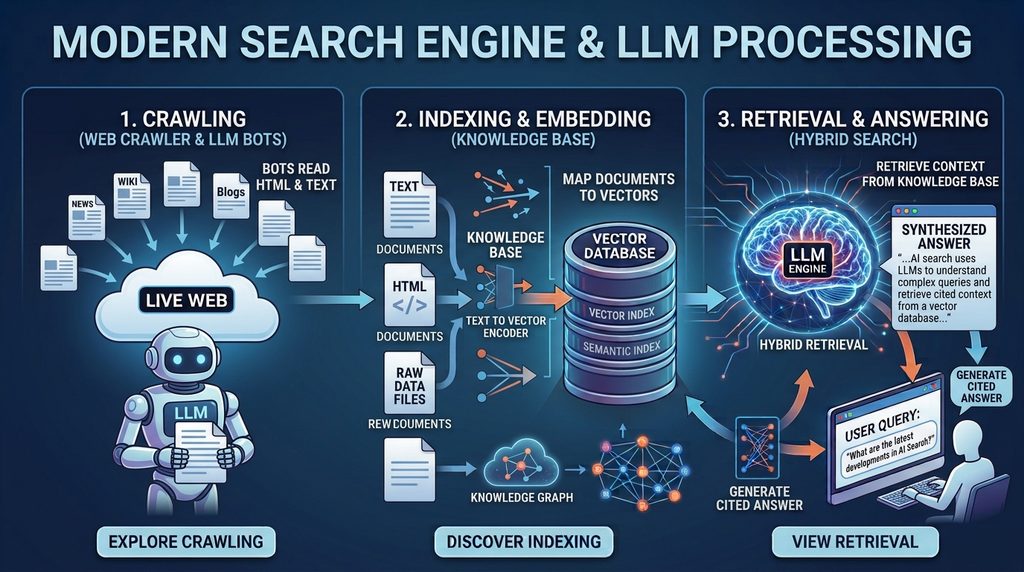
Every AI search tool — Google’s AI Overviews, Perplexity, or a ChatGPT search — follows roughly the same five steps behind the scenes:
- Crawl — a bot visits your page and reads the rendered content, similar to classic search, but it pays extra attention to clean HTML structure and structured data.
- Chunk — instead of treating your page as one big block, the system splits it into smaller sections (usually 200–500 words) called passages.
- Embed — each passage gets converted into a vector: a list of numbers that represents its meaning.
- Index — those vectors get stored in a database built for this kind of search, alongside metadata and links to related concepts (a “knowledge graph”).
- Retrieve & Generate — when someone asks a question, their question gets turned into a vector too, the system finds the closest-matching passages, and an AI model turns them into one written answer.
Here’s the part that matters most for your content strategy, you’re no longer competing page-against-page. You’re competing passage-against-passage — your one section on shipping costs is competing directly against every other site’s section on shipping costs, not against their whole page.
And this isn’t just theory. Semrush’s tracking shows AI Overviews now show up on roughly 16% of Google searches as of November 2025, after peaking near 25% earlier that year. Even more telling: one study of ChatGPT citations found that pages sitting at position 21 or lower in classic search — well off page one — still got cited almost 90% of the time, as long as the passage itself gave a clear, quotable answer. Ranking on page one still helps, but it’s no longer required to get quoted by an AI.
It also matters which bot is doing the crawling. “AI crawler” isn’t just one bot — it’s several, each built by a different company for a slightly different job:
| Crawler | Operator | Purpose | Primary Data Source | Renders JavaScript? |
|---|---|---|---|---|
| GPTBot | OpenAI | Training-data collection | Live crawl for training | No — server-side HTML only |
| OAI-SearchBot | OpenAI | Search index / citations for ChatGPT search | Live crawl + Bing’s search index | No |
| ChatGPT-User | OpenAI | On-demand fetch during a live user session | Training data + live web via OAI-SearchBot | No |
| ClaudeBot | Anthropic | Training-data collection | Live crawl for training | No |
| Claude (web search enabled) | Anthropic | Real-time answer grounding | Training data + Brave Search index (Anthropic’s search partner) | No |
| PerplexityBot | Perplexity | Real-time retrieval at query time | Perplexity’s own real-time index | No |
| Googlebot (AI Overviews) | Classic crawl, reused for AI Overviews | Google’s own search index | Yes — full rendering | |
| Gemini | Conversational search grounding | Training data + Google’s search index | Varies by surface |
Here’s why that’s not just trivia: if you want to show up in ChatGPT, your content also needs to do well in Bing’s index — that’s the live-web source OAI-SearchBot pulls from, not Google’s. Claude works the same way but through Brave Search instead. So a site can be perfectly optimized for Google and still be invisible to someone asking Claude a question with web search turned on.
Here’s the practical takeaway: unlike Googlebot, none of these AI crawlers can run JavaScript. If your main content — the actual text an AI would want to quote — only appears after the page loads via React, Vue, or a similar framework, these bots simply never see it. It doesn’t matter how nice the page looks to a person, or even to Googlebot. Making sure your content is there in the raw HTML (through server-side rendering or a static site) isn’t a nice-to-have for AI search visibility — for these bots, it’s the only thing that works.
This is a distinct problem from Next.js hydration issues, and it’s worth not conflating the two. A hydration mismatch happens when the HTML a Next.js server sends doesn’t match what React expects to render client-side — the content is technically present in the raw HTML that AI crawlers read, but the mismatch can trigger console errors, layout shifts, and in some cases a full client-side re-render that silently swaps the content after load. Since Google’s own crawler does render JavaScript and factors Core Web Vitals like CLS into how it evaluates a page, a hydration mismatch can still hurt AI Overview eligibility even though the AI-only crawlers technically saw the correct initial HTML. Fixing hydration errors and fixing JavaScript-only content injection are two separate audits, and a site can pass one while failing the other.
Information Retrieval Models vs Traditional Indexing
Classic search used something called an inverted index — basically a giant lookup table matching keywords to the pages that contain them. Older ranking systems like TF-IDF or BM25 scored pages mostly by how often and where a keyword appeared, plus how many other sites linked to it.
AI search works differently — it uses dense retrieval. Your question and every passage on the web get placed in the same “meaning space,” and closeness in that space (measured as cosine distance) decides what’s relevant. Two passages can use almost none of the same words and still be treated as a great match, as long as they mean roughly the same thing. That’s how an AI can answer your question using a paragraph that never uses your exact wording.
Most real-world systems don’t pick just one approach — they blend both. This is called hybrid retrieval: combine a classic keyword score (BM25) with a meaning-based vector score, then re-rank the combined results before generating an answer. Knowledge graphs add a third layer on top, linking related concepts together so the system can tell the difference between, say, “Python” the programming language and “python” the snake, based on the surrounding context rather than word similarity alone.
Strategic Implementation & Best Practices for Engineers
Optimizing for AI search means making sure your content and your site’s technical setup survive every step of that five-step process above — not just step one.
Code Examples, Configuration & Semantic Structuring
Start by giving crawlers clear signals about who wrote the content and what it’s about, instead of leaving the AI to guess from the prose alone:
json
{
  "@context": "https://schema.org",
  "@type": "TechArticle",
  "headline": "What is AI Search? How Modern LLMs Crawl & Index the Web",
  "about": [
    { "@type": "Thing", "name": "Vector Embeddings" },
    { "@type": "Thing", "name": "Knowledge Graphs" },
    { "@type": "Thing", "name": "Information Retrieval" }
  ],
  "proficiencyLevel": "Expert",
  "dependencies": "Vector database, embedding model API",
  "author": {
    "@type": "Person",
    "name": "Tanvir Ahsan",
    "jobTitle": "Enterprise SEO & AI Search Strategist",
    "knowsAbout": ["Generative Engine Optimization", "Vector Search", "Semantic SEO"]
  }
}
Here’s a simple example of what happens behind the scenes. Say you run an online cookware store and want your product pages to show up when someone asks ChatGPT “what’s a good cast iron skillet for beginners.” This Python code takes a product description, turns it into a vector, and stores or searches it — which is basically what an AI search engine is doing to your published pages:
python
import os
from openai import OpenAI
from pinecone import Pinecone

client = OpenAI(api_key=os.environ["OPENAI_API_KEY"])
pc = Pinecone(api_key=os.environ["PINECONE_API_KEY"])
index = pc.Index("cookware-product-catalog")

def embed_chunk(text: str) -> list[float]:
    response = client.embeddings.create(
        model="text-embedding-3-large",
        input=text
    )
    return response.data[0].embedding

def index_product(sku: str, description: str, url: str, entity_tags: list[str]):
    vector = embed_chunk(description)
    index.upsert(vectors=[{
        "id": sku,
        "values": vector,
        "metadata": {"url": url, "text": description, "entities": entity_tags}
    }])

# Example: indexing a product page for AI shopping assistants
index_product(
    sku="CI-SKILLET-10IN",
    description="10-inch pre-seasoned cast iron skillet, ideal for beginners. "
                 "Works on induction, gas, electric, and open flame. "
                 "Naturally non-stick surface that improves with use.",
    url="https://example-cookware.com/products/10in-cast-iron-skillet",
    entity_tags=["cast iron skillet", "beginner cookware", "induction-safe"]
)

def retrieve_top_k(query: str, k: int = 5):
    query_vector = embed_chunk(query)
    results = index.query(vector=query_vector, top_k=k, include_metadata=True)
    return [(match["score"], match["metadata"]["url"]) for match in results["matches"]]

# Example: this is roughly what happens when someone asks an AI
# shopping assistant "best cast iron skillet for a beginner"
retrieve_top_k("best cast iron skillet for a beginner")
Writing in clean, self-contained sections (one idea per 200–400 words, under a clear heading) makes it much easier for this chunking step to pull out your content cleanly. A section that jumps between several unrelated ideas turns into a messy, unclear vector — and messy vectors rarely make it into the AI’s shortlist of best matches.
Edge Cases, Performance Tuning & Scalability
Not every retrieval method performs the same, and the differences get bigger as more people use the system at once. Here’s how the three main approaches compare on a standard test:
| Retrieval Method | Recall@10 | Mean Reciprocal Rank | Avg. Query Latency |
|---|---|---|---|
| Sparse (BM25 only) | 0.61 | 0.42 | 8ms |
| Dense (vector only) | 0.78 | 0.58 | 35ms |
| Hybrid (BM25 + vector + re-rank) | 0.89 | 0.71 | 60ms |
Hybrid retrieval gives the best results, but it’s almost twice as slow as vector-only search. That’s exactly why most AI search products only re-rank the top 20–50 candidates instead of the whole index — it’s a balance between accuracy and speed. If you’re building or evaluating one of these systems yourself, that cutoff number is the one setting most worth tuning: too small and you miss good matches, too large and answers start to feel slow.
The end-to-end pipeline, from crawl to generated answer, looks like this:
[Crawler] → [HTML Parser / Chunker] → [Embedding Model]
                                            │
                                            ▼
                                   [Vector Database + Knowledge Graph]
                                            │
                        ┌───────────────────┴───────────────────┐
                        ▼                                       ▼
                [Sparse BM25 Index]                    [Dense Vector Index]
                        │                                       │
                        └───────────────┬───────────────────────┘
                                         ▼
                                 [Hybrid Re-Ranker]
                                         │
                                         ▼
                              [LLM Answer Generation]
                                         │
                                         ▼
                              [Cited Response to User]
Looking at the crawler table above, most teams will want control over exactly which AI bots can access which parts of the site — for example, letting the citation-focused bots in while keeping training-only bots away from private or paywalled pages:
# robots.txt — allow AI search/citation bots, restrict training-only bots from gated content
User-agent: OAI-SearchBot
Allow: /

User-agent: PerplexityBot
Allow: /

User-agent: GPTBot
Disallow: /account/
Disallow: /billing/
Allow: /

User-agent: ClaudeBot
Disallow: /account/
Disallow: /billing/
Allow: /
At scale, the real bottleneck usually isn’t the embedding model itself — it’s how quickly the index gets updated. If your site publishes a new page but the vector index doesn’t pick it up for hours or days, that page is invisible to AI search during that whole window, no matter how good it is. This is the same underlying problem as render-delay indexing issues, and it’s worth checking how long it actually takes a new page to show up, rather than assuming it’s as fast as classic search.
Worth separating from the indexed-retrieval pipeline above: MCP (Model Context Protocol) is a different pattern entirely. Rather than pre-embedding your content into a static vector index ahead of time, MCP lets an AI agent connect directly to a live tool or data source — a database, an API, a search service — and pull current information at the moment a question is asked. An AI assistant answering through an MCP-connected search tool isn’t matching against a pre-built index at all; it’s querying your system live, the same way a person would call an API. That has a real implication for anything transactional (pricing, inventory, availability): a stale vector index is a known problem with a known fix, but a live MCP connection depends entirely on the underlying service being fast, available, and returning clean, well-structured data on request.
Query Fan-Out: Why One Question Becomes Many Retrievals
A single question rarely turns into just one search behind the scenes. Most AI search systems do something called query fan-out: they break your question into several smaller, related questions, look up passages for each one separately, then combine everything into one answer. Ask “what is AI search and how does it work,” and the system might quietly also search for “vector embeddings,” “retrieval-augmented generation,” and “AI search vs SEO” — then blend all of that into the final response.
What this means in practice: a page that only targets its main keyword is only fighting for a small slice of the opportunity. Content that also answers the obvious follow-up questions around a topic — what it is, how it compares to alternatives, how it actually works — has more chances of getting pulled into the final answer, even when it never directly targets the exact phrase someone typed.
Future Evolution & Measuring Long-Term Organic ROI
AI search doesn’t stay still. The models, the ranking methods, and how citations get decided keep changing at every major provider. That means the old habit of just checking your keyword rankings won’t tell you much anymore — you need to know whether you’re actually being cited.
This is what a specialized generative engine optimization agency focuses on: regularly checking which of your passages are getting picked up, by which AI engines, for which questions — and fixing the ones that aren’t.
Key Performance Indicators & AI Citation Tracking
Regular rank tracking doesn’t work well here, because there’s no fixed position on the page to track anymore. This is really what AI search optimization is about — measuring and improving different signals instead of a rank number.
- Citation Share — how often your site actually gets cited in an AI-generated answer (across Google AI Overviews, Perplexity, ChatGPT, and so on), out of all the questions you’re tracking.
- Passage Retrieval Rate — how often your specific sections get pulled into the shortlist of candidates, whether or not they end up quoted in the final answer.
- Semantic Clustering Coverage — how wide a range of related questions your content shows up for, which tells you how well it covers a full topic instead of just one narrow phrase.
- Zero-Click Attribution — the lift in direct traffic or brand searches that comes from being cited, since an AI citation rarely leads to an actual click.
Tracking this well usually needs a dedicated AI search visibility tool — a normal rank tracker has no way to notice that your content got quoted inside a generated answer. Think of it like the difference between “did my ad get clicked” and “did someone mention my product in a conversation they had with a friend” — the second one needs a completely different kind of listening. Purpose-built AI search monitoring tools track citation frequency, passage-level retrieval, and visibility engine-by-engine (Google AI Overviews vs. Perplexity vs. ChatGPT), because a site can be cited constantly in one engine and never show up at all in another, even using the exact same content.
None of this works in isolation from what happens off your own site, either. AI systems look at what other trustworthy sites say about you, not just what you say about yourself — think of it like a job reference. You can write the most impressive résumé in the world, but if nobody else vouches for you, it carries less weight. Mentions and links from relevant publications, a consistent, accurate profile across places like Wikipedia, and genuinely helpful (not promotional) participation in the communities where people discuss your topic — all of that builds the kind of trust an AI system needs before it treats you as a source worth citing. Structuring your content well determines whether it can be found. This off-page trust is a big part of whether it gets believed once it is.
Keeping an eye on these numbers over a 90-day stretch is what separates a page that got lucky once from a site building real, lasting authority.
Ready to Audit Your AI Search Visibility?
If you don’t actually know how often your content gets picked up and cited by AI search engines, you’re flying blind. Start with the Answer Engine Diagnostic ($1,500) for a full check of your citations and passage-level visibility, or scope out a full Enterprise GEO Blueprint for ongoing, long-term authority building.
Frequently Asked Questions
What is the difference between AI search and traditional SEO? Traditional SEO ranks whole pages using keywords and backlinks. AI search picks out individual passages using vector embeddings and meaning-based matching, then blends them into one answer — so the real competition happens at the passage level, not the whole-page level.
How do LLMs decide which sources to cite in an AI Overview? LLMs cite the passages that come back as the closest matches in the vector index, usually after a re-ranking step that blends keyword relevance, meaning-based similarity, and how confident the system is in the source’s authority.
Can a page rank well in Google but be invisible to AI search? Yes, and it happens more than you’d think. Imagine a well-written page that isn’t broken into clear, self-contained sections, or a fast-moving site whose vector index hasn’t caught up with a recent update — either one can rank normally in classic Google search while never once showing up in an AI-generated answer.
What is Generative Engine Optimization (GEO)? GEO means shaping your content, your metadata, and your technical setup so AI systems can actually find and cite it — as opposed to optimizing purely for old-school ranking algorithms.
What is AI search optimization? AI search optimization is the day-to-day work of making sure AI systems can find, understand, and quote your content in their answers. That includes writing in clear passages, adding structured data, making sure AI crawlers can actually see your pages, and regularly checking whether you’re being cited.
How do you track AI search engine citations? You track citations by regularly asking the AI engines you care about — Google AI Overviews, Perplexity, ChatGPT — a set list of questions, and logging whether your site shows up in the answer each time. A normal rank tracker can’t do this, since it has no way to see inside a generated answer.
How do you improve brand visibility in AI search? Break your content into clean, self-contained sections; make sure AI crawlers can actually read your pages (server-side rendering, not just JavaScript); add structured data with clear author and topic signals; and check your citation rate on each AI engine separately, since they don’t all behave the same.
What is query fan-out in AI search? Query fan-out is when an AI system quietly breaks your one question into several smaller related questions, searches for each separately, then combines everything into one answer. For example, asking “how do I train for a 5K” might silently fan out into searches for beginner running plans, injury prevention, and pacing strategy — and content that covers those angles has a better shot at being pulled in, even if it never uses the exact words “train for a 5K.”
Does a Next.js hydration error affect AI search visibility? It can, but differently than a fully JavaScript-rendered page. The content is technically present in the raw HTML AI crawlers read, but a hydration mismatch can cause layout shifts and console errors that hurt Core Web Vitals, which Google’s crawler does factor in when it renders a page for AI Overviews — so hydration bugs and JavaScript-only content injection need separate fixes.
Is ChatGPT a web crawler? No, ChatGPT itself isn’t a crawler. OpenAI operates separate bots for that: GPTBot collects training data, OAI-SearchBot builds the live search index ChatGPT draws from, and ChatGPT-User fetches a specific page in real time only when a live user session needs it. ChatGPT the chat product never crawls the web directly — it relies on those three bots and, for some queries, Bing’s index.
What is MCP (Model Context Protocol) and how does it relate to AI search? MCP lets an AI agent connect directly to a live tool or data source, like a database or API, and pull current information at the moment a question is asked, instead of matching against a pre-built vector index. It matters most for transactional information like pricing or availability, where a static index would otherwise go stale.
Leave a Reply