Most companies evaluating GEO services already understand the basic idea. The harder question is more practical:
What actually happens after you hire a GEO provider?
A credible engagement should produce measurable technical changes, clearer content architecture, repeatable citation monitoring, and a reporting system that connects AI visibility to business outcomes.
This guide explains what a professional GEO engagement can include, how the work progresses, what technical deliverables to expect, and how to compare providers before making a decision.
At a Glance: Key Generative Engine Optimization Deliverables
These should be treated as engagement benchmarks, not guaranteed outcomes. Actual performance depends on the site’s technical condition, authority, content quality, query set, AI platform, and implementation speed.
1. How AI Search Engines Crawl, Retrieve, and Cite Content
A GEO engagement is most useful when every deliverable maps to a specific part of the information-retrieval process.
A simplified model looks like this:
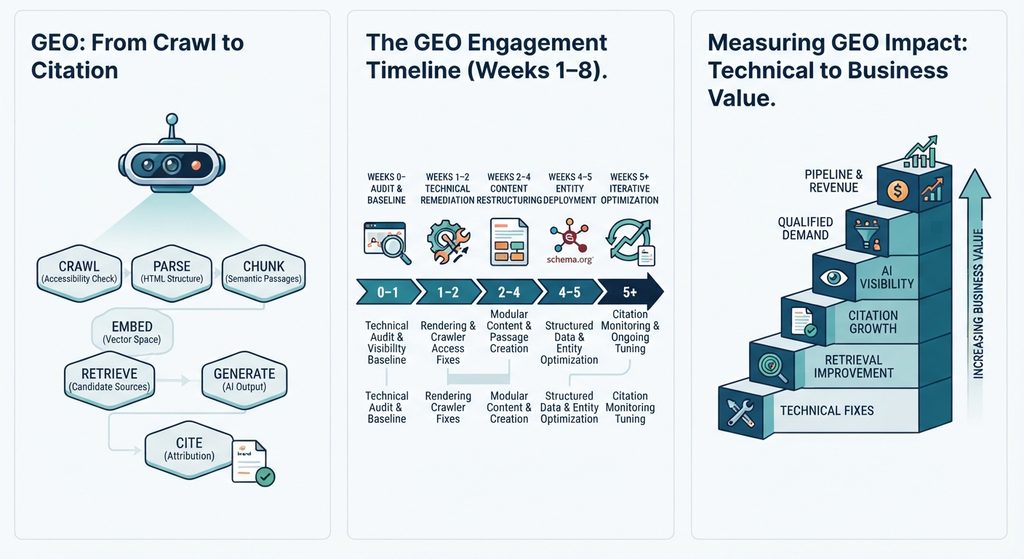
Crawl → Parse → Chunk → Embed → Index → Retrieve → Generate → Cite
The objective is not simply to “rank in AI.”
The objective is to make the right information accessible, understandable, retrievable, and attributable when an AI system processes a relevant query.
Crawl: Making Content Accessible for AI Bots
The first step is technical accessibility.
A GEO audit should examine:
For JavaScript-heavy websites, the important question is whether the content that matters is available in the HTML that crawlers can access.
A provider should be able to demonstrate the difference between what a browser renders and what a crawler can actually retrieve.
Chunk: Structuring Information into Semantic Passages
Large pages often contain multiple ideas competing for the same contextual signal.
GEO work can therefore restructure important sections into self-contained semantic passages. Your existing implementation framework uses roughly 200–400 words as a working range for these passages.
The purpose is not to force every section into an arbitrary word count.
The purpose is to make each passage answer a coherent question without depending heavily on unrelated surrounding text.
Embed: Strengthening Vector and Semantic Relevance
Modern retrieval systems can represent content and queries in vector spaces.
That makes semantic relationships important.
Instead of optimizing a page around one exact keyword, GEO work should strengthen the relationships between:
This creates broader contextual coverage rather than isolated keyword targeting.
Retrieve and Generate: Becoming a Candidate Source
Retrieval determines which information is available to the generation system.
That means a page can be technically crawlable yet still perform poorly if its content is difficult to retrieve or lacks sufficient contextual relevance.
A strong GEO engagement therefore measures retrieval performance rather than relying exclusively on traditional keyword rankings.
2. Core Metrics Optimization in Generative Engine Optimization
Traditional SEO metrics still have value, but they do not tell the entire story when the objective is AI visibility.
A mature GEO measurement framework should include several layers.
Information Retrieval Performance
Measure how frequently relevant passages appear among the top retrieved candidates for a defined query set.
Recall@10 can be used as one practical metric:
The exact evaluation methodology should be documented so that results are reproducible.
Citation Share & AI Visibility Tracking
Track how frequently the brand or its content is cited across a defined set of relevant AI queries.
Rather than reporting:
A better report shows:
The trend matters more than a single number.
Entity & Semantic Relationship Coverage
Entity Coverage
A strong GEO strategy also evaluates whether important entities are clearly represented and connected.
For example:
Brand → Product → Category → Use Case → Problem → Industry
The stronger these relationships are, the easier it becomes to build coherent topical coverage.
Semantic Coverage
Instead of measuring only one target phrase, map the broader question neighborhood around the commercial topic.
For example:
Generative engine optimization services
can connect to:
The objective is to create meaningful coverage around the subject, not simply repeat the primary keyword.
3. Generative Engine Optimization Engagement Timeline (Weeks 1–8)
A professional engagement should have a visible implementation roadmap.
Week 0–1: Technical & Baseline Audit
The first phase establishes the starting point.
Typical deliverables:
The key deliverable should not be a strategy deck alone.
It should be a baseline that can be measured again later.
Week 1–2: Rendering & Crawler Access Remediation
Technical issues identified during the audit are addressed.
Typical work includes:
The goal is simple:
Make important content technically accessible before investing heavily in content restructuring.
Week 2–4: Modular Content & Passage Restructuring
Priority pages are reorganized into clearer semantic units.
Typical work includes:
This is where GEO begins to move beyond technical SEO.
The goal is to make information easier for retrieval systems to interpret and select.
Week 4–5: Structured Data & Entity Deployment
Structured data is implemented and validated where appropriate.
Potential schema types include:
Schema should accurately describe the page.
It should not be treated as a shortcut for generating AI citations.
Week 5+: Citation Monitoring & Iterative Search Optimization
GEO does not end when the first technical fixes are deployed.
AI search systems change continuously, and competitor content changes as well.
Ongoing work can include:
4. Performance Benchmarks for Generative Engine Optimization
The following framework can be used as a practical way to communicate progress:
These are working ranges from the engagement framework, not guarantees or universal industry benchmarks. The underlying draft explicitly presents them as realistic ranges that vary according to technical complexity.
For that reason, a provider should always establish a baseline before promising a target.
5. Technical Deliverables and Configuration Code
A serious GEO engagement should produce artifacts that another technical team can inspect, reproduce, and implement.
Example: GEO Audit Configuration
The important point is not the YAML itself.
It is the operational principle behind it.
The engagement should define what is being tested, what constitutes a failure, what is being measured, and how the results will be compared over time. Your original draft similarly positions the runnable configuration and baseline report as a week-one deliverable rather than a static PDF.
Example: Recurring Citation Sweep
A useful report should show:
Baseline → Current State → Change → Cause → Recommended Action
That is substantially more useful than a monthly screenshot of AI search results.
6. Measuring ROI and Business Impact of Generative Engine Optimization
Executives ultimately need to connect technical improvements to commercial outcomes.
This creates a more useful measurement chain:
Technical Fix → Retrieval Improvement → Citation Growth → AI Visibility → Qualified Demand → Pipeline → Revenue
Not every organization will be able to attribute revenue directly to an AI citation.
That is why the measurement framework should distinguish between technical KPIs, visibility KPIs, behavioral KPIs, and revenue KPIs rather than forcing every engagement into an ARR number.
7. Comparing Top Generative Engine Optimization Service Providers
Provider comparisons are useful when they focus on what each company actually emphasizes, rather than presenting unsupported claims of superiority.
The draft’s provider comparison uses these same providers and positions them around their stated service focus rather than treating the list as an endorsement.
When comparing providers, ask five questions:
The differentiator is not the number of deliverables.
It is whether the provider can improve retrieval quality, demonstrate what changed, and measure whether visibility is increasing.
8. Questions to Ask Before Hiring a GEO Agency
Before signing a GEO engagement, ask for evidence rather than terminology.
Ask for a Baseline
A provider should be able to show where your domain currently appears across a defined query set.
Ask What Gets Implemented
There is a major difference between:
“Here are 50 recommendations.”
and:
“Here are the 12 changes we implemented, why they matter, and how we will measure them.”
Ask How Citations Are Measured
The provider should define:
Ask About Technical Access
Implementation-level GEO work may require repository, hosting, CMS, analytics, or other technical access depending on scope.
Without implementation access, the engagement may be an audit or consulting engagement rather than an implementation service.
Ask for Trend Data
Never evaluate GEO performance from one screenshot.
Ask for:
Baseline → Month 1 → Month 2 → Month 3
The direction of change is more informative than a single citation percentage.
9. The Bottom Line: What a Good Generative Engine Optimization Engagement Looks Like
A strong generative engine optimization service should not feel like traditional SEO with “AI” added to the sales deck.
It should have a measurable operating system:
Audit → Fix → Structure → Retrieve → Measure → Iterate
You should know:
The technical work creates the foundation.
The measurement system proves whether the foundation is producing better AI visibility.
And the business layer determines whether that visibility is actually valuable.
Ready to Evaluate Your AI Visibility?
Start with the Answer Engine Diagnostic ($1,500) to establish a technical baseline, identify crawl and retrieval issues, and benchmark your current AI citation visibility.
For organizations requiring implementation and ongoing optimization, the Enterprise GEO Blueprint extends the engagement into technical remediation, semantic architecture, structured data, retrieval measurement, and continuous citation optimization.
The goal is not simply to appear in AI answers.
The goal is to become a source that AI systems can reliably discover, retrieve, understand, and cite.
Leave a Reply