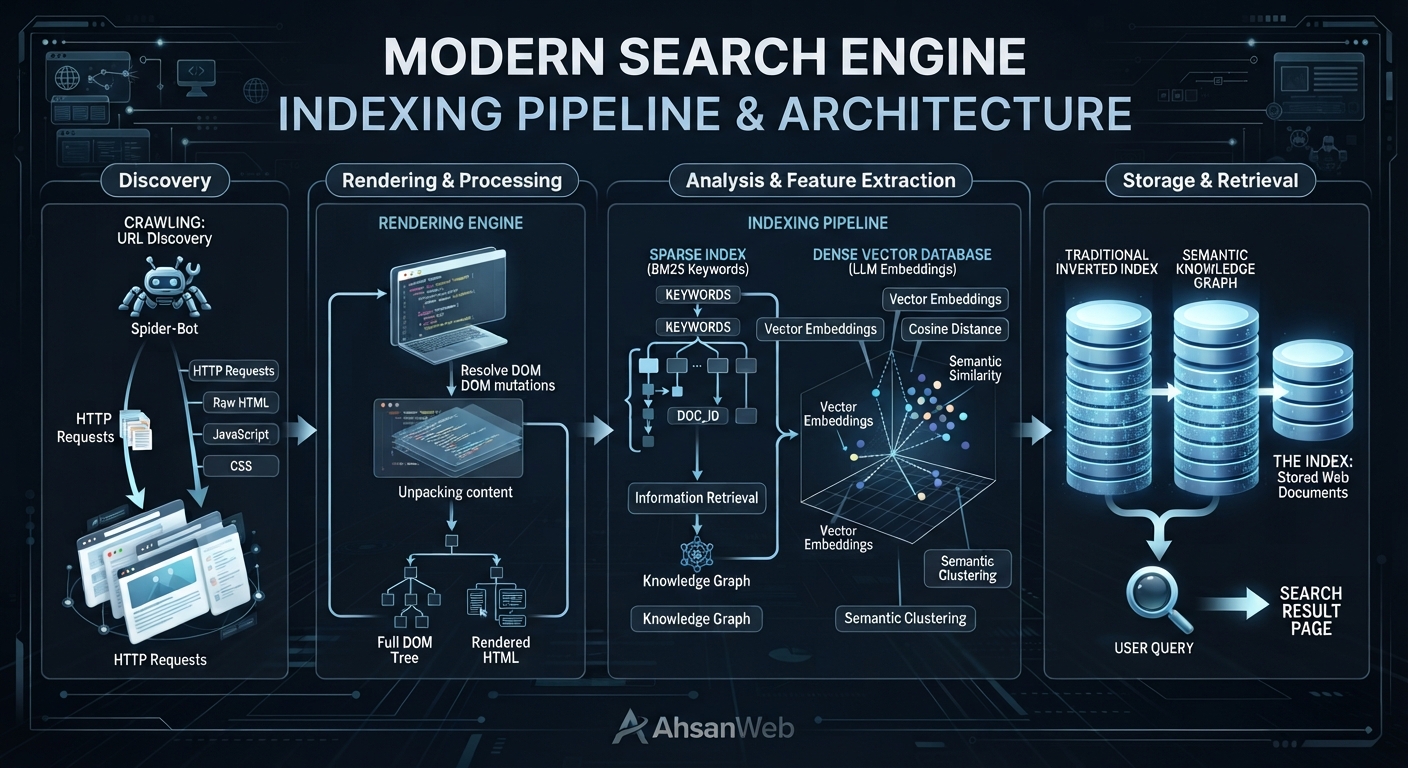
An indexed page is a web page that a search engine has discovered, read, and saved in its database. When your page is indexed, it means it is eligible to show up in search results when people search online. Modern search engines don’t just store words—they analyze your entire page to understand its true context and meaning for both traditional search and AI answers.

How Indexing Works: What It Means for Your Website
Search engines use automated systems to discover, load, and analyze web pages before saving them. If a page passes quality checks and technical rules, it gets stored in an index where it can be retrieved instantly.
How Search Engines and AI Read and Process Web Pages
When a search engine bot visits your site, it loads your code and runs any JavaScript to see the full page layout, just like a real user.
Once loaded, the engine breaks down the text, headings, and code. Traditional engines link specific words directly to your page. Modern AI search systems take this a step further by turning your content into numeric maps (called vector embeddings). These maps help AI understand concepts, tone, and context so it can answer complex user questions accurately.
During this process, the engine measures how closely your content matches the user’s search intent. If a page fails quality checks or has technical issues (like duplicate content), it will remain unindexed and won’t appear in search results.
Proximity Protocol: How Search Engines Measure Relevance
When an AI search engine processes your content, it uses proximity protocols to evaluate how closely words, concepts, and entities are linked together on a page.
Instead of just checking if two target keywords exist on your site, the engine analyzes:
- Distance: How many words or paragraphs separate two related terms.
- Context: Whether keywords share a logical sentence structure or topical relationship.
- Semantic Proximity: How closely related concepts are mapped within vector space.
If relevant terms are placed too far apart or separated by thin, unrelated filler content, the search engine assigns a lower relevance score—which can prevent the page from ranking for multi-term or conversational search queries.
Old Keyword Indexing vs. Modern AI Vector Search
In the past, search engines relied heavily on exact keyword matches. If someone searched for a word, the search engine looked for pages containing that exact phrase.
Today, search engines combine word matching with AI vector search. This allows them to understand synonyms, related topics, and intent. Instead of just counting words, the engine evaluates how well your content covers a topic as a whole.
[ Raw Web URL ]
       │
       ▼
[ Headless Browser Rendering Engine ]
       │
       ▼
[ DOM & Metadata Extraction ] ──► [ Sparse Inverted Index (BM25 / Keywords) ]
       │                                     │
       ▼                                     │
[ Transformer Embedding Model ]              │
       │                                     │
       ▼                                     │
[ Dense Vector Database (ANN) ]              │
       │                                     │
       ▼                                     │
[ Unified Ranking & Scoring Engine ] ◄───────┘
Technical Setup & Best Practices for Developers
To make sure search engines can find and index your pages quickly, you need to set up clear rules for crawlers and maintain a clean website structure.
Key Code, Meta Tags, and Robots.txt Settings for Better Discovery
You can guide search engines using simple control files and HTML tags.
- Robots.txt File: Tells search crawlers which parts of your site they can visit and which areas to stay away from (like checkout pages or internal account settings).
- Meta Robots Tag: Placed in your page HTML to explicitly tell crawlers to index the page and display preview images or snippets in search results.
Fixing Slow Speed, Server Errors, and Page Duplicates
Search engines have a limited amount of time to crawl your website. If your site is slow or messy, crawlers may leave before indexing your content.
- Fix Page Duplicates: Use self-referencing canonical tags to tell search engines which version of a web page is the main copy.
- Speed Up Your Server: Keep your server response fast so crawlers don’t time out or drop connections.
- Manage Filter Pages: Add
noindextags to unnecessary filtered or sorted pages so you don’t waste crawler resources on duplicate content.
How to Measure Your Success in Search and AI Answers
Tracking your website’s performance requires looking beyond simple keyword ranks.
Tracking Your Indexed Pages and AI Citations
As search evolves toward generative answers and zero-click AI overviews, traditional tracking metrics like average keyword position are no longer enough. Modern digital strategists must expand their metrics to measure deep visibility:
- Index Coverage Ratio: The percentage of valid, high-value URLs successfully stored in search engine databases versus submitted URLs.
- Content Quality & Depth: A composite evaluation of document semantic density, entity alignment, and topical depth against competitors.
- AI Citation Frequency: Tracking how often an indexed document’s extracted entities, structured data points, and insights are cited inside generative AI answer blocks.
To achieve continuous visibility gains and resolve deep architectural roadblocks, leverage professional technical SEO audit services to uncover hidden crawler traps, JavaScript rendering failures, and canonical misalignments.
Frequently Asked Questions
What is the difference between crawled and indexed pages?
A crawled page is simply discovered and downloaded by a search engine bot. An indexed page has passed quality evaluations, been processed through rendering and vectorization pipelines, and stored in the database available for retrieval during user queries.
Why are some of my web pages not getting indexed?
Pages often fail indexing due to technical blocks such as accidental noindex tags, robots.txt disallows, thin content, duplicate URL parameters, slow server response times, or structural canonicalization errors.
How can I get search engines to index my pages faster?
You cannot strictly “force” indexing, but you can accelerate discovery by submitting an updated XML sitemap, utilizing the Indexing API for eligible content types, ensuring pristine internal linking, and eliminating rendering barriers.
Leave a Reply